
Granularity
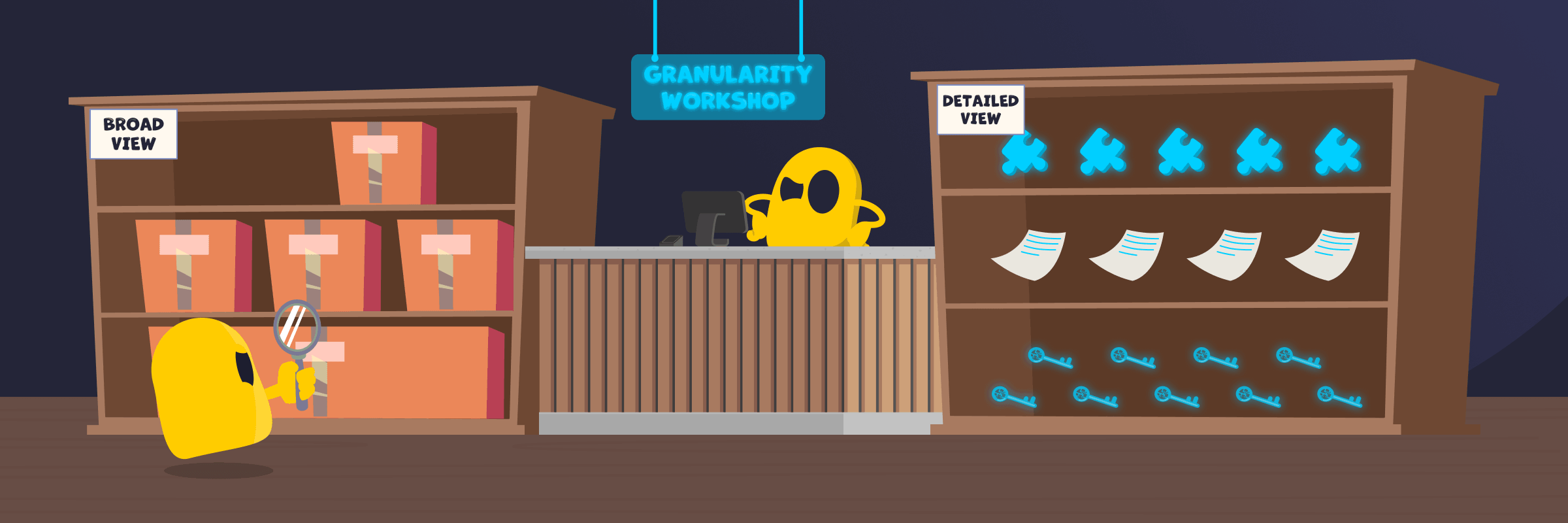
Granularity Definition
Granularity, sometimes called grain size in computing, is the level of detail used to divide, describe, or control something in a system. It shows whether information, tasks, permissions, or components are handled as small, specific units or broader groups. The term appears in data management, cybersecurity, software architecture, and parallel computing. In each area, granularity describes how detailed a system’s structure, rules, or output is.
How Granularity Works
Granularity is set when a system decides where one item ends and the next begins. After that, the same boundary guides how the system stores, compares, processes, or controls information. Granularity is typically measured by the size of those units relative to the larger dataset or workload. Smaller units provide finer granularity, while larger units provide coarser granularity.
A narrower split leaves more context available. A broader split reduces the amount the system has to handle. In parallel computing, the same idea can describe how much work happens before processors exchange information.
Types of Granularity
- Fine-grained: Individual-level detail with many separate entries, actions, or controls.
- Medium-grained: Moderate detail that keeps related items together while preserving some separation.
- Coarse-grained: Larger groups with fewer categories and less individual tracking.
- Time-based: Information arranged by time period, such as hour, day, month, or year.
Granularity Examples
- A sales database can keep one row for every purchase instead of only storing a monthly sales total.
- Security logs may show the exact setting an admin changed, not just that the admin signed in.
- An access-control system can let someone open one file without giving them the whole folder.
- Software teams may split one payment service into separate parts, letting card payments and wallet payments change separately.
Read More
FAQ
Granularity describes the level of detail in information or a process. Finer granularity means information is broken into smaller, more detailed parts, while coarser granularity groups information into larger units. Abstraction focuses on simplifying complexity by hiding unnecessary details and showing only the information that matters for a particular task. For example, a database containing individual transaction records has high granularity, while a dashboard that displays only monthly totals provides a higher level of abstraction.
No. Extra detail helps only when someone will use it. If a team only needs a trend, a long list of small records can slow the system and make reviews harder.
In parallel computing, granularity is often written as G = Tcomp / Tcomm. Tcomp is the time spent on computation. Tcomm refers to communication time between processors. When computation time is much higher than communication time, the task has coarser granularity.
Yes, but not always easily. Some tools can change it through filters, logging levels, or report views. A monitoring tool, for example, may keep full event data for a short time and then switch to daily summaries. Larger shifts take more work. A database, access model, or software design may need new tables, rules, or service boundaries before it can use a different level.
Data granularity is how much detail a dataset contains. It can include raw entries, grouped records, or larger totals. For example, a weather dataset may store every sensor reading or only hourly averages. The first gives more room for close checks, while the second is easier to scan and report.
 45-Day Money-Back Guarantee