
Digital fashion has gone from niche concept to online status symbol almost overnight. Virtual outfits, AR try-ons, video game skins, and AI-designed looks now let people show off style without ever touching fabric. This was only amplified by the pandemic—online fashion shows, influencer culture, and the rise of digital self-expression brought virtual clothing to the spotlight.
The sustainability pitch sounds promising, too. Fashion is one of the world’s biggest polluters, with textile waste sitting just behind essentials like food, housing, and transportation. Revolving fashion trends are only making the problem worse, flooding landfills with barely worn clothing.
But the truth isn’t that simple. Digital fashion relies on energy-hungry data centers, powerful rendering tools, and even blockchain systems to get to you. So, how sustainable is virtual clothing really? Do virtual clothes actually reduce physical shopping or just add another layer of consumption?
Moreover, there is little talk about how this rising trend affects our online privacy. When fashion moves into the digital space, it also moves into the realm of cybersecurity, surveillance, and tracking.
At CyberGhost, we seek to promote users’ online security and privacy. So, as digital style takes over our feeds, it’s worth asking how this innovation can affect our lives—both the benefits and the risks, and how we can continue to protect ourselves.
The World of Digital Fashion
Digital fashion is introduced as a direct answer to the problems usually encountered with traditional fashion. Think of it as the “umbrella term” for any type of clothing that’s created using digital tools, whether it ends up existing online, in real life, or both. Below, we break down its meaning further.
What Is Digital Fashion?
At its core, digital fashion is about using tech to design, visualize, and express identity—often long before any fabric is cut. While some become physical products after being designed with software, others are fully virtual, like game skins or avatar outfits.
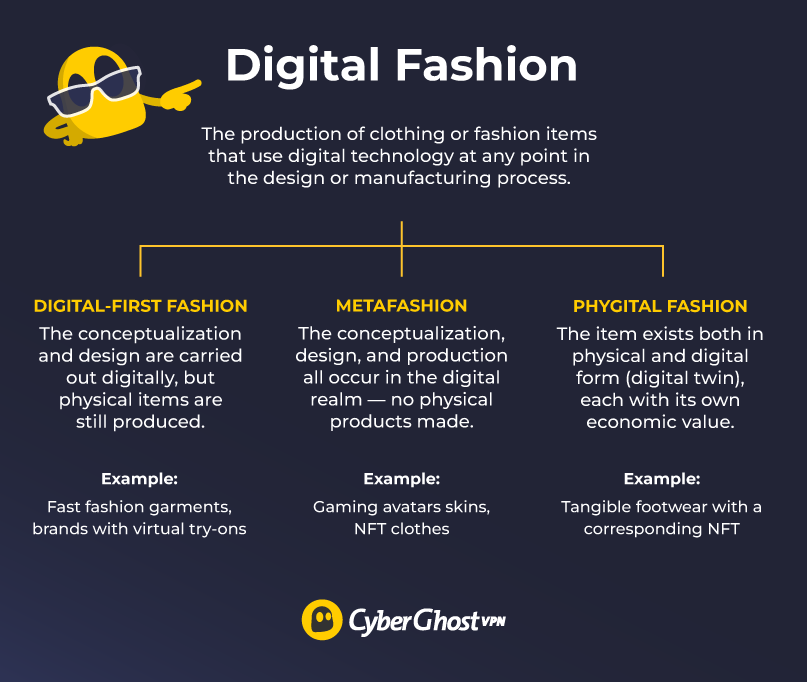
To understand this concept better, we can split digital fashion into 3 sub-categories:
-
- Digital-first: This type uses digital tools like 3D sampling to design and preview clothing, but the final product is still physical. The goal is to reduce waste and produce physical garments more efficiently.
-
- Metafashion: This type exists purely online, so it can also be referred to as digital-only fashion. Designs are rendered virtually, and no physical items are manufactured (think NFT outfits, metaverse wearables, and Fortnite skins).
-
- Phygital: This type sits in between the other two, linking digital ownership to physical items, such as sneakers with NFC chips or NFTs that unlock a real hoodie.
All these differ from traditional fashion, wherein clothes are designed, sampled, and manufactured in the real world. While digital elements may be used later, it’s usually for marketing or e-commerce purposes.
The pandemic accelerated the shift from traditional to digital fashion. And although clothing continues to be manufactured in purely physical settings, an increasing number of people are spending huge parts of their lives online.
Whether it’s on social media, in video games, or in virtual worlds, there are more and more reasons to engage with digital fashion—accessibility, convenience, self-expression, or simply for entertainment.
What’s the Issue With Traditional Fashion?
The main problem with traditional fashion is the hefty price tag—not only financially but also in terms of its environmental impact. The industry consumes enormous amounts of water, energy, and raw materials, making it a significant contributor to global carbon emissions. On top of that, dyes, treatments, and scraps cause substantial water and land pollution.
The scale of the problem makes fashion one of the most environmentally damaging consumer industries in the world. “Ultra-fast fashion” has also become a growing problem in the past decade. Low-quality garments are produced en masse to make them more available to consumers. But since these clothes are typically not durable, they get discarded much more quickly and aren’t recycled.
In 2024 alone, the global fashion industry produced 120 million metric tons of textile waste1. This is equivalent to throwing away over 4 years’ worth of global cotton production in one year alone2. Even more troubling, around 80% of this textile waste is dumped in landfills, and less than 1% is recycled.
And yet, despite the rise of fast fashion, garments produced through traditional means are still often inaccessible. Physical clothing costs money to produce, ship, and store, which often makes trend-driven pieces expensive.
They can also be inconvenient to consumers, since clothes ordered online without fitting or clear visualization may not meet expectations. And every return creates even more pollution and waste, as many items sent back by online shoppers are never resold.
Digital fashion promises to solve at least some of these issues. AI, AR, and VR tools are allowing consumers to virtually “try on” clothes they’re looking to purchase physically, reducing the amount of waste generated from returns.
By designing with software or shifting some expression into virtual spaces, brands also claim they can cut production waste and bypass many physical constraints.
The Specifics of Digital-First Fashion
Digital-first fashion is basically a “hybrid” between real-world and purely virtual fashion. The end goal for consumers is the same: obtain a physical piece of clothing. It’s the “how” that differs slightly.
How Do Consumers Experience Digital-First Fashion?
Currently, the most common type of digital fashion is digital-first, since it combines the virtual experience with the physical output. It’s not meant to replace real clothes—instead, it aims to help consumers “test” outfits before committing to a purchase.
The best example: AR-powered virtual try-ons (VTOs). These tools use phone cameras to place a digital version of a garment or pair of shoes onto your body or a live video. Brands like H&M and Zara have tested digital fitting rooms, while Amazon and Snapchat now offer VTOs for shoes and clothing directly inside their apps.
On the Google Play Store, similar apps (like Style DNA, TryFit, and FitRoom) are getting millions of downloads. And globally, the VTO market is expected to reach US$46.42 billion by 20303. These digital tools are essentially allowing consumers to preview how garments look on their bodies without going shopping in person. This means brands are investing in tech that eliminates roadblocks for consumers to buy their products.
Live shopping and digital fashion shows are also becoming widespread. Viewers can now see outfits modeled on real people or avatars. Influencers play a huge role here, with community creators selling between 1.5 and 2 billion fashion pieces per year. In 2024, the global fashion influencer market was valued at US$6.82 billion, and it’s projected to reach US$39.72 billion by 20304.
Behind the scenes, manufacturers typically create digital twins of a garment using 3D design software. Designers test fit on virtual avatars, then export precise digital patterns for factories. This helps fashion companies optimize clothing production and reduce logistics costs.
How Can Digital-First Fashion Make Things Better?
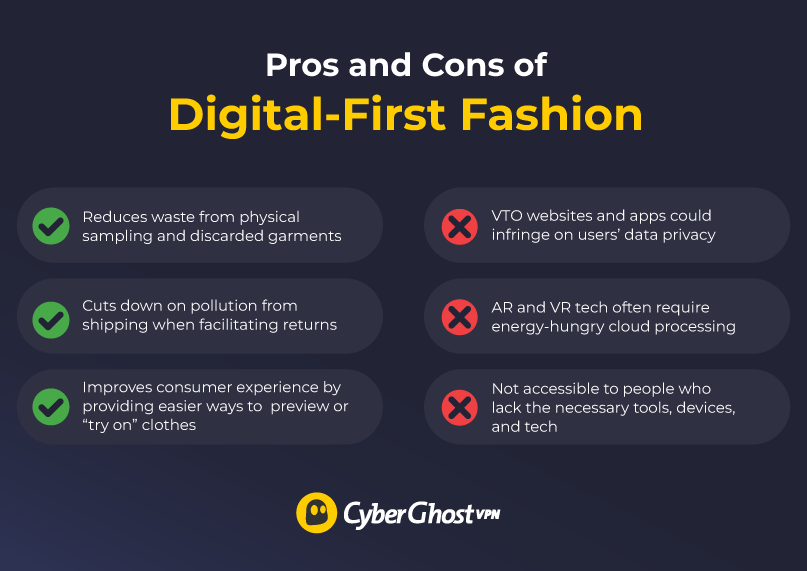
Digital fashion is promoted as a fix to some of the most wasteful parts of traditional fashion. At the production level, digital rendering and 3D designing intend to drastically cut down on the number of physical samples required to create and test patterns. Fewer samples mean less fabric waste, less water consumed, and fewer resources burned.
Some case studies show that designing a garment digitally generates up to 30% less CO₂ than physical prototyping5. And because there’s less fabric to dye, wash, and cut, the process can save around 3,300 liters of water per garment.
Digital fashion can also cut down on pollution from shipping. Traditional fashion moves samples, clothes, and returns across the globe, which adds up fast in terms of carbon emissions. When samples stay digital (or when events and showrooms move online), transport needs drop. Specifically in the case of fashion shows, going fully digital has been seen to reduce the carbon footprint per visitor from over 100 kg of CO₂ to less than 1 kg6.
For shoppers, the experience is suggested to be better, too. VTOs and 3D previews let people see how something looks on their own body without going to a store or ordering multiple sizes to return later. Fewer returns not only means reduced waste but also less frustration for buyers. In fact, brands using AR shopping tools have reported higher engagement and even conversion rate boosts of up to 250%7.
Are There Risks Associated With Digital-First Fashion?
While digital fashion and VTOs promise to address many of the problems with traditional fashion, they also introduce new issues.
AR tools, 3D scanners, and VR devices can be used in physical stores to reduce purchasing roadblocks for consumers. Most popularly, AR mirrors enable shoppers to see how garments look on them without the hassle of fully changing into them8.
This tech typically requires cloud-based processing to function optimally. The data centers that power cloud computing are already growing their energy consumption by around 12% every year, with up to 80% coming from non-renewable sources9. The continued rise of in-store VTOs is likely to further increase energy demands.
Accessibility is another issue. Although in-store VTOs are theoretically available to anyone visiting physical outlets, brands that offer these services are not that common. Moreover, at-home digital try-on apps can quietly exclude those who can’t afford devices with the necessary specs or users who live in areas with unreliable connectivity. While digital fashion is often pitched as “more inclusive,” the reality depends heavily on who has access to the tools.
The bigger concern, though, is privacy. To make digital-first fashion feel “personal,” platforms collect more personal information than physical or even online shopping ever did10. They become a biometric database.
VTOs often require you to upload your likeness—whether through images, live photos, or full videos—to create a 3D model of you. This means body measurements, facial geometry, and movement data of thousands of customers are being processed behind the scenes. But where does that data go? Who gets access to it?
These tools typically rely on AI-powered scans and may even log your activities on the VTO website or app, including your style preferences and how long you interact with certain items. That information can be stored, shared with third parties, or reused to train algorithms. In other words, your body becomes data.
A 2024 study of VTO websites and apps found that 65% of sites and 18% of apps send user images off-device, often to third-party servers11. Moreover, 11% of the VTO websites were discovered to be violating their own privacy policies, such as saving or sharing user images despite claiming otherwise. Another 25% of these sites were found to rely on providers that were flagged for similar policy violations.
The study concluded that nearly a quarter of VTO websites mislead users with inaccurate disclaimers or privacy declarations. The researchers also found security vulnerabilities that may be exploited to breach users’ data. Around 31% of websites were confirmed to store user images, with some photos still accessible months later. Tracking scripts and cookies are also common, which means that your try-on session can be linked to broader browsing behavior.
There’s also a long-term risk people rarely think about: identifiability. Studies in virtual environments show that body movement and nonverbal data alone can identify users with up to 95% accuracy12—even without names or faces. In other words, your body data can be just as identifying as your face. And without strong protections in place, that data could potentially be compromised and used by malicious actors.
The Novelty of Metafashion
Metafashion is the complete reimagining of traditional fashion—a concept that has been quickly gaining popularity in gaming spaces for quite some time. Below, we break down everything you need to know about this trend.
What Is Metafashion?
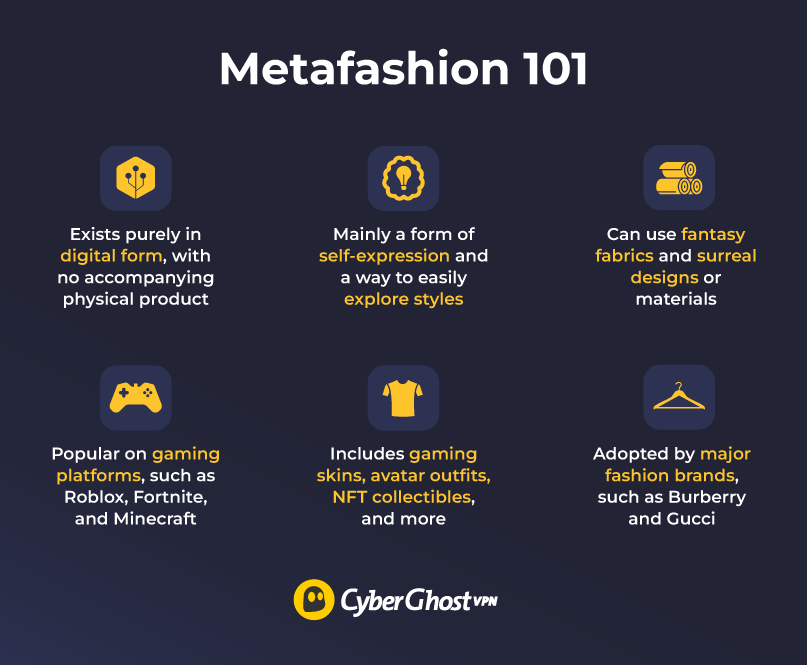
Metafashion exists only in digital spaces. Virtual garments are displayed on avatars, layered onto photos or videos, or collected as digital assets. They’re not prototypes for physical clothes, and they’re never meant to be manufactured.
Brands working in this sector usually operate primarily in digital spaces, so they build their collections for online experiences instead of physical stores. They typically grow their business through social media marketing, engagement, online shopping, and virtual base-building.
Given the nature of these brands, they tend to focus on self-expression, creativity, and internet culture rather than real-world wearability. And since no physical materials are used, their products are often marketed as a sustainable form of self-expression through fashion—or as a cool skin that can enhance your virtual experience.
Metafashion isn’t a niche for only a few brands, either. High-fashion designers like Zac Posen, Alexander McQueen, and Calvin Klein have released digital-only versions of their designs. Luxury and mainstream companies have also jumped in, with brands like Tommy Hilfiger, Dolce & Gabbana, and even Forever 21 launching full virtual collections during Decentraland’s first Metaverse Fashion Week in 2022.
How Can Consumers “Wear” Metafashion?
Since metafashion pieces are purely digital, they’re typically “worn” on avatars, images, videos, or virtual characters. DRESSX, one of the most prominent digital fashion platforms, popularized the “Photoshop-style” method. Users buy a digital garment and upload a photo; the brand then sends back a professionally edited image with the outfit added.
AR can also be leveraged using your mobile phone apps or social media filters. Users can see themselves wearing a digital outfit in real time, take photos or videos, or even show up to a Zoom call in a virtual look.
Sometimes, the garment isn’t “worn” at all. NFT-based fashion has grown alongside interest in digital ownership, collectibles, and limited-edition virtual drops. Some people buy digital-only clothing to collect it, admire the design, or own it as an NFT. In those cases, the outfit functions more like digital art than clothing.
How Are Video Games Shaping Metafashion?
Gaming is a major driver of metafashion. Virtual spaces and games have normalized the idea of paying for pieces that exist purely online. If you’ve ever bought a skin, outfit, or accessory for an avatar, you’ve already participated in digital-only fashion.
In the first half of 2025 alone, an average of 18.8 million users visited the Roblox Marketplace daily to browse items for their avatars, generating US$330 million in revenue for the user-created fashion market13. The platform later shared that nearly 90% of its users try out new styles on their avatars before purchasing similar physical clothing for themselves14.
Behind every digital outfit is a surprisingly detailed workflow. It usually starts with high-resolution sculpting, where designers create a super-detailed garment using tools like CLO3D or ZBrush. These early versions are visually rich but far too heavy for games. Next comes retopology, where the design is rebuilt into a low-poly version that won’t slow gameplay.
The fine details—stitching, folds, fabric texture—are then “baked” into image maps, so the outfit still looks detailed without complex geometry. After that, the garment is rigged with a skeleton and skinned so it moves naturally with the avatar. Once finished, it’s exported and uploaded as a wearable asset.
Some of the major fashion brands have fully embraced this space. Burberry partnered with Minecraft to create a branded in-game experience. Balenciaga also collaborated with Fortnite, letting players dress their avatars in high-fashion looks inside the game.
Ultimately, what makes video games the perfect environment for metafashion is scale. Millions of players already spend money customizing avatars, and digital outfits don’t have sizing issues, shipping costs, or return complications. For fashion brands, games offer instant global reach. For players, metafashion offers a new way to express identity.
How Can Metafashion Make Things Better?
In a nutshell, digital-only fashion expands the realm of possibility in terms of creativity and expression. It changes how brands work. Without physical production, collections can be released faster, updated more easily, and tested without risk. There’s no minimum order quantity and no need to guess how many units might sell. This means lower costs and more freedom to try new styles.
Metafashion also gives consumers an avenue to explore their creative self-expression without physical overconsumption. Digital-only garments aren’t bound by the laws of physics or influenced by comfort and durability issues, so clothes can be as surreal as the designer or “wearer” desires.
“Wearing” metafashion—whether on an avatar, through AR, or in edited photos—also creates a stronger sense of immersion. Research into virtual fashion spaces shows that people often feel more emotionally engaged and creatively inspired in digital environments (where identity can be more fluid and playful than in real life) than in traditional settings15.
For collectors and gamers, metafashion is valued aesthetics. Exclusive digital items and NFTs can be bought, sold, or traded—creating real economies inside virtual worlds.
The NFT trading market is an evolving ecosystem. During the pandemic, its popularity was driven mostly by perceived resale value. This means that prices were based on speculation regarding scarcity, social signaling, and hype. The market narrowed after 2022, focusing on established NFT collections and catering mostly to wealthy collectors and investors.
As such, owning rare pieces today has become a visible signal of dedication or status within online communities. In other words, digital-only pieces create economic, social, and artistic value all at the same time.
Metafashion also completely eliminates the logistical hurdles often encountered in traditional or even digital-first fashion. Not only is the design done virtually, but the final product also exists purely in digital form—no resource consumption, transport issues, or physical storage needs.
Simply put, when absolutely nothing is manufactured, there’s nothing to waste… or so it seems.
What Challenges Does Metafashion Face?
While metafashion removes physical waste from the equation, it comes with its own set of energy and processing issues.
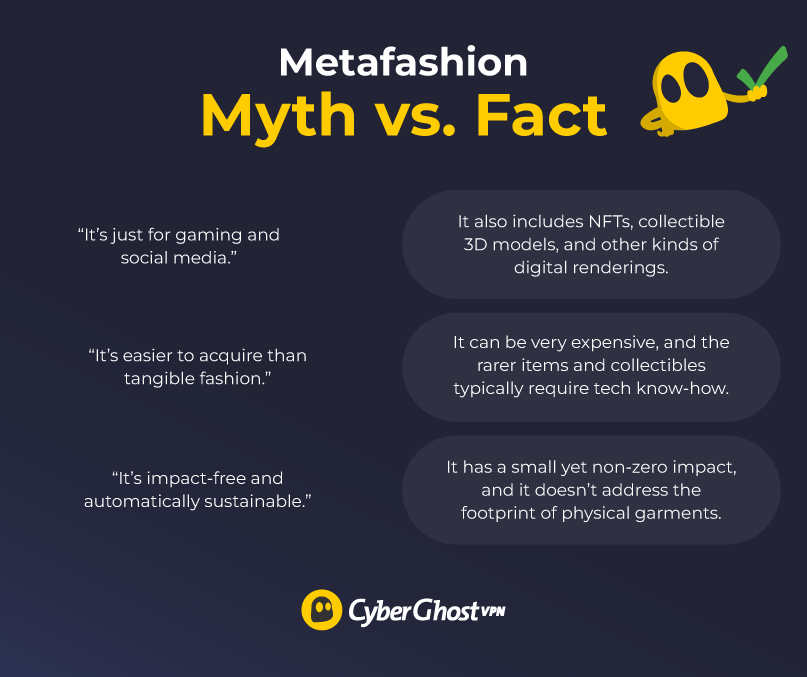
The creation of one NFT can produce around 100 kg of CO216. Meanwhile, its entire lifecycle can generate over 5 times that amount, depending on the number of transactions it goes through. So, although the physical art world has already been called into question for its shipping emissions, NFT transactions incur a much higher environmental cost—over 14 times the carbon footprint of mailing art prints across the United States17.
That number isn’t fixed—it depends on the blockchain, transaction volume, and technology used—but it shows that digital doesn’t automatically mean impact-free. Even as some blockchains become more energy-efficient, the overall footprint grows as NFT usage scales.
Then there’s the tech load behind the digital clothes themselves. High-quality digital-only fashion needs detailed textures and high-resolution models to look good, especially up close. Large files can slow down apps, crash uploads, or behave inconsistently across phones, laptops, and headsets. To keep things running smoothly, platforms often have to compromise between visual quality and performance.
Heavier files not only impact load times and accessibility; they also put more strain on devices and servers. Data centers account for around 3% of global electricity consumption from fossil fuels18, while their cooling systems are typically water-intensive.
Outside of the environmental impacts, metafashion also faces challenges with cross-platform compatibility and ownership rights or limitations.
A digital outfit you buy for one game or metaverse world usually can’t be “worn” anywhere else. Each platform has its own file formats, avatar systems, and technical rules. Interoperability is often promised or implied, but in practice, most digital garments are still locked into specific ecosystems.
Ownership, especially in terms of NFTs, can also be very complicated. Buying a digital garment doesn’t always mean you fully own it in the way you’d own a physical jacket. In many cases, you’re buying a license to use (often for display), not the design or “item” itself. That usually means you don’t get copyright or design rights, and your ability to resell, modify, or share the item depends on the platform’s rules.
There’s also the risk of losing access. In some cases, the blockchain might record that you own an NFT, but the actual garment file often lives off-chain, hosted on a platform’s servers. If that platform shuts down, changes its terms, or removes the file, your NFT can become useless. A study in 2022 pointed out that an NFT can easily lose all its value if the linked off-chain asset gets deleted or duplicated19.
Lastly, you can’t freely lend a digital outfit the way you’d lend a friend a sweater. Some platforms restrict transfers entirely, while others limit where and how items can be used. In extreme cases, digital items can even be revoked or disabled, similar to how e-books can be removed from digital libraries if users breach the terms of sale.
The Bigger Costs of Metafashion
As with every trend and tech innovation, metafashion comes with some caveats and has raised some questions among tech experts, digital privacy advocates, and the general public. The most commonly discussed problems include privacy and anonymity, environmental impact, accessibility, and manufactured demand. We look at each of these 4 below.
Privacy and Anonymity
Does metafashion really enrich the online experience, or does it just add yet another layer of tracking? The side to it that gets far less attention is data. Virtual clothes don’t just change how we shop or express ourselves—they also change what information we give up in the process.
Moreover, digital clothing tied to blockchain is often marketed as “permanent” ownership—no wear and tear, no degradation, forever collectible. However, this means that your data is permanently attached to it, too. And most blockchains are public by design.
Every NFT purchase, transfer, or resale can be linked to an immutable ledger. That means your digital wardrobe can become permanently traceable. Anyone who connects your wallet to your identity can see what you own, when you bought it, and sometimes even how much you paid.
Unlike traditional shopping, there’s no such thing as quietly donating or discarding an NFT. Even if you stop wearing it, the record stays. Over time, these records can paint a surprisingly detailed picture of taste, spending habits, and online identity. Fashion choices have always been expressive—but now they’re also searchable.
The metaverse opens up yet another aspect. It’s not as simple as avatars wearing clothes; every user interacts with virtual marketplaces that can signal preferences through behavior. This raises a familiar concern: are avatars about to become as trackable as web browsers?
If virtual stores can log where your avatar goes, what it looks at, and what it buys, hyper-personalized advertising may become inevitable. The difference is that this tracking feels more immersive—and much less obvious—than cookies or pop-ups.
Put it all together, and metafashion starts to look like a trade: less physical waste in exchange for deeper digital surveillance. That doesn’t mean it’s inherently bad. Fashion has always evolved alongside technology. But it does mean that users need to learn how to safely navigate this space as it continues to grow.
Accessibility
Does metafashion really “democratize” fashion, or does it just reproduce inequalities in the digital space? Digital-only pieces are often marketed as a way to be “more inclusive” and make fashion more accessible. While this is true in some ways, it doesn’t really show the full picture.
Digital runways, virtual showrooms, and online drops have opened access to experiences that were once limited to editors, buyers, and celebrities. Today, anyone with an internet connection can attend a digital fashion show or explore new haute couture collections.
Some major fashion weeks have been known to offer free online access, removing the huge cost and exclusivity of physical events. The pioneer for such a shift was Helsinki Fashion Week, which held a 100% virtual experience from 2020 to 2024. Other well-known events include Prada’s Spring/Summer 2021 show and the Metaverse Fashion Week hosted by Decentraland.
When it comes to clothing itself, accessibility is not as straightforward. Basic digital garments are often affordable. On platforms like DRESSX or Replicant, simple items like t-shirts and pants usually cost between US$6 and US$20, which puts them in the same price range as fast fashion.
Luxury digital-only fashion, however, is a very different story. High-end NFT garments are often priced as collectibles, not everyday wear. Digital couture pieces sold in metaverse platforms like Decentraland commonly range from US$200 to US$2,000. The first major fashion NFT sale, which happened in 2019, went for around US$9,500 for a single dress.
Moreover, while it’s true that multiple digital tools are popping up to allow users to generate outfits and experiment with designs, they may not be usable for people without access to the needed tech. While many digital-only fashion experiences only require a smartphone, others need crypto wallets, payment of blockchain gas fees, or high-end devices.
Gas fees (transaction costs paid to blockchain validators) alone can be a major barrier for NFT buyers, as each transaction can go up to US$500. Hardware expenses matter, too: entry-level VR headsets cost around US$299, while more expensive AR headsets can reach US$3,499.
Moreover, despite being marketed as more “hassle-free” than physical fashion, metafashion requires a level of digital competence that older generations may either struggle with or not be as interested in exploring. The avenues where metafashion thrives—gaming and metaverse platforms—are also generally less appealing to older users.
In reality, patrons of digital-only fashion are limited to mostly younger users; around 21% of millennials and 19% of Gen Zs have purchased a digital-only piece or NFT, with men roughly twice as likely as women to buy fashion in the metaverse.
So even though metafashion does lower some barriers, perhaps it’s more accurate to say that metafashion simply recreates the landscape in a new format. Luxury items remain a luxury, and production accessibility still filters out those without access to the necessary tech.
Environmental Impact
Does metafashion really reduce the ecological footprint, or does it just shift pollution to servers? It’s a common misconception that digital-only fashion is impact-free. In fact, the continued rise of metafashion is likely to create its own set of environmental issues—even though that impact is a little more “hidden.”
There are claims that metafashion consumes 97% less carbon than traditional fashion20. While this may be true in isolation, its implications could be a little misleading. Digital-only pieces can’t substitute real-world garments, so it doesn’t necessarily lead to fewer items being manufactured.
In fact, it could be argued that metafashion only adds another layer of consumption, and it risks shifting—not reducing—pollution from factories to servers.
Every time a digital outfit is designed, stored, rendered, streamed, or worn in AR or a metaverse space, it relies on data centers and global networks. Those systems use energy 24/7 and also consume water for cooling, create e-waste from constantly replaced hardware, and generate emissions from electricity.
Globally, data centers consume around 400 TWh of electricity per year21. Crypto mining adds at least 200 TWh22—close to the annual electricity consumption of Thailand, which ranks 22nd in the world23. While the metafashion industry accounts for only a small share of server space, its rising popularity will only continue to increase the demand for more data centers24.
Overall, it’s true that metafashion’s environmental impact is lower than that of traditional fashion. However, the growth of digital-only fashion does not mean the decline of physical manufacturing. This means that metafashion may have little to no direct contribution to reducing the impact of traditional fashion and is likely generating its own separate—albeit small—footprint.
In fact, optimistic models suggest that the continued rise of digital fashion may add up to 1.2% to the fashion industry’s carbon emissions by 203025, unless it also reduces physical production.
Manufactured Demand
If metafashion can’t address the impact generated by traditional fashion, does it really solve a problem, or does it just create a need? Overall, the cost-benefit analysis of digital-only fashion will look slightly different for brands and consumers. Although some of its pros are evident, not everyone will experience them the same way.
From a business perspective, the upsides are clear. Brands can cut production and logistics costs, move faster, and open up entirely new revenue streams. The value is more nuanced for consumers.
On the one hand, metafashion satiates users’ “need” for artistic expression through fashion without needing to purchase actual physical items. This also eliminates the hassle of figuring out sizes, paying for shipping, or dealing with potential returns. On the other hand, metafashion can feel like a luxury add-on rather than a necessity.
Virtual runway access, avatar skins, and NFT couture can’t replace real-world garments, which means that they will exist alongside people’s need for actual clothing. High-end digital-only fashion often mirrors physical luxury pricing, too. In those cases, metafashion doesn’t democratize fashion so much as recreate exclusivity.
There’s also the question of manufactured demand. Digital-only fashion removes friction. Much like online shopping, it’s easy to click, preview, and buy something instantly. But unlike online shopping, metafashion doesn’t “inconvenience” consumers with physical products and possible shipping headaches.
Given the ease with which users can buy clothing that exists only in virtual spaces, people may end up buying more of both digital and physical garments—especially with the accessibility of VTOs that promote digital-first alongside digital-only fashion.
That said, the benefits of metafashion in terms of self-expression and creativity can’t be denied. Digital fashion taps into community and belonging in ways that traditional fashion may no longer be capable of doing.
Overall, it seems the problem now points to redundancy. Metafashion, to an extent, addresses certain demands. However, it can also create new wants, new habits, and new ways to consume. The outcome depends on whether it replaces excess or simply creates new pathways for unrestricted consumerism.
Making Conscious Fashion Choices
Digital fashion is here to stay and likely grow. At the same time, physical clothing production is continuing to rise alongside it. As such, brands and consumers alike must take steps to balance the two and ensure that their coexistence doesn’t worsen environmental and ethical problems in the industry. Here’s how.
What Can Fashion Companies Do?
The fashion industry’s impact is hard to ignore. It’s responsible for roughly 10% of global carbon emissions, and it’s expected to shoot up to 26% by 205026. It produces around 92 million metric tons of textile waste every year and uses huge amounts of water and chemicals along the way.
Digital fashion can help at the margins, but real change still depends on how physical clothes are made, sold, and used.
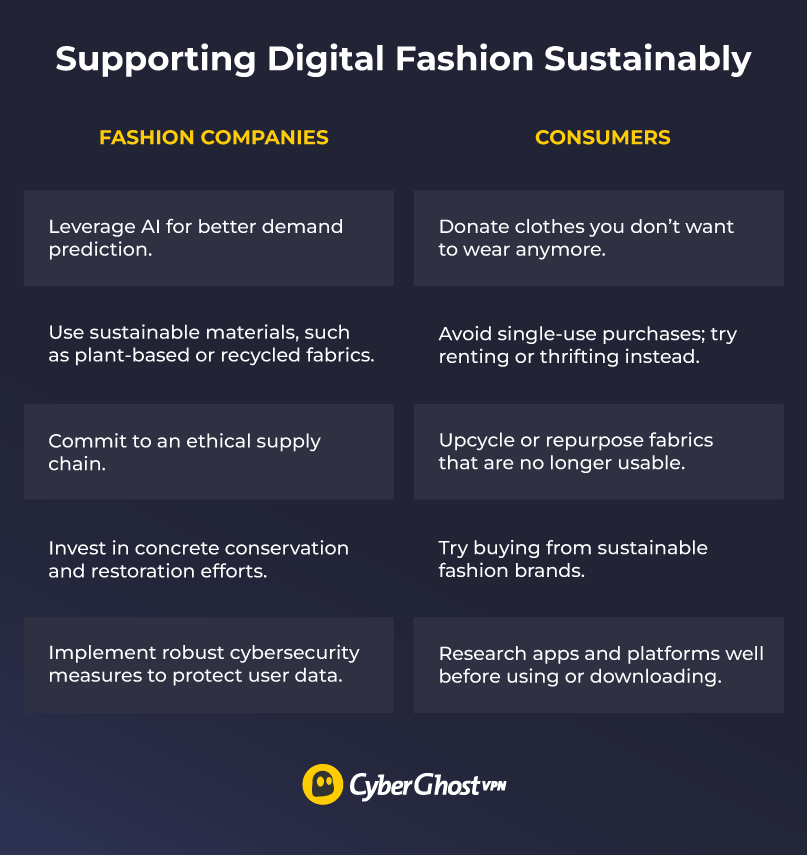
One big fix is producing less in the first place. Overproduction is the main reason clothes go to waste, and brands are starting to use AI-driven demand forecasting to get better at predicting what will actually sell. By combining past sales data, trend signals, and real-time demand, these tools help brands avoid making huge batches that never leave the warehouse.
Materials matter, too. Brands like VIVAIA and Desserto are experimenting with lower-impact alternatives, such as turning recycled plastic bottles into shoe fibers or making leather alternatives from cactus. Bolt Threads has also developed Mylo, a mushroom-based leather substitute that cuts down on animal farming and resource use.
Furthermore, brands need to commit to ethical supply chains—fair wages, safe working conditions, and no outsourcing pollution or labor abuse. Companies are also starting to invest in restoring ecosystems through science-based solutions, such as Gucci’s regenerative agriculture27 and the watershed restoration project by Levi’s28.
Lastly, fashion brands and VTO platforms must invest in cybersecurity measures to protect the information of their users and consumers. The fast and continued development of AI has introduced more sophisticated methods to launch cyberattacks29, so it’s up to the companies to stay up to date and continually patch potential system weaknesses.
What Can Consumers Do?
In the United States alone, people throw away about 17 million tons of textiles annually30. Many of these clothes are barely worn, too, with 65% of garments getting discarded less than a year from purchase. Admittedly, individual choices don’t compare to the scale of industrial overproduction—but they still count.
If you want to reduce your impact without going extreme, start small. Wear what you already own for longer. Extending a garment’s life by just nine months can cut its waste footprint by over 20% and save a third of the water used to make it31. If you grow tired of using an outfit, consider donating instead of dumping—organizations like Oxfam and Salvation Army accept clean, wearable items.
For damaged clothes, try repurposing the fabric. Old tees make great cleaning rags, while scraps can become tote bags, quilts, or cushion covers. When buying new, look for brands that are transparent about sourcing and labor. Tools like the Higg Index or blockchain systems such as Aura Blockchain can help verify sustainability claims.
You can also rent or resell instead of buying new. Renting often has a lower emissions-per-wear footprint, and resale keeps clothes in circulation longer. None of these fixes will change the fashion industry overnight—but while the system needs to change, these are realistic ways to push in the right direction without putting the burden on consumers.
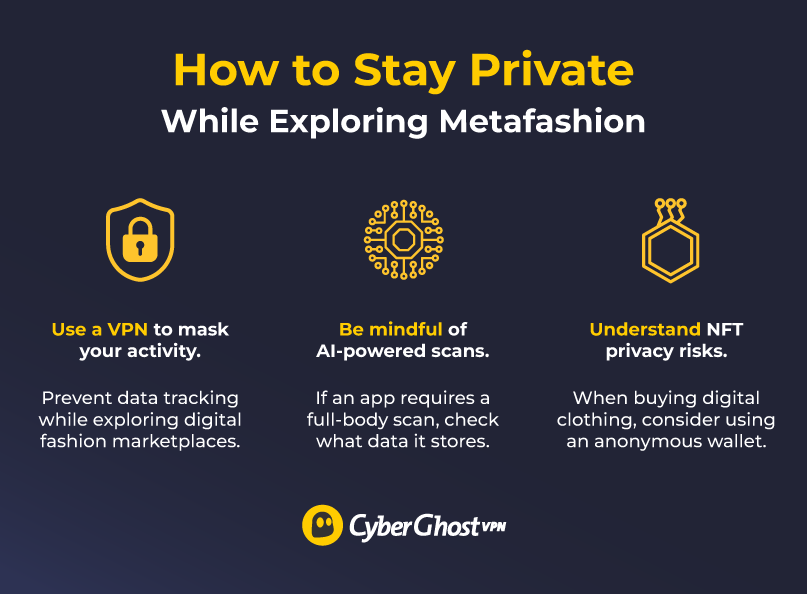
In terms of privacy, users need to be increasingly educated about the risks of engaging in virtual platforms. Privacy protection matters more than ever. Whether it’s masking IP addresses with a VPN, browsing with greater privacy through the Tor network, or using email aliases when signing up to VTO websites, limiting data exposure across platforms can help users explore new digital spaces without handing over their entire digital identity.
Metafashion may be the future, but that shouldn’t come at the cost of control over your own data.
So, Is Digital Fashion Worth It?
At its best, digital fashion can cut out a lot of the mess that comes with making physical garments, especially when they’re used to replace things like overproduction, excess sampling, or impulse buys made just for producing content.
The problem is how we use it. If digital fashion simply adds another layer of consumption—more outfits, more drops, more “must-haves”—then it doesn’t really solve anything. Owning a virtual closet doesn’t automatically make a physical one smaller.
Moreover, we need to learn about the privacy risks and chart clear paths to protect ourselves. Users should know what data gets recorded, shared, and used.
Where metafashion starts to make sense is in a hybrid world. Digital fashion can empower creativity, play, and identity online, as long as we stay mindful about preserving our digital identities. The win isn’t choosing one over the other; it’s being more intentional about both.
References
- Spinning Textile Waste into Value—bcg.com
- World Cotton Production Statistics—theworldcounts.com
- Virtual Try-on Market (2024 – 2030)—Grand View Research
- Fashion Influencer Marketing Market (2025 – 2030)—Grand View Research
- How 3D Garment Design Can Mitigate the Impact of the Environment—metail.com
- Virtual Versus Sustainable Fashion: A Systematic Literature Review—Silesian University of Technology
- Digital Innovations in E-Commerce: Augmented Reality Applications in Online Fashion Retail—A Qualitative Study among Gen Z Consumers—mdpi.com
- Why The New Generation Of AR Smart Mirrors Are Catnip For Fashion And Beauty Retail—Forbes
- Cloud Computing : Environmental Impacts And Sustainability—earth5r.org
- Privacy paradox in 3D body scanning technology: the effect of 3D virtual try-on experience in the relationship between privacy concerns and mobile app adoption intention—Nature
- Try On, Spied On?: Privacy Analysis of Virtual Try-On Websites and Android Apps—Springer Nature Link
- Personal identifiability of user tracking data during observation of 360-degree VR video—National Library of Medicine
- Virtual Fashion and Metaverse Commerce: Roblox’s UGC Ecosystem as a High-Growth Investment Opportunity—ainvest.com
- The 2025 Roblox Replay: Decoded Through Search and Style—Roblox
- Virtual fashion experiences in virtual reality fashion show spaces—Frontiers
- How do NFTs impact the environment?—cointelegraph.com
- Explainer: What Are NFTs, And What is Their Environmental Impact?—Earth.org
- Growing Energy Demand from Data Centres Driven by AI and Projected Electricity Consumption to Reach 945 TWh by 2030, Representing 3% of Global Electricity Consumption—globenewswire.com
- Do NFTs’ Owners Really Possess their Assets? A First Look at the NFT-to-Asset Connection Fragility—Cornell University
- Could Digital Fashion Be an Eco-Friendly Replacement for Fast Fashion?—ecocult.com
- Energy demand from AI—IEA
- How Much Electricity Does Bitcoin Mining Use? Complete 2025 Analysis with Real Data—solartechonline.com
- Electricity Consumption by Country 2026—World Population Review
- America’s data center growth hot spots, mapped—Axios
- ETC CE Report 2025/6 Textiles and the environment – The role of digital technologies in Europe’s circular economy—eionet.europa.eu
- Fast Fashion and Emissions: What’s the Link?—Earth.org
- Transforming fashion for a nature-positive impact: Gucci—Ellen Macarthur Foundation
- Levi Strauss water strategy expands focus from factories to communities—trellis.net
- AI Hacking: How Hackers Use Artificial Intelligence in Cyberattacks—opswat.com
- How many clothes are too many?—PIRG
- How sustainable is rental fashion?—fashionrevolution.org

Leave a comment