
Most mainstream email services collect data about how you use their platforms, though exactly what they collect varies by provider. They may log account activity, store metadata, and often connect your account to identifying information such as your name or phone number. If you want to avoid spam, tracking, or exposing your personal email online, a standard inbox may not offer the level of privacy you’re looking for.
That’s where anonymous email comes in. Privacy-focused email providers collect less personal information and give you more control over what data links to your account. In this article, you can review the best free anonymous email platforms and learn what to look for when choosing a free email provider.
For stronger privacy, it’s worth protecting your connection as well as your inbox. CyberGhost VPN encrypts your internet traffic before it reaches your email provider and hides your IP address from the websites and networks you connect through. It also offers quality features, like a Kill Switch, DNS leak protection, and a strict no-logs policy, which add another layer of protection.
What Is an Anonymous Email and How Does It Work?
Anonymous email refers to an email service that helps reduce the amount of identifying information connected to your account and messages. Unlike many standard email providers, privacy-focused services often let you create an account without providing extensive personal information and collect less personal identifiable information.
You may also find additional privacy features, including removed identifying information from email headers, limited metadata, or end-to-end encryption. Some services also let you create temporary addresses, called burner emails or aliases, for one-off sign-ups or short-term use. These help keep your primary inbox private and reduce unwanted marketing emails if the address is later exposed.
Why Do You Need an Anonymous Email?
Every email you send contains more than just your message. Depending on your provider and setup, it may also include metadata and account information that links back to you. Many mainstream email services also collect data about how you use their platforms. If you want to share less personal information, an anonymous email can help reduce what’s connected to your account and messages.
Here are the main reasons you may be looking for an anonymous email:
- To protect your privacy and reduce extensive data collection: Online privacy is a concern for around 68% of people globally.1 Many anonymous email providers let you sign up with minimal personal information and aim to collect less data about your activity than mainstream services.
- To avoid spam, breaches, and data leaks: Using your primary email for every sign-up or subscription increases the chances of it ending up on marketing lists or in a data breach. A burner email or alias helps keep your main inbox separate.
- To share sensitive information more privately: Journalists, researchers, whistleblowers, and others may need to communicate without revealing more personal information than necessary. An anonymous email helps reduce the details linked to your account, which can limit the amount of information exposed if it’s compromised.
- To keep your professional and private lives separate: Freelancers, creators, and public-facing professionals can use anonymous email accounts without sharing their primary contact details.
- To contact unknown parties with less risk: When replying to an online listing or making first contact with someone new, an anonymous email lets you share less personal information until you’re comfortable doing so.
What to Consider When Choosing an Anonymous Email
For stronger anonymity, look beyond marketing claims and evaluate how the service actually handles your data. Here are the key factors to consider:
- Data collection and logging: It’s important to know what information the provider requires at sign-up and what it stores afterward. Does it log IP addresses, login activity, or metadata? Even limited logs can connect your account to your identity. Look for clear, minimal data retention policies.
- IP protection and metadata stripping: Emails contain technical header data that can reveal routing details and sometimes IP information. Strong anonymous services mask or remove identifying metadata and may allow access through privacy networks. This reduces the traceable footprint of each message.
- Encryption and security: If you want privacy beyond anonymity, choose a service that offers end-to-end encryption. Encryption protects the content of your emails, while an anonymous email protects who sent them. Secure login protections also matter.
- Jurisdiction: The country where the provider operates affects how it handles user data. Some regions require data retention or allow broad government access. Privacy-friendly jurisdictions generally impose fewer obligations to store user information.
- Payment traceability: If it’s a paid service, consider how you pay. A personal credit card links your identity to the account. Alternative payment options can reduce that link.
- Open-source software: Some privacy-focused providers publish their apps and code as open source, allowing independent researchers to inspect them for security issues and verify how they handle user data.
- Extra features: Features like email aliases, secure file sharing, or the option to use your own custom domain are a bonus. Other useful tools include password managers or spam filtering to block unwanted emails.
Quick Overview: The Best Free Anonymous Email Providers
To save you time, we’ve compiled a list of trusted anonymous email providers with free and paid options. We’ve also included a comparison table so you can review their key features.
| Feature | Proton Mail | Tuta | Guerrilla Mail | Mailfence | Addy.io | PrivateMail |
| Free plan | ✅ | ✅ | ✅ | ✅ | ✅ | ❌ |
| Encryption | ✅ | ✅ (post-quantum encryption) | ❌ | ✅ (user-managed) | Optional | ✅ |
| No personal info required | ✅ | ✅ | ✅ | ✅ | ✅ | ❌ |
| Self-destructing emails | ✅ | ❌ | ✅ | ❌ | ❌ | ❌ |
| Disposable / burner options | ❌ | ❌ | ✅ | ❌ | ✅ (aliases) | ❌ |
| Supports IMAP/third-party clients | Limited | ❌ | ❌ | ✅ | ❌ | ✅ |
The Best Anonymous Email Providers
Proton Mail
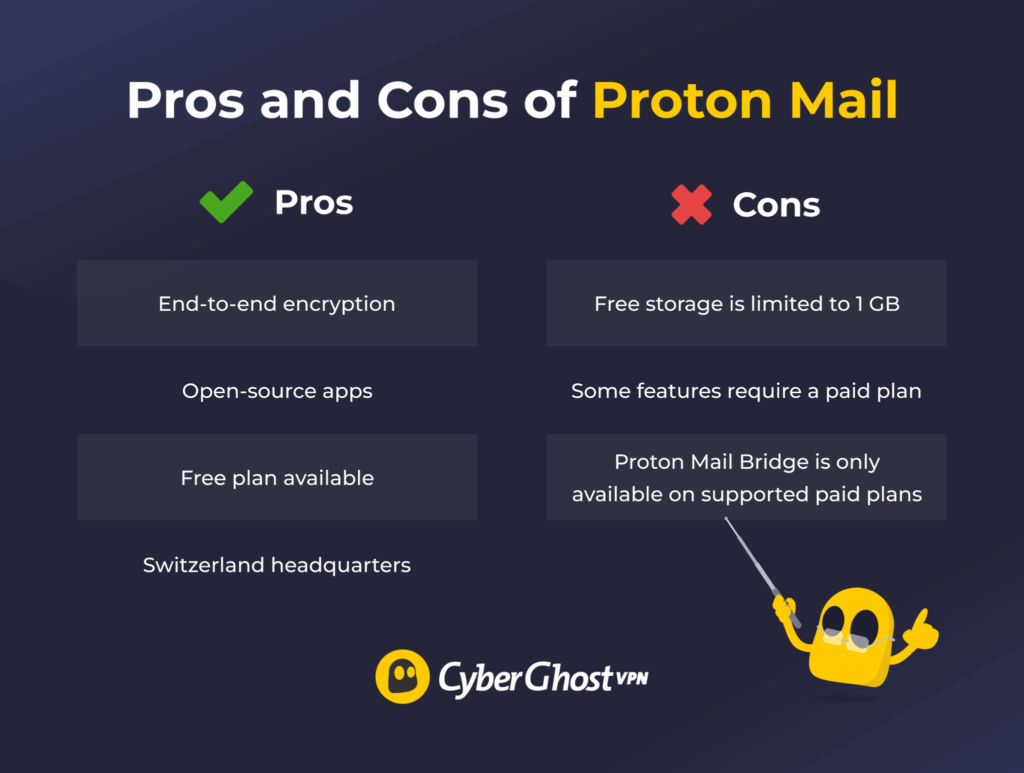
Proton Mail is one of the best all-round choices if you want a private email service that’s easy to use. It’s great for everyday email but includes strong privacy features by default, making it suitable for anyone who wants to reduce the amount of personal information connected to their inbox.
Based in Switzerland, a country with strong privacy protection, Proton Mail uses end-to-end encryption for supported emails and offers open-source apps. You can create an account without providing extensive personal information, and the free plan includes 1 GB of storage and up to 150 emails per day. Proton Mail also supports self-destructing emails, giving you more control over how long sensitive messages remain accessible.
The free plan is generous for occasional use, but some advanced features, such as more storage and full support for third-party email clients through Proton Mail Bridge, require a paid subscription.
Tuta (Formerly Tutanota)
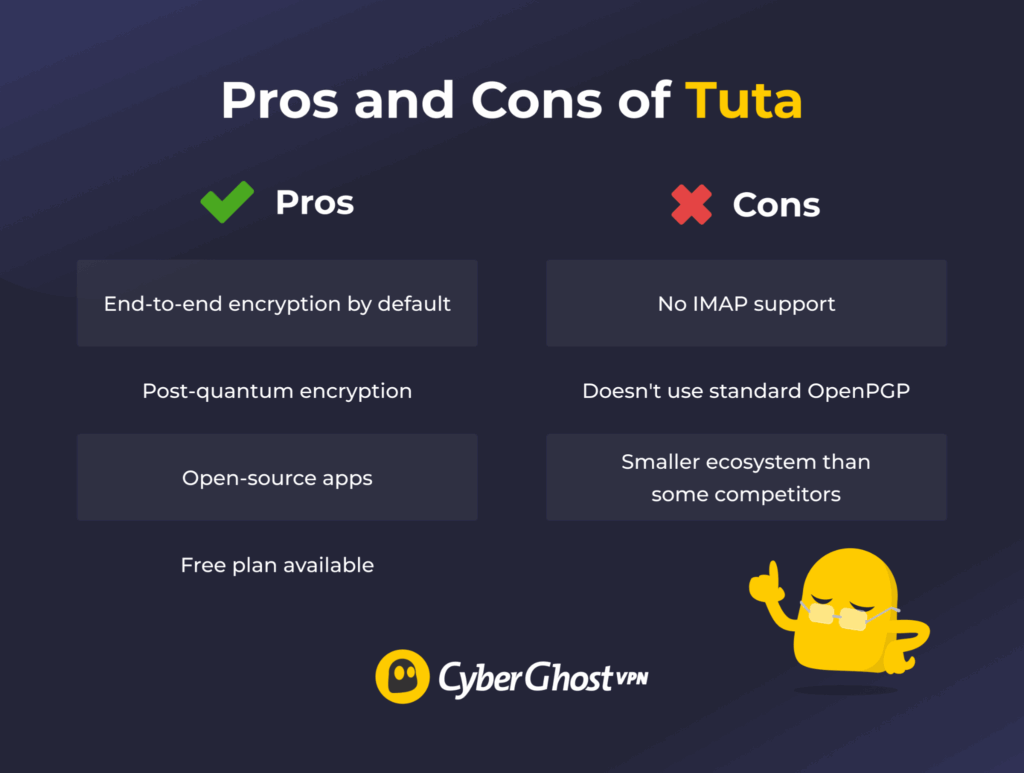
Rather than trying to mirror traditional email providers, Tuta focuses on securing as much of your mailbox as possible while keeping the service simple to use.
Its end-to-end encryption protects your emails as well as subject lines, contacts, and calendars. Instead of standard OpenPGP, it uses its own encryption system and introduced TutaCrypt, a post-quantum protocol designed to resist future quantum attacks. All apps are open source, and you can sign up without providing personal information. A free plan is available, with paid plans offering additional storage and features.
The main drawback is compatibility. Because Tuta doesn’t use standard PGP or support traditional Internet Message Access Protocol (IMAP), it doesn’t integrate easily with third-party email clients. This makes it better suited to people who are happy using Tuta’s own apps.
Guerrilla Mail
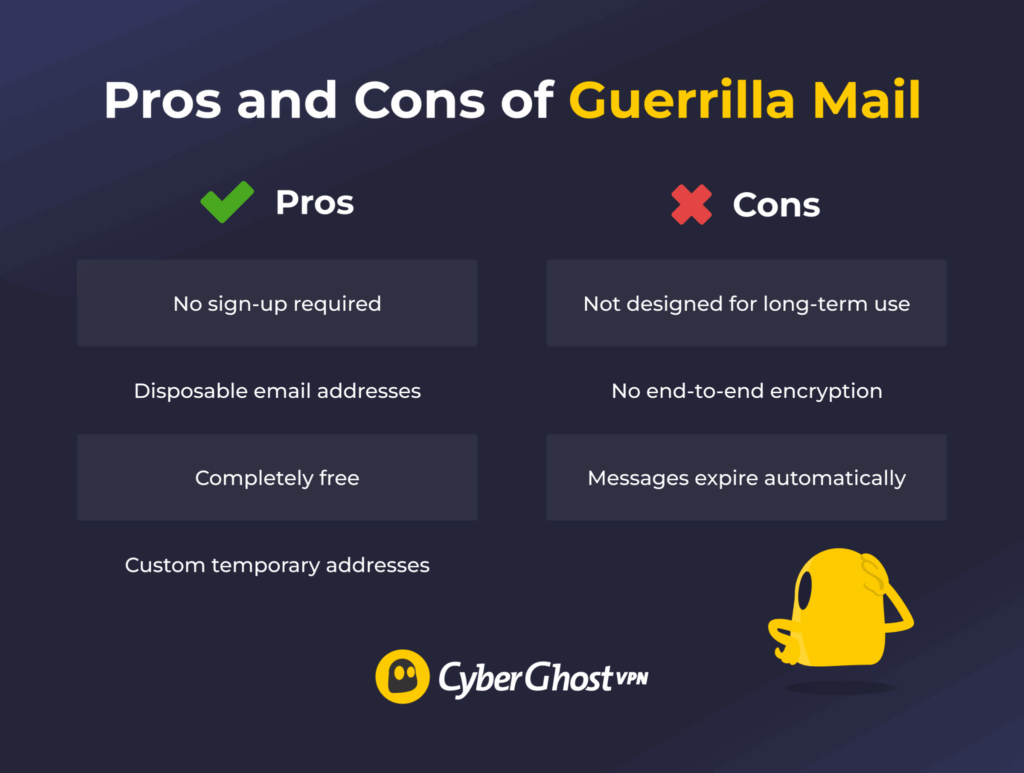
If you only need an email address for a few minutes, Guerrilla Mail is hard to beat. It’s designed for temporary use, making it ideal for one-off sign-ups, downloads, or situations where you don’t want to share your primary email address.
There’s no registration process and you can start using a disposable inbox straight away. Guerrilla Mail lets you generate random email addresses or create your own custom temporary address, and you can even send emails without creating an account. Messages automatically expire after about an hour, helping reduce the amount of personal information tied to temporary communications.
Because it’s intended to be disposable, Guerrilla Mail isn’t suitable for long-term conversations or storing important emails. It also doesn’t offer end-to-end encryption, so it’s best used for convenience rather than sensitive communications.
Mailfence
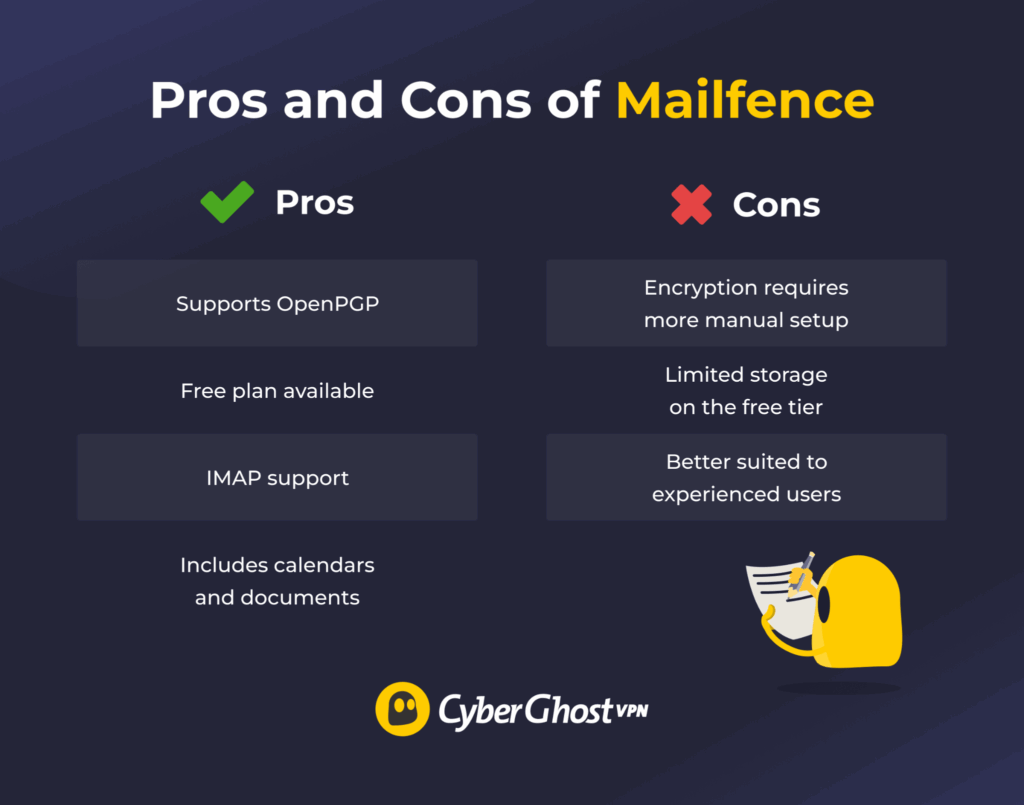
Belgium email platform Mailfence is a good option if you want more control over how to secure your email. Instead of handling everything behind the scenes, it gives you the tools to manage your own encryption keys while still providing a modern email service.
Mailfence supports OpenPGP encryption, allowing you to encrypt emails and manage your own keys. It also includes calendars, contacts, document storage, two-factor authentication, and support for third-party email clients through IMAP. The free plan offers basic email and document storage, while paid plans increase storage limits and add features like custom domains and advanced key management.
Mailfence is a bit more technical than services like Proton Mail or Tuta. If you’re already familiar with OpenPGP or want greater control over your encryption, it’s an excellent choice. Beginners, however, may find the manual setup takes a little getting used to.
Addy.io (Formerly AnonAddy)
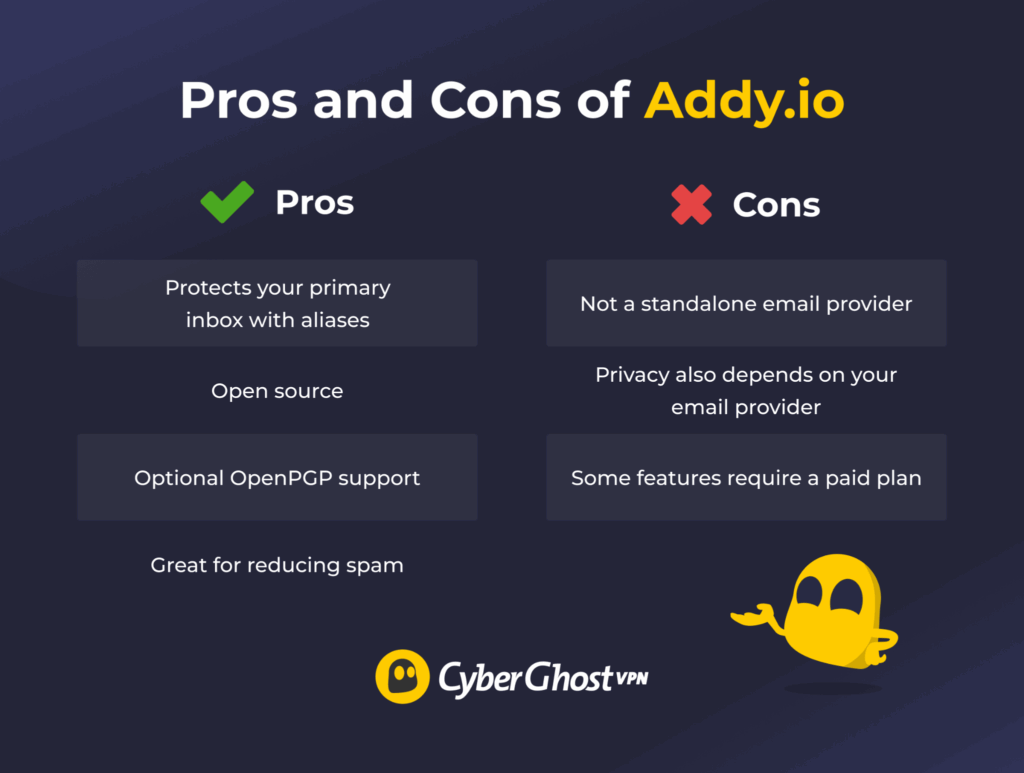
Instead of replacing your inbox, Addy.io protects it by creating unique email aliases you can use for every website, subscription, or online account.
Whenever someone emails one of your aliases, Addy.io forwards the message to your existing inbox. If an alias starts receiving spam or gets exposed in a data breach, you can disable or delete it without affecting your main email address. Addy.io is open source, supports unlimited aliases on paid plans, and provides optional OpenPGP encryption for forwarded messages. It’s especially useful if you sign up for online services and want to keep your primary email private.
Since Addy.io forwards messages rather than host your mailbox, it isn’t a standalone encrypted email provider. In part, your overall privacy still depends on the email service receiving those forwarded messages.
PrivateMail
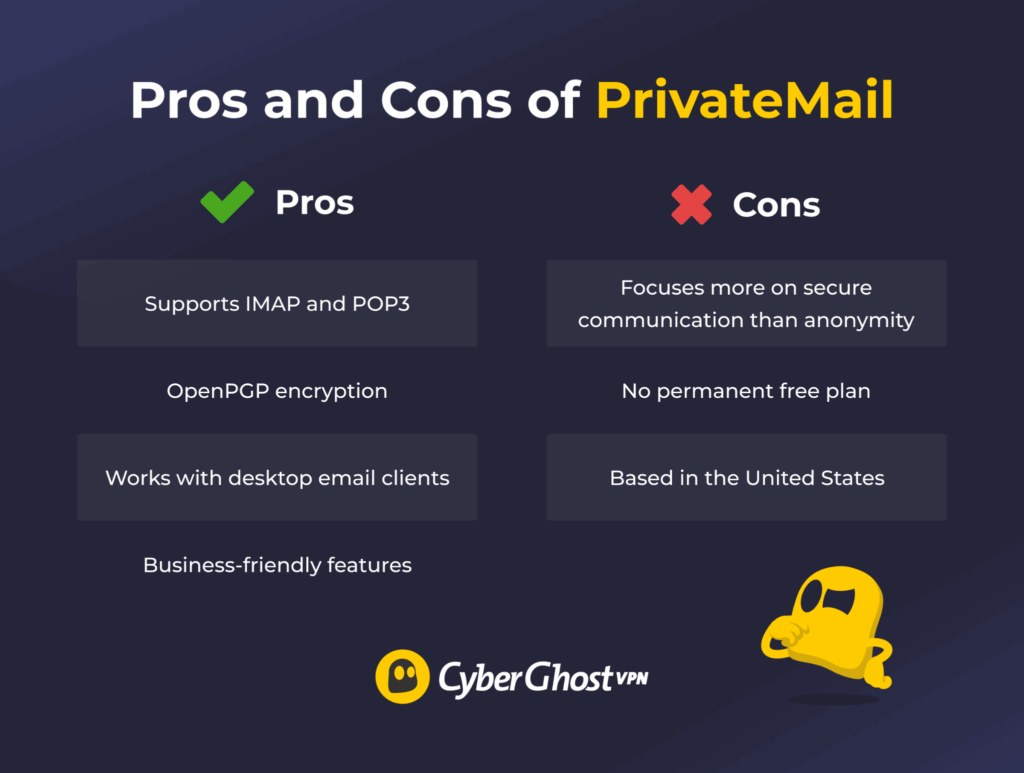
PrivateMail is for people who want secure email without giving up a traditional desktop email client. It combines encrypted email with support for popular mail applications, making it a good fit for professionals and business users.
Owned by Namecheap, PrivateMail supports OpenPGP encryption and works with IMAP and POP3, allowing you to use clients like Outlook, Apple Mail, or Thunderbird. Paid plans also include encrypted cloud storage, secure file sharing, and collaboration features designed for business use.
Unlike many of the other providers on this list, PrivateMail doesn’t offer a permanent free plan. It’s also based in the United States, so if you’re looking for the strongest privacy-friendly jurisdiction, you may prefer alternatives such as Proton Mail or Tuta.
Free vs Paid Options
A free plan is often enough if you only need a secondary inbox, temporary email address, or occasional private communication. If you plan to use your anonymous email every day, a paid plan usually gives you more flexibility and features. Here’s what you can often expect:
- More storage and higher sending limits: Paid accounts usually offer larger inboxes, more storage, custom domains, and extras like advanced key management.
- Extra privacy and productivity features: Depending on the provider, paid plans may include custom domains, email aliases, advanced encryption options, priority support, or secure file storage.
- Greater flexibility: Many providers reserve features like third-party email client support, additional addresses, or multiple user accounts for paid subscribers.
Anonymous vs Burner Email Accounts
Anonymous email accounts and burner email addresses both help you share less personal information online, but they’re designed for different situations. Here’s how they compare:
- Purpose: An anonymous email account is for ongoing use and focuses on privacy. A burner email is a temporary address you use for one-off sign-ups, downloads, or situations where you don’t want to share your primary email.
- Lifespan: Anonymous email accounts for long-term use, much like a regular email account. Users may use burner emails on a temporary basis and let them expire or discard them after they’ve served their purpose.
- Privacy features: Many anonymous email providers offer features like end-to-end encryption, aliases, and minimal data collection. Burner email services primarily reduce spam and keep your main inbox private, rather than provide advanced privacy or security features.
- When to use: An anonymous email works best for secure conversations, professional separation, or protecting your identity online. Use a burner email when you only need a temporary address for a website, free trial, or online form.
Boost Your Privacy With an Anonymous Email
The best anonymous email service depends on how you plan to use it. If you want a private everyday inbox, providers like Proton Mail and Tuta are strong choices. If you only need a temporary address for sign-ups or downloads, a burner email service like Guerrilla Mail may be a better fit. The key is choosing a service that matches your privacy needs without collecting more information than necessary.
For even stronger privacy, pair your anonymous email with CyberGhost VPN. It encrypts your internet traffic, hides your IP address, and follows a strict no-logs policy, helping protect your connection whenever you create an account, check your inbox, or send emails. You can try CyberGhost VPN risk-free with a 45-day money-back guarantee (14 days for monthly plans).
FAQ
Is there such a thing as an untraceable email?
Completely untraceable emails are extremely difficult to achieve. However, you can make your emails much harder to link back to you by choosing a privacy-focused email provider, sharing as little personal information as possible, and protecting your connection with a VPN. The less identifying information attached to your account and messages, the stronger your privacy.
Is it illegal to make an anonymous email?
No, creating an anonymous email account is legal in most countries. Many people prefer them for privacy protection, spam reduction, or to separate personal and professional communication. What matters is how you use it. Using any email account for illegal activities, such as fraud, harassment, or scams, is still against the law.
Can an anonymous email be traced?
It depends on the provider you use and the steps you take to protect your privacy. Some services collect very little personal information, while others may retain more account or connection data. Using a privacy-focused email provider alongside tools like a VPN can make your emails harder to link back to you, but no solution can guarantee complete anonymity.
Can you send an email anonymously?
Yes, but to an extent. Privacy-focused email providers and temporary email services can help reduce the amount of personal information connected to your messages. Some also offer features like end-to-end encryption or email aliases for additional privacy. Pairing one with a VPN can help protect your connection while you create an account and send emails.
How do I send an anonymous email?
Start by choosing a privacy-focused email provider or a temporary email service that fits your needs. Create your account using as little personal information as possible, avoid including identifying details in your messages, and consider using a VPN to help protect your connection. These steps can improve your privacy, although they won’t make you completely anonymous.

Leave a comment
Sandra Girardau
Posted on 07/03/2023 at 02:16
Can I use a ghosted account on social media
Ghostie
Posted on 23/03/2023 at 18:24
Hi Sandra! Yes, you can use CyberGhost VPN to access your social media accounts from any country. Your sessions are private and you can browse and post without worrying about anyone intercepting your data. Check out our article on how to access Facebook with CyberGhost VPN for more information on using a VPN with social media.
Someone important
Posted on 22/01/2023 at 18:32
Thank you… in my new position, that requires me to wear different hats (work in competitive environments), I need this information and guidance to stay safe, secure, and to keep the bad guy from buying my info and ideas to share, sell, or leverage for their personal gain…
Ghostie
Posted on 20/02/2023 at 17:42
Hi! Glad to hear you found the article useful! The internet is filled with data-hungry entities, but with CyberGhost VPN, your browsing habits will stay strictly between you and the (virtual) walls. Our No Logs policy ensures that none of your online activity is ever recorded or stored.
Deloitte gave our servers and systems the thumbs up! Their comprehensive inspection concluded that we are in compliance with all applicable regulations. If you’re curious to learn more, go here for detailed information.
Joseph
Posted on 22/11/2022 at 05:01
Love this app 😍
Ghostie
Posted on 29/11/2022 at 10:08
Glad to hear, Joseph! Thanks for reading.