
Crypto scams can start with something that seems harmless: an investment tip, a new online connection, or a convincing trading platform. The losses can escalate. In 2025, the FBI’s Internet Crime Complaint Center (IC3) received 181,565 complaints involving cryptocurrency, with reported losses totaling approximately $11.37 billion.1
Some crypto scams are easy to recognize. Others only become obvious when you try to withdraw your money or question a request. Learning the most common cryptocurrency scams and the warning signs to watch for is important for your privacy and security. There are also steps you can take if something feels off.
What Are Crypto Scams, and How Do They Work?
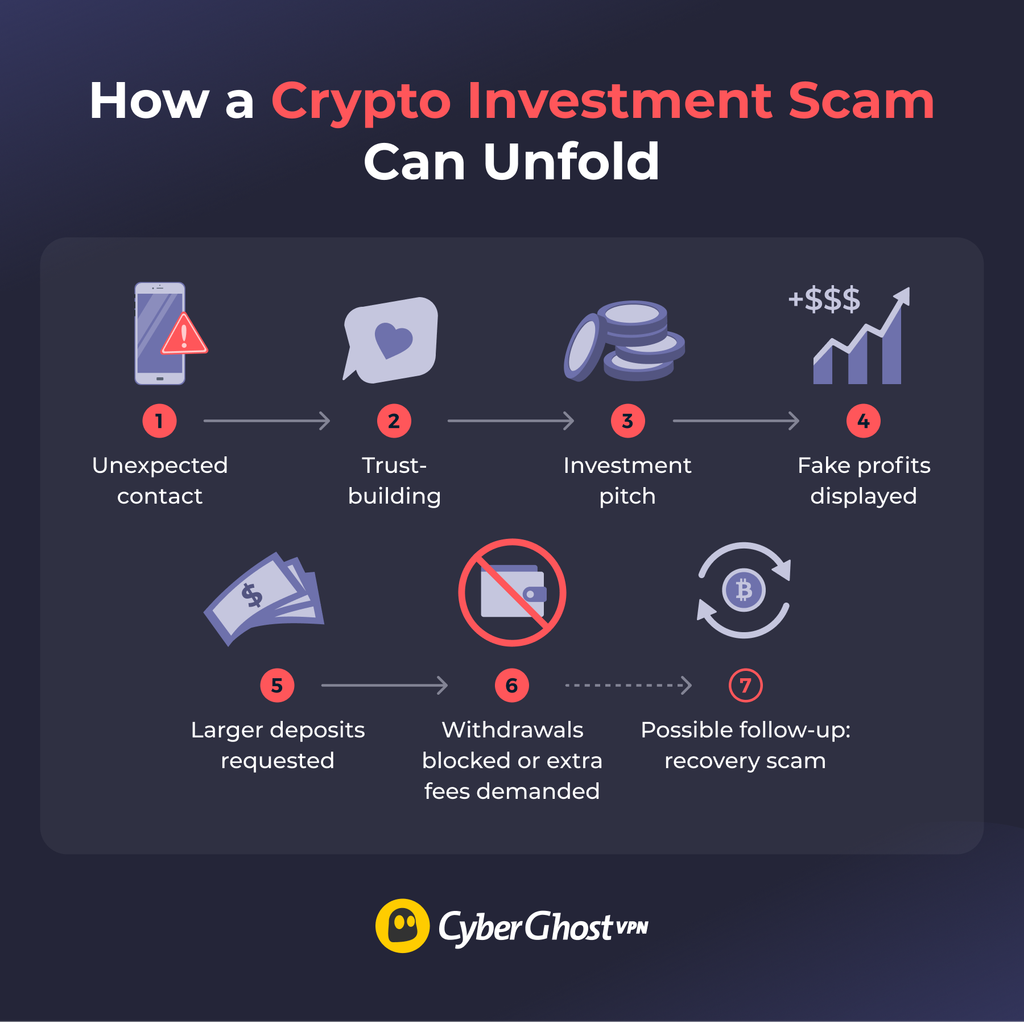
Cryptocurrency scams are fraud schemes that use cryptocurrency as the investment, the payment method, or the target of theft. Many crypto scams target human judgment rather than the blockchain itself. They often take one of two routes, which often rely on social engineering to create trust, urgency, or confusion:
- Manipulation: A scammer persuades you to send cryptocurrency. The story might involve an investment opportunity, a new relationship, a giveaway, a job offer, or an urgent payment request.
- Access theft: A scammer tries to get control of your funds by stealing login details, private keys, or recovery phrases, sending you to a phishing site, or getting you to approve a harmful wallet request.
Cryptocurrency payments aren’t easy to reverse once they’re sent, which can make losses harder to recover. Wallet control also depends on sensitive credentials and transaction approvals. If someone obtains the credentials needed to control your wallet or tricks you into authorizing a malicious transaction, your crypto assets may be stolen or become inaccessible, sometimes with no recovery possible.
8 Common Crypto Scams to Watch Out For
Crypto scams can take different forms, but the same methods tend to surface again and again: build trust, create urgency, make the opportunity look credible, then push for access. Understanding these tactics makes it easier to recognize the warning signs.
Fake Investment Platforms and Managers
Fake crypto investment schemes account for some of the largest reported losses in recent history. They often begin with someone who presents themselves as an investment manager, trading expert, or member of an exclusive group.
At first, everything looks convincing. Your dashboard may show steady gains and the person guiding you may encourage you to increase your deposit. Eventually, withdrawals stop working, or you’re told you need to pay more before they can release your funds.
In December 2025, the United States Securities and Exchange Commission (SEC) charged three purported crypto trading platforms and four investment clubs, alleging that they used social media ads and group chats to build trust before directing people to fake trading platforms. The SEC alleged that the defendants misappropriated at least $14 million from US retail investors.2
Relationship Investment and Romance Scams
Also known as “pig butchering” scams, relationship scams can begin with romance, friendship, professional networking, or someone who seems suspiciously helpful. The conversation may have nothing to do with crypto at first. Over time, the person builds trust. They might suggest moving the conversation to a messaging app, talk about their own success, or offer to teach you a strategy they claim worked for them.
Once the relationship feels established, crypto or investing enters the conversation. The person may offer to guide you, recommend a platform, or claim they’ve found a reliable way to make money.
In one case, the SEC alleged that people posing as wealthy professionals contacted prospective investors through social media, pursued romantic relationships over messaging apps, and directed them to a fake crypto trading platform. The SEC said at least 11 investors lost about $2.2 million.3
Be cautious when someone you’ve only met online starts taking a strong interest in where or how you invest.
Phishing, Fake Exchanges, Wallets, and Apps
Some crypto scams imitate services you already trust. A phishing message might send you to a lookalike exchange or wallet site, while a fake app can imitate a legitimate trading platform. Others ask you to connect your wallet or hand over a recovery phrase or private key. If you’re asked to approve an unexpected request, it may be an example of ice phishing.
Connecting your wallet to a malicious site can expose you to harmful transaction requests. A scammer may try to steal sensitive wallet credentials, steer you to a convincing login page, or trick you into connecting your wallet to a wallet drainer. If you sign a malicious transaction or grant an unsafe token approval, the attacker may be able to transfer certain crypto assets or NFTs from your wallet.4
If you receive an unexpected crypto link or wallet request, don’t engage until you can verify if it’s legitimate.
Pump-and-Dump Schemes
Pump-and-dump schemes start with hype. Scammers promote a little-known coin or token through social media, messaging groups, fabricated news, or coordinated posts, creating the impression that demand is taking off. As more people buy in, the price rises. The organizers then sell their holdings while interest is high, which can plummet the value and leave later buyers absorbing the losses.
A sudden wave of promotion around an obscure token is worth treating cautiously, especially when it comes with pressure to buy. The United States Commodity Futures Trading Commission (CFTC) warned that digital asset pump-and-dump schemes often use social media and messaging communities to manufacture hype and urgency.5
Rug Pulls
A rug pull occurs when the people behind a crypto project exploit investors and then abandon the project or take funds or assets that investors expected to remain available. In some cases, developers withdraw liquidity, leaving investors unable to sell their tokens easily.6
Rug pulls and pump-and-dump schemes differ in their execution. In a rug pull, insiders abandon the project or pull away key support such as liquidity. Pump-and-dumps rely on manufactured demand before organizers sell their holdings.
Giveaway and Impersonation Scams
A familiar name can make a suspicious request feel convincing. Scammers may pose as public figures, businesses, customer support teams, government agencies, investment professionals, or even friends with compromised accounts.
The story varies. You might be told to send crypto to have it “doubled,” move funds to protect an account, pay a wallet-verification fee, or scan a QR code to complete an urgent transaction. The approach might arrive through an email, text, phone call, social account, or direct message.
Be wary when someone impersonates a trusted person or organization to pressure you into sending crypto or acting immediately. Scammers often use impersonation tactics alongside cryptocurrency payment requests and fake giveaways. AI-generated voices, videos, and images are making some of these impersonation attempts more convincing, so a familiar face or voice shouldn’t be your only reason to trust a request.7
Crypto ATM and Payment Scams
Crypto ATM scams usually begin with an urgent story. Someone might claim there’s a problem with your bank account, an unpaid bill, a government investigation, or another issue that needs immediate attention. The scammer may tell you to withdraw cash, visit a cryptocurrency kiosk, and buy Bitcoin to send to a wallet they control, often by scanning a QR code.
A request to solve an urgent problem by sending money through a crypto kiosk is a major warning sign. In 2025, IC3 received 13,460 complaints involving cryptocurrency kiosks, with reported losses reaching $389 million.1
Job and Task Scams
Fake job offers can look ordinary at first. A recruiter or employer may offer remote work, simple online tasks, or commissions paid in crypto. The catch appears later, when you’re asked to deposit your own money to start working, unlock more tasks, or withdraw earnings you made. Some schemes keep asking for larger deposits as the promised balance grows, making it harder to walk away.
A legitimate job shouldn’t require you to keep sending cryptocurrency in exchange for payment. The FTC warns that scammers may display fake earnings and then demand cryptocurrency deposits to unlock additional tasks or withdraw those supposed earnings.8 Never pay money to get a job or collect wages.
How to Spot a Crypto Scam Before You Send More Money
The clearest warning sign is often the pattern of behavior around the investment or payment, rather than the cryptocurrency itself. One strange message may mean little on its own. Several warning signs appearing together deserve a much closer look.
| Warning Signs Before Sending Crypto | Warning Signs After Sending Crypto |
| Unexpected investment advice or contact | A dashboard shows unrealistic and consistent profits |
| Guaranteed returns or claims of little to no risk | You’re encouraged to deposit progressively larger amounts |
| Pressure to act immediately | A small early withdrawal works, but larger withdrawals don’t |
| The conversation moves to private messaging | New tax, anti-money laundering (AML), security, or verification payments appear |
| Someone asks for a recovery phrase or private key | You’re told another deposit will unlock existing funds |
| Someone presents an unfamiliar site or app as exclusive or special | The explanation for your blocked withdrawal keeps changing |
A small successful withdrawal can be particularly convincing. You might think that if money came back once, the platform must be genuine. Scammers can use that early withdrawal, along with fake profits shown on a trading dashboard, to build confidence and encourage much larger deposits.
Pay attention to the language, too. Promises of “guaranteed returns,” “limited-time opportunities,” or “safe transfers” should make you cautious. Also scrutinize demands for an extra “tax,” “verification deposit,” or “account unlock fee” before you can withdraw your funds. Verify any legitimate tax obligations rather than paying a fee because a platform demands it.
The same goes for someone who keeps changing the reason you can’t withdraw your money. A technical issue becomes a tax problem, then a security check, followed by one final fee. Each new explanation pressures you into paying again.
How to Help Protect Your Crypto Wallet and Accounts
Scammers don’t always need to break into a wallet. Sometimes they only need you to hand over the wrong information or approve the wrong request. A few careful habits can help you spot those attempts before you lose control of your funds:
- Protect your private keys and recovery phrase: Never share them with someone offering investment advice, customer support, wallet help, or recovery services. Anyone with the right private credentials may be able to control the funds in your wallet.
- Verify websites and apps: Instead of opening a link from an unexpected message, find the provider’s official site or app yourself. Check the domain before signing in or connecting a wallet.
- Review wallet requests: Take a moment to understand what you’re approving before you sign a transaction, connect your wallet, or grant access to a crypto service.
- Verify unexpected support contacts: Contact the provider through its known official website or app. Don’t assume a support number or login page is legitimate because it appears in a search result or sponsored link.
- Use strong, unique passwords and MFA: Give extra attention to your exchange, email, and other accounts connected to your crypto activity.
- Keep your devices and software updated: Install security updates for your operating system, browser, wallet apps, and other software you use for crypto.
- Research the person or platform: Look beyond the information they’ve given you. Check independent sources for complaints, inconsistencies, or other reasons to question the offer before sending funds.
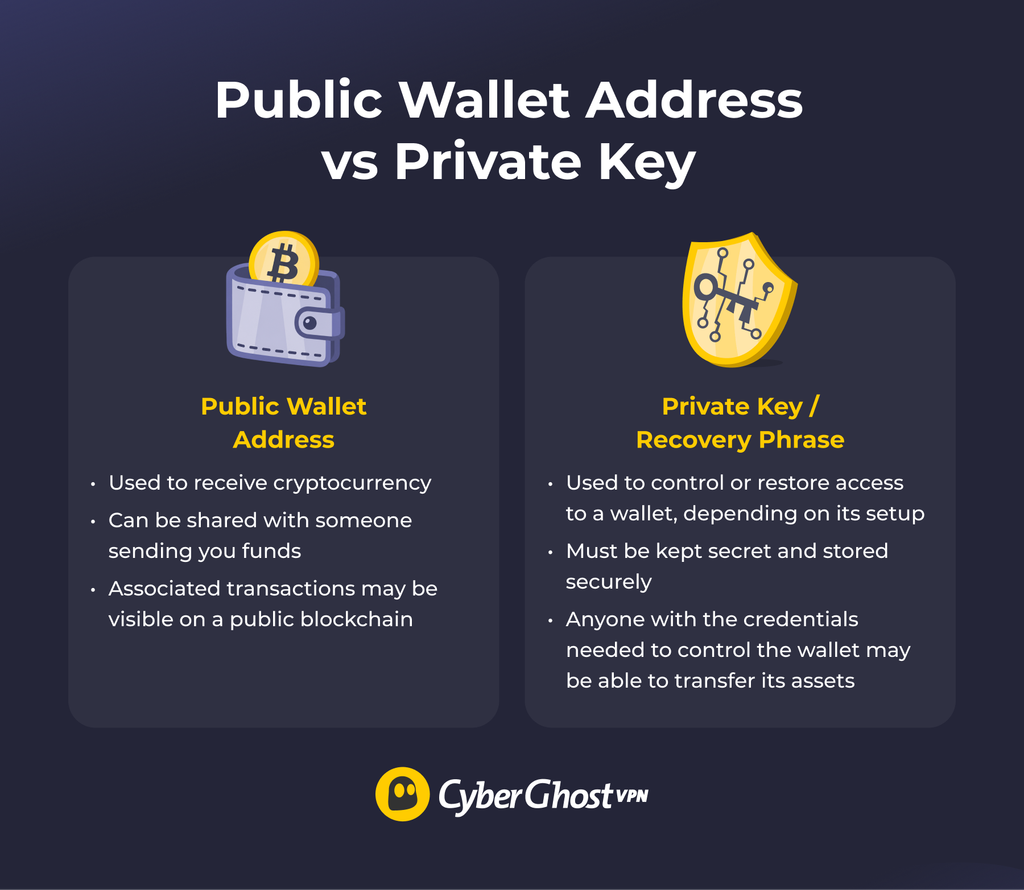
A public wallet address works differently from a private key. You can share a public address to receive cryptocurrency, but knowing that address alone doesn’t provide the private key needed to authorize transfers from it. Public blockchain records can still reveal transaction activity associated with the address.
CyberGhost VPN can add a layer of protection to your internet traffic by encrypting the traffic between your device and the VPN server. When CyberGhost VPN routes your connection through the VPN tunnel, websites and online services see the VPN server’s IP address rather than your original public IP address.
CyberGhost VPN also follows an independently audited No-Logs policy, which means we don’t collect your browsing activity. On supported platforms, our Content Blocker can help prevent access to known malicious websites at the DNS level. Using CyberGhost VPN alongside vigilant checks of investment offers, wallet requests, and unexpected contacts can give you broader protection online.
What to Do If You’ve Been Scammed
If you think you’ve fallen for a crypto scam, acting quickly can help limit further damage. Start by cutting off the scammer’s access to any more money or information.
1. Stop Sending Money
Don’t pay another withdrawal fee, tax request, verification charge, security deposit, or recovery fee, even if you’re told it’s the final step needed to release your funds. Scammers often keep adding new conditions once you’ve already invested. Any additional payments can deepen the loss.
2. Contact the Relevant Provider
Reach out to any legitimate service involved in the transaction as soon as you can. Depending on what happened, that could be your:
- Crypto exchange
- Wallet provider
- Financial institution
- Card provider
- Payment provider
Use the provider’s official website or app to find its support channel. Provide the transaction details and explain what happened. Crypto transfers can be difficult to reverse, so don’t assume the provider will be able to recover the funds.
3. Secure Affected Accounts
If you shared login details, approved an unfamiliar wallet request, or exposed other sensitive information, secure the accounts involved.
- Change affected passwords from a trusted device.
- Turn on MFA where it’s available.
- Follow your exchange or wallet provider’s official security guidance.
- Revoke suspicious wallet connections or permissions where appropriate.
Focus first on preventing further access by moving remaining funds to a new wallet. More technical wallet recovery steps will depend on the wallet and what information the scammers exposed.
4. Preserve the Evidence
Save as much information about the scam as you can before deleting messages, blocking accounts, or closing anything. Useful details include:
- Receiving wallet address
- Transaction hash or ID
- Cryptocurrency type and amount
- Date and time
- Website or domain
- Email addresses and phone numbers
- Usernames or profiles
- Messages and screenshots
These details can also help investigators trace cryptocurrency transactions across wallet addresses. However, tracing funds doesn’t guarantee that you can freeze or recover them.
5. Report the Scam
It’s important to report what happened, even if you’re unsure whether the funds can be recovered. A report documents the incident and may help authorities connect it with related cases.
6. Watch Out for Recovery Scams
Losing crypto can make you a target for a second scam. Someone may contact you claiming to be a recovery specialist, investigator, lawyer, government employee, or law enforcement representative who can get your funds back.
Be cautious if they ask for an upfront payment before anything can be recovered. IC3 warns about cryptocurrency recovery services that charge advance fees. Treat unexpected recovery offers with the same scrutiny you’d apply to the original scam.
How to Report Crypto Scams
Where you report crypto scams depends on where you live. Contact the appropriate fraud, financial, cybercrime, or law-enforcement authority in your country, and include the transaction and communication evidence you preserved above.
In the US, you can report cryptocurrency fraud to the Internet Crime Complaint Center (IC3) and the Federal Trade Commission (FTC). Reporting as soon as possible can give investigators more useful information to work with, although they can’t guarantee recovery.
Spot the Patterns and Keep Your Accounts Safe
Cryptocurrency scams can look different on the surface, yet the same warning signs tend to come back: growing pressure, fake profits, blocked withdrawals, and one more request for money. Spotting the patterns early can help avoid further losses.
CyberGhost VPN can help protect your internet traffic and add a layer of privacy when you access crypto-related accounts. Combine CyberGhost VPN with strong account security and careful checks of unexpected messages and wallet requests.
FAQ
What are the most common crypto scams?
Common crypto scams include fake investment platforms, phishing, relationship scams, impersonation, pump-and-dumps, crypto ATM scams, and fake job offers. Although the tactics vary, scammers try to trick you into sending cryptocurrency, revealing your wallet’s recovery phrase, or connecting your wallet to a malicious service.
How can I tell if a crypto investment is a scam?
To tell if a crypto investment is a scam, be on the lookout for investments promising guaranteed returns, consistent but suspicious profits, or quick wealth promises with little risk. Scammers may approach you through social media or messaging apps, show fabricated account balances, and pressure you to invest before you’ve had time to research the opportunity. Another major warning sign is a platform that prevents withdrawals unless you pay additional taxes or fees.
Can I recover cryptocurrency lost to a scam?
You can sometimes recover cryptocurrency lost to a scam, but this isn’t a guaranteed outcome. Cryptocurrency transfers can be hard to reverse, although providers or investigators may be able to trace transactions and, in some circumstances, help freeze funds. Save transaction details and report the scam as soon as possible. Be cautious of anyone promising recovery in exchange for an upfront fee.
What should I do if I fall victim to a crypto scam?
If you are the victim of a crypto scam, your first step is to stop sending money and contact any legitimate exchange, wallet, bank, or payment provider involved. Secure any accounts that may have been exposed. Save wallet addresses, transaction IDs, messages, and screenshots before reporting the incident.
How can I protect my crypto wallet from scammers?
You can help protect your crypto wallet from scammers by keeping your private keys and recovery phrase secret, verifying crypto sites and apps, reviewing wallet approvals, and using MFA when available. Treat unexpected support or investment messages cautiously. Sharing a public wallet address alone doesn’t provide the private key needed to move your funds.
Are crypto giveaways on social media legitimate?
Some legitimate promotions exist, but unexpected offers asking you to send crypto first so you can receive more back are a classic scam pattern. Scammers may impersonate public figures, businesses, or other trusted accounts to make the offer look convincing.
References
- 2025 IC3 Annual Report — FBI Internet Crime Complaint Center
- SEC Charges Three Purported Crypto Asset Trading Platforms and Four Investment Clubs with Scheme That Targeted Retail Investors on Social Media — U.S. Securities and Exchange Commission
- SEC Charges Multiple Individuals and Entities in Relationship Investment Scams — U.S. Securities and Exchange Commission
- Criminals Pose as Non-Fungible Token Developers to Target Internet Users — FBI Internet Crime Complaint Center
- Digital Asset Frauds — Commodity Futures Trading Commission
- SEC Charges New York Blockchain Engineer with Perpetrating “Rug Pull” Fraud — U.S. Securities and Exchange Commission
- 5 Ways Fraudsters May Lure Victims Into Scams Involving Crypto Asset
- Securities — Investor.gov

Leave a comment