
Getting fragged because Counter-Strike isn’t responding quickly enough? You press the right keys to move, but the game starts rubberbanding, and suddenly you’re the one staring at the death screen. High ping and other connection issues can make the game feel like it’s always one step behind you.
Fortunately, you can take measures to troubleshoot your connection and potentially lower your ping. We’ll explain how to check your latency in CS:GO and CS2 and what might be sending it through the roof. Then, we’ll walk through the fixes that can help you get your connection, and hopefully your K/D ratio, back on track.
What Is Ping and Why Is It Important?
Ping measures how long it takes for data packets to travel from your device to CS’s game servers and back. It’s measured in milliseconds (ms), and generally, the lower it is, the more responsive your connection feels. High ping means there’s a longer delay between what you do and what the game server registers. You shoot, the game registers it half a second later than you expect it to — and your screen blacks out because your opponents got to you first.
Ping vs Latency vs Jitter
If you’re looking up solutions to your problems with high ping, you likely came across the terms “ping,” “latency,” and “jitter.” These terms are related, but they have some subtle differences:
- Ping: A measurement used to test the round-trip time between your device and a server.
- Latency: The delay involved in sending your data across a network. Higher latency can make online games feel less responsive.
- Jitter: Fluctuation of your latency over time. Also called “packet delay variation.” Having low latency and high jitter can be just as disruptive as high latency on its own, causing rubberbanding or stuttering.
Gamers commonly use “ping” and “latency” interchangeably when talking about connection delay. We’ll do the same throughout this guide, while using “jitter” specifically for fluctuations in that delay.
What Causes High Ping?
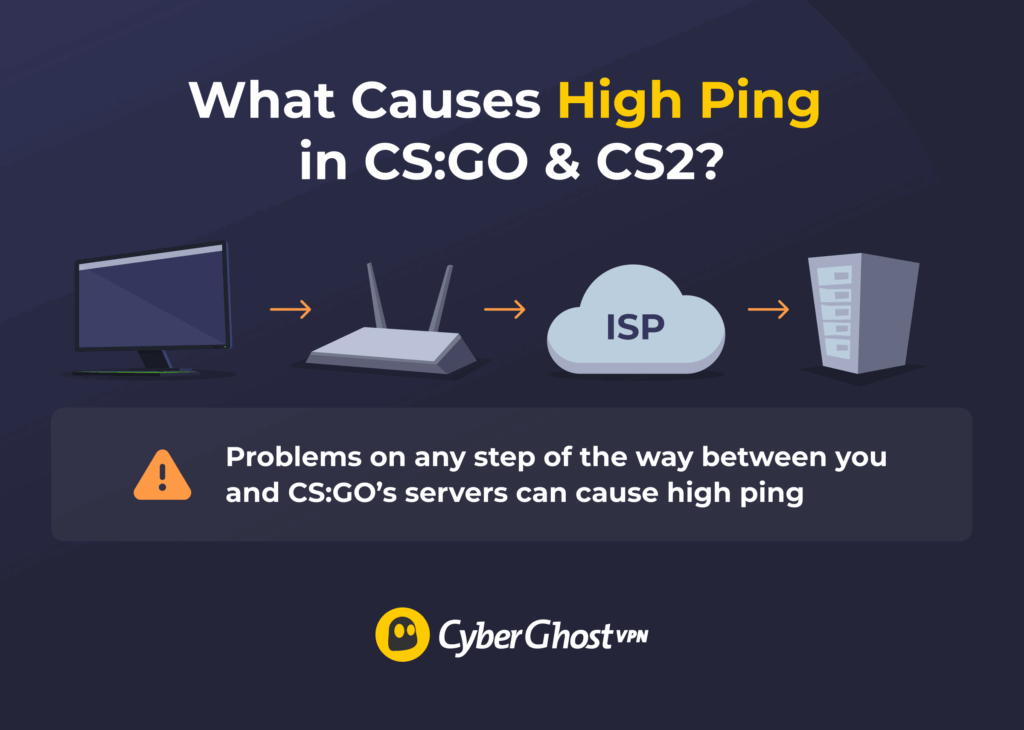
Your connection to a CS:GO or CS2 server has to travel through several stops before your inputs reach the game and the response makes it back to you. A problem anywhere along that route can increase latency or make your connection less stable. Some of the more common problems include:
- Wi-Fi or home network issues: A weak Wi-Fi signal, interference, or problems with your router can increase latency, jitter, or packet loss.
- Network congestion: If many other people are streaming, downloading, or otherwise competing for connection, your game traffic may take longer to get through.
- Distance from the server: The farther your data has to travel, the more latency you can expect. Connecting to a distant CS server can therefore increase your ping.
- Activity-based throttling: Some ISPs might slow down connections for activities that require high bandwidth usage.
- Suboptimal routing: Your ISP may route your traffic along a longer or less efficient path to the game server, adding unnecessary latency.
- Server congestion: The community server’s host can’t handle all the players currently connected.
How to Check Your Ping in CS:GO and CS2
CS:GO (Console Command)
CS:GO has an in-game console command that displays ping, so you don’t need to rely on a third-party checker. Here’s how you can use it:
- Launch CS:GO.
- Go to Settings > Game settings.
- Go to the Game tab.
- Find the Enable developer console setting and toggle it to Yes.
- Start up a game.
- Press “~” on your keyboard (the button directly below the Esc key if you’re using an alternative layout).
- This opens the developer console. Type in “net_graph 1” without the quotation marks and click Submit.
This shows a set of parameters in the corner of your screen. The parameters include your framerate (fps), ping, and two percentages marked as “loss” and “choke.” These can help you get a better guess of where the problem causing high ping lies.
- Loss: The percentage of data packets lost on the way to the server. High packet loss can mean the problem is with your device or the ISP’s network.
- Choke: The percentage of data packets that the server can’t process. High choke usually means the issue is with the server.
CS2 (HUD Telemetry Setting)
CS2 doesn’t support the “net_graph 1” command that CS:GO did, but it makes the ping process as simple as ticking a setting. Follow these instructions:
- Launch CS2.
- Go to Settings > Game tab.
- Scroll down to the Telemetry section.
- Find the Show ping setting and click the dropdown menu.
- You can choose to display ping either Always or If conditions are poor, which means when it’s rising or unstable enough to affect your gameplay.
This shows your ping in the upper right corner of your screen.
How to Reduce Ping in CS:GO and CS2
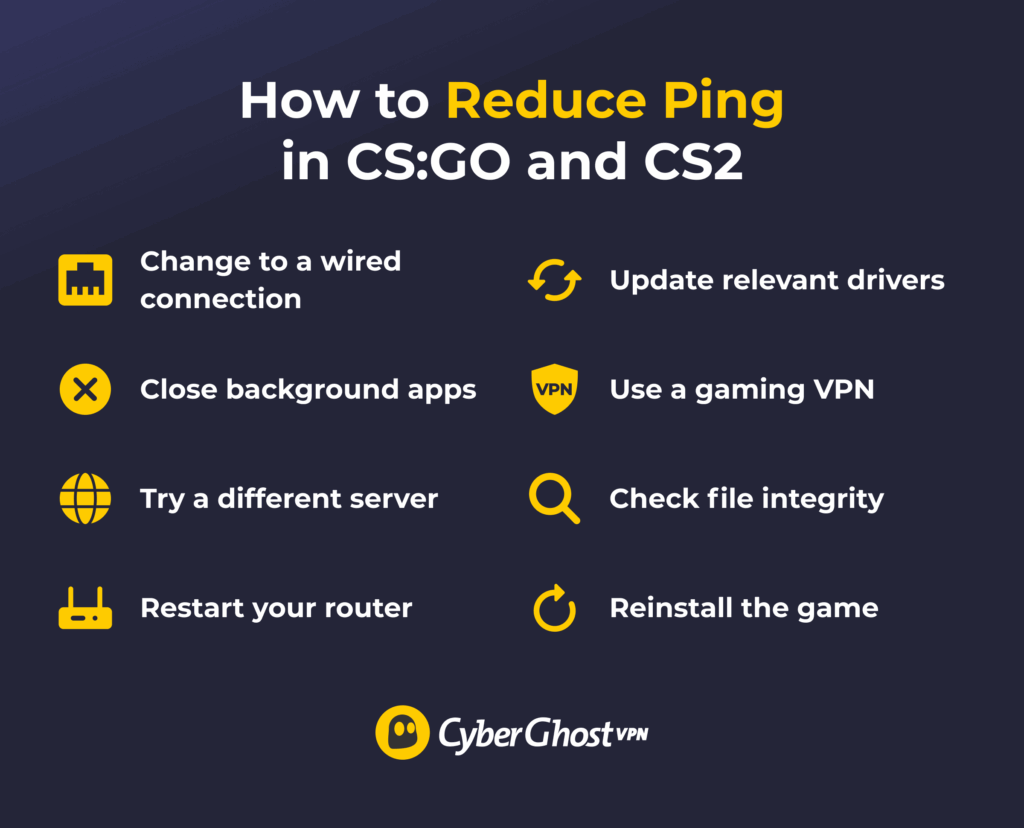
1. Change to a Wired Connection
Instead of relying on a Wi-Fi connection, use an Ethernet cable to connect your device to the router. Walls and other physical barriers between you and the router can significantly impede your Wi-Fi connection, especially on a 5-GHz connection. A cabled connection helps avoid the interference, which should reduce packet loss and improve ping.
2. Close Unnecessary Applications
Other apps running in the background might be using up your bandwidth and making CS:GO or CS2 lag. Open up Task Manager and check what else is running. Pay attention to streaming apps or large downloads, including software updates. Close anything that you don’t need to free up bandwidth and your computer’s processing power.
3. Try a Different Server
A lot of the time, high ping in CS multiplayer is simply because your data is traveling too far to reach the server. Picking servers physically closer to your location helps reduce your latency. Most public server lists display where the server is located, as well as the current number of players. Servers with a lot of players may experience congestion, which can also cause high latency.
4. Restart Your Router
Turning your router off and on again can fix some issues with your router causing high ping. Your router’s cache might be cluttered up and causing a slowdown; restarting clears the cache and forces the router to establish a fresh connection with the ISP’s network. This can help improve the routing between your device and the game server you’re playing on.
5. Update Network Adapter Drivers
Network adapter drivers regulate how your device connects to the internet, so outdated drivers might cause issues like high ping, jitter, or packet loss. The drivers typically update themselves as part of regular Windows updates, but you can still manually update them to be sure they work.
- Press the Windows key + S to open the search bar.
- Start typing “device manager.” It should pop up as the first result.
- Open the Device Manager.
- Scroll through the device list until you find Network Adapters.
- Right-click each driver and click Update driver.
- In the opened window, click Search automatically for drivers.
This process tells you if the driver is up to date and applies the updates if not.
6. Use a Gaming VPN
A gaming VPN routes your traffic through an encrypted tunnel before it reaches the CS:GO community server or Valve’s CS2 server you’re playing on. If high ping is caused by suboptimal ISP routing, setting up this alternative route for your traffic can help. If it’s a result of intentional throttling, the encryption a VPN provides can make it harder for your ISP to target your CS activity specifically.
CyberGhost VPN’s server network covers 120+ locations across the world, so you can choose one close to the CS community server or CS2 server you’re playing on. It also has specialized gaming servers in France, Germany, the UK, and the US, optimized for stable latency and protection against DDoS attacks.
7. Check Game File Integrity
High ping sometimes happens because game files are unexpectedly bugging out, increasing latency or packet loss. Steam has a built-in file integrity checker, which can identify corrupted files and try to fix them. Here’s how you can use it:
- Restart your computer and launch Steam again.
- Find CS:GO or CS2 in your Steam Library.
- Right-click it and go to Properties.
- Go to the Installed Files tab.
- Click Verify integrity of game files.
This process takes a few minutes. After the verification is done, relaunch the game and see if the problem is fixed.
8. Reinstall the Game
If all else fails, a fresh CS install might patch up the problems. Uninstall the game, download it again through Steam, launch it, and see how it goes. But before you do this, make sure to try all the other methods. Lots of factors influence ping, and a combination of approaches could easily fix the issue.
High Ping in CS:GO & CS2 Isn’t the End of the Game
If high ping is making you a sitting duck in CS:GO or CS2, don’t give up. Start with your connection: switch to Ethernet if you can, close bandwidth-heavy apps, restart your router, and try a game server closer to you. You might need to try a few fixes before you find what’s causing the problem.
If your ISP is taking a less-than-ideal route to the game server, CyberGhost VPN may also help. It gives your traffic another route to try, with server locations around the world and gaming-optimized options in France, Germany, the UK, and the US. It won’t magically fix every case of high ping, but if routing is the problem, it’s worth a shot. Plus, you get a 45-day money-back guarantee (14 days on the monthly plan) to see what the hype is all about.
FAQ
How can I perform a CS:GO ping test?
You can check your ping in-game through CS:GO’s developer console. You have to enable the console in the game settings and then run the “net_graph 1” command. It gives you a list of parameters, including your current ping, loss, and choke values, which can help you determine whether you’re dealing with packet loss or a server-side problem.
How can I perform a CS2 ping test?
The upgrade to CS2 got rid of CS:GO’s “net_graph 1” command. However, the game now lets you enable a setting to display ping in just a few clicks. Pause the game (with the Esc key, for example), go to Settings > Game tab > Telemetry section > Show ping and toggle the option on.
How can I lower my ping in CS:GO and CS2?
You can lower your ping in several ways, depending on what’s causing the increase in latency. For problems on your device, you can try closing unnecessary programs and switching to an Ethernet connection instead of Wi-Fi. For problems with the server, you’re likely better off connecting to a closer or less populated server. For problems with the game itself, you can run Steam’s file integrity checker or reinstall the game entirely.
Why do I only have high ping in CS:GO or CS2?
If you’re the only one on your team having high ping, the issue is likely between you and the server — so it’s your device, router, or ISP causing the problem. However, it could also be because you’re physically the furthest from the community server for CS:GO or official server for CS2. Try connecting to a server closer to your location. If the high ping persists, the problem is most likely on your side.
Can CyberGhost VPN lower my ping?
CyberGhost VPN can lower your ping in two specific cases. First, it directs your traffic through a VPN server, which establishes an alternate route to CS:GO or CS2’s servers. This helps if the high ping is caused by your ISP’s suboptimal routing. Second, it encrypts your traffic, which helps if your ISP is intentionally throttling gaming activity.

Leave a comment