
Onion sites are often associated with the Dark Web, which is frequently portrayed as unsafe or illegal. While that perception comes from real risks, it doesn’t reflect the full picture. Onion sites are simply websites that run on the Tor network. They’re designed to provide a privacy boost, which is why they’re used in a range of contexts, from journalism and research to secure communication. At the same time, the lack of oversight on these networks also means there are real risks you need to be aware of.
In this article, we’ll go through how onion sites work, what they’re used for, and what risks you need to keep in mind while browsing.
What Is an Onion Site?
An onion site is a type of website that runs on the Tor network and can’t be accessed through standard browsers. These sites are often described as part of the Dark Web, although that term is commonly misunderstood.
You can usually recognize onion sites by their “.onion” addresses instead of typical domain endings like “.com” or “.org.” These addresses aren’t registered in the traditional way. Instead, they’re generated as part of the site’s cryptographic setup. This system allows the Tor Browser to connect to the site without revealing its actual server location. In simple terms, both the user and the website’s network locations remain hidden, which is what enables the network’s focus on privacy.
How Onion Sites Work
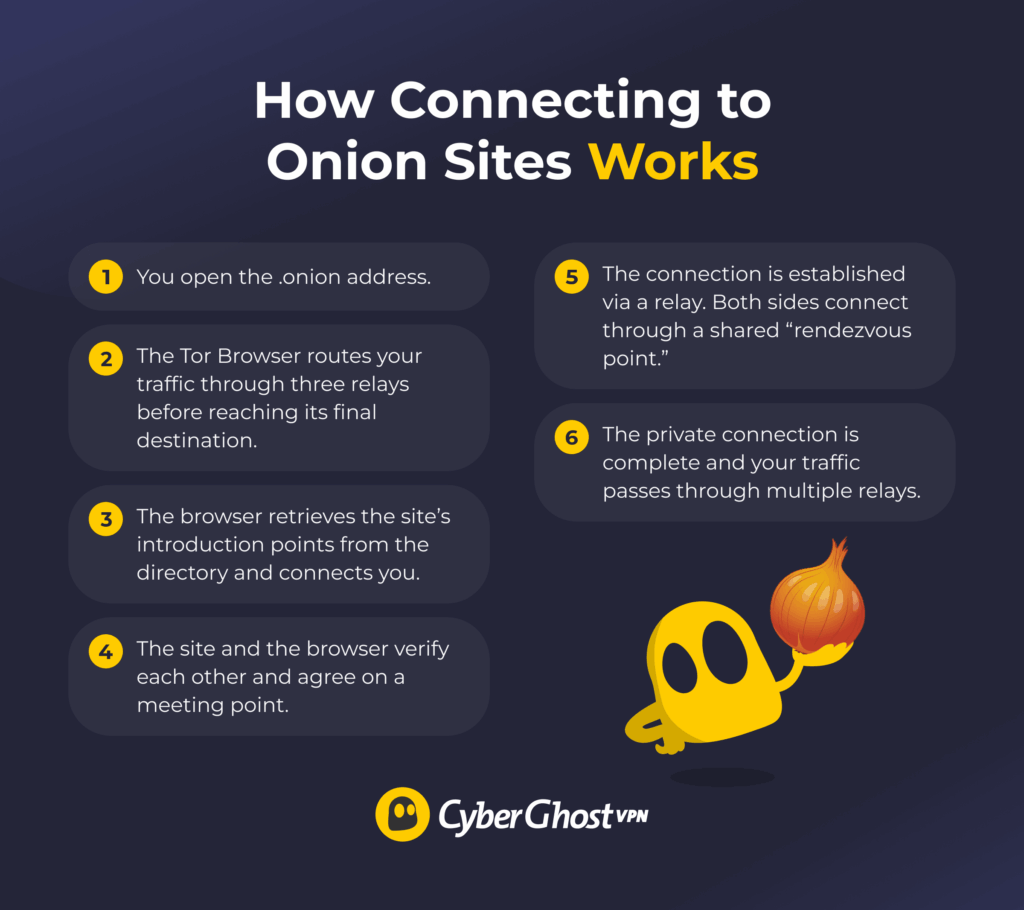
Connecting to an onion site works differently from connecting to a regular website. Instead of sending traffic directly to a server, the Tor Browser encrypts your data multiple times and routes it through three randomly selected computers on the network, known as relays. Every relay removes only one layer of encryption, just enough to know where to send your traffic next. This prevents any single relay from knowing the origin of the traffic and its final destination.
Onion sites use a similar process on their end. Their servers aren’t publicly listed or tied to a visible IP address, so a user can’t look them up using DNS queries. Instead, they rely on special entry points within the Tor network, called introduction points.
When you try to connect, the Tor Browser retrieves these entry points from an encrypted directory. From there, both the browser and the onion site go through a secure process to agree on a shared connection point, known as the rendezvous point. This is where the actual communication happens, without either side revealing its location.
How Onion Sites Are Used
Onion sites are designed to provide a strong privacy boost for both website operators and visitors. Because of this, they’re used in a variety of contexts, some of which focus on privacy and secure communications.
Some online services offer .onion versions of their websites to give users an additional layer of security. For example, major news outlets offer onion sites where whistleblowers can submit documents without revealing their personal details.
Some onion sites are also used to host private forums and communities. These spaces allow users to communicate without sharing their identities or locations. Depending on the context, this can include activists, researchers, or individuals discussing sensitive topics who prefer a higher level of privacy.
Risks of Onion Sites
- Scams: Fake marketplaces and vendors can simply take cryptocurrency payments and never deliver the goods. Phishing sites can also mimic legitimate services.
- Malware: Files on onion sites may contain malicious software, including viruses, ransomware, keyloggers, or spyware designed to compromise a device or identity.
- Illegal or disturbing content: The unregulated nature of onion sites means they can be used to host illegal or harmful content.
- Compromised relays: Bad actors can run Tor relays and observe limited traffic metadata. While breaking Tor’s privacy system would require large-scale analysis and is difficult in practice, it remains a theoretical risk.
How to Stay Safe on Onion Sites
- Use the Tor Browser, as it’s specifically configured for more secure access to onion sites.
- Regularly update the Tor Browser, your antivirus, and your operating system’s security.
- Double-check .onion addresses before connecting. Onion URLs aren’t easy to verify, and small mistakes can lead to completely different or unsafe sites.
- Limit the personal information you share. Tor is designed for extra privacy, but revealing personal details can still expose your identity.
- Be cautious with downloads. Files from unknown sources may contain malicious code.
- Understand the limits of privacy tools. Technologies like Tor are designed to improve security, but they don’t eliminate risk or guarantee safe activity. Some users choose to combine Tor with a VPN for additional privacy, but this doesn’t replace safe browsing habits or protect against malicious content.
Staying Safe While Exploring Onion Sites
Onion sites aren’t inherently dangerous, but they do require a different level of awareness than the regular web. The same features that enable privacy also reduce oversight, which means it’s easier to run into scams, malicious content, or unreliable services. Sticking to well-known resources, avoiding downloads, and being mindful of what you click goes a long way.
For added privacy, some users choose to combine Tor with a VPN. A service like CyberGhost VPN can help protect your connection to the Tor network by adding another layer of encryption before your traffic enters it. Just keep in mind that no tool replaces safe browsing habits, especially in environments where content isn’t moderated.
FAQ
Is accessing Tor illegal?
No, using the Tor Browser itself is legal in most countries. It’s a privacy tool used by journalists, activists, and everyday users to help protect their online activity. However, what you do while using Tor can be illegal, just as with a regular browser. Always review local laws before connecting to an onion site.
Is accessing the Dark Web illegal?
Accessing the Dark Web isn’t illegal on its own in most countries. It’s a part of the internet that requires specialized software to access, such as the Tor Browser. Many onion sites on the Dark Web are used for completely legal purposes, like forums for tech enthusiasts.
What is the best Dark Web search engine?
It’s hard to determine what the best Dark Web search engine is, as there are a lot of different search engines that specialize in indexing onion sites. Different services index different parts of the network, and coverage can vary. Some search engines aim to filter out harmful or illegal content, while others take a broader approach. Some of the safest and most reliable options are DuckDuckGo and Ahmia, as they don’t typically list illegal onion sites.
How do I know if I am on the Dark Web?
You’re on the Dark Web if you’re using the Tor Browser to visit onion sites. They’re easily recognizable because their URL addresses end in “.onion” instead of “.com” or other top-level domain names. If you’re using the Tor Browser to visit regular websites, you’re using Tor’s anonymized connection, but you’re not on the Dark Web.
How dangerous is it to click on random onion links?
Clicking on random onion links can be very dangerous because onion sites aren’t a regulated environment. The risks can include malware infecting your device through malicious files or seeing disturbing and illegal content.
Can I access the Dark Web on mobile?
It’s possible to access onion sites on mobile devices, but it comes with some additional risks. Mobile operating systems often enable more background data sharing, app tracking, and system-level integrations than desktops, which can reduce overall privacy. While you could use a dedicated mobile browser, they don’t always offer the same level of control or transparency as desktop setups. For that reason, accessing the Dark Web on mobile is generally less predictable from a privacy standpoint, so approach it with caution.
Can I use a free VPN to access the Dark Web?
We don’t recommend it. A VPN alone won’t enable you to go on the Dark Web; you still need the Tor Browser. Free VPNs may also introduce limitations such as slower speeds or unclear privacy practices, which can affect performance and reduce overall privacy. Using Tor to access onion sites can already be quite slow because of the multiple encryption layers used. A slowdown from a VPN on top of that can make the connection too slow to use at all.

Leave a comment
Blossom eEalaji
Posted on 03/09/2022 at 13:44
Wow, so tiring to use the dark web without being exposed, but why do we need to log out of all our social media accounts before we continue
Ghostie
Posted on 22/09/2022 at 14:46
Hey Blossom eEalaji,
Navigating through the dark web is risky, and it’s best to err on the side of caution. We recommend you close all other applications, especially those that you have accounts for, when surfing the dark web. It’ll keep you safe from accidentally exposing your identity and other vulnerabilities. Remember, your safety and privacy are worth taking extra precautions for.
JAN
Posted on 16/05/2022 at 01:28
Why on earth would you use a vpn to connect to Tor? lol..
Do you understand how Tor works?
Ghostie
Posted on 18/05/2022 at 09:35
Hi Jan! That’s a great question. Some people and jurisdictions don’t like Tor and they specifically monitor anything that looks like Tor traffic.
If you wanted to hide the fact that you’re using Tor, you can do so by connecting to a VPN. We also discuss more reasons why you should use a VPN when connecting to Tor in the Tor Won’t Keep you Safe on Onion Sites section.
Thank you & stay safe.