
Spam calls and random scam texts are frustrating enough. But in some cases, an exposed phone number can also create privacy and security concerns that aren’t immediately obvious.
After getting strange calls, scam texts, or unexpected verification codes, many people start wondering, “What can people do with my phone number?” In this guide, you’ll learn why phone numbers are valuable, what risks to watch for, and how to better protect your privacy.
What Can Hackers Do With Your Phone Number?
Hackers can sometimes use an exposed phone number as part of larger privacy, security, or account-related scams. While a phone number alone is rarely enough to compromise an account, it can provide useful information for scammers looking to build a broader profile of a target.
Spam Calls and Scam Messages
One of the most common ways criminals misuse phone numbers is through spam calls and messages. Once a number gets exposed, it can quickly end up on robocall and spam databases shared between scammers and advertisers.
Scammers typically pretend to be banks, delivery companies, streaming services, or government agencies. Their goal is to pressure you into sending money, sharing verification codes, or calling fake support numbers before you have time to think twice. Common scam messages may say things like “Your account has been locked” or “Package delivery failed.”
These scams are becoming more convincing and more expensive for victims. According to 2025 data from the Federal Trade Commission (FTC), consumers reported more than 1 million imposter scams, with reported losses rising to $3.5 billion1.
Phishing Attacks
Phone numbers are also used in phishing attacks designed to steal sensitive information like passwords, banking details, login credentials, or security codes. Scammers use phone numbers to send fake links that lead to convincing websites built to capture personal data.
At first glance, these messages can look completely normal. You might get a text asking you to verify your account, reset a password, confirm a payment, or log in to fix a problem urgently. One tap on the wrong link could hand over your login details or even give attackers access to your accounts.
Phishing attacks continue to be a major cybersecurity threat. The Federal Bureau of Investigation (FBI) reported that cybercriminals stole more than $359 million through account takeover fraud in 2025. According to the FBI, scammers commonly use phishing emails, fraudulent text messages, spoofed websites, and social engineering tactics to trick victims into revealing login credentials and verification codes2.
Identity Theft
An exposed phone number might give scammers another piece of the puzzle needed for identity theft. Many websites, apps, banks, and online services use phone numbers for password resets, login alerts, account recovery, and two-factor authentication. If scammers can connect your number to other publicly available or leaked information, they may be able to build a more detailed profile for fraud or impersonation attempts.
Scammers often combine phone numbers with information collected from phishing scams, data breaches, public records, and data broker websites. It’s a bit like digital detective work, except the goal is stealing identities instead of solving crimes. They may use that information to pretend to be you during customer support calls, bypass identity checks, target financial accounts, or attempt account takeovers.
These scams are also becoming more common. According to the FTC, consumers submitted 3 million fraud reports in 2025 and reported $15.9 billion in losses, more than $3 billion higher than the previous year3.
SIM Swapping
SIM swapping is a scam where criminals try to transfer your phone number to a SIM card they control. This could happen after scammers successfully collect personal information. They will impersonate you when contacting your mobile carrier and ask for a SIM replacement or number transfer.
Once the number gets transferred, you might lose service, stop receiving calls and texts, or notice your phone showing “No Signal” out of nowhere. Meanwhile, scammers may start receiving your password reset links, security alerts, and verification codes tied to banking apps, email accounts, social media profiles, and other online services.
In many cases, criminals use SIM swaps to bypass SMS-based verification and attempt account takeovers before the victim even realizes what happened.
Account Takeovers
Phone numbers can sometimes link to important online accounts, including email services, banking apps, shopping platforms, and messaging apps. Once criminals get access to a phone number, they may try to use it during password reset requests, phishing scams, or social engineering attacks designed to gain access to those accounts.
They often target accounts that rely on SMS-based verification or password recovery linked to a phone number. You might receive fake login alerts, suspicious verification requests, or messages asking you to confirm account activity you never initiated. Some attackers even combine phishing scams with SIM swapping attempts to intercept security codes and break into accounts more easily.
A phone number usually isn’t enough to access an account, but it can become a starting point for larger scams and account takeover attempts.
Harassment, Stalking, and Doxing
A publicly exposed phone number can sometimes lead to unwanted contact, harassment, or other privacy-related issues. Scammers, stalkers, or online trolls may use it to send repeated calls, spam texts, abusive messages, or unwanted content designed to pressure or disturb the victim over time.
In some cases, people also use phone numbers to search for additional personal information online, including social media profiles, workplaces, addresses, or family connections. That information may then get shared through doxing campaigns meant to embarrass, threaten, or target someone online and offline.
How Criminals Collect Phone Numbers
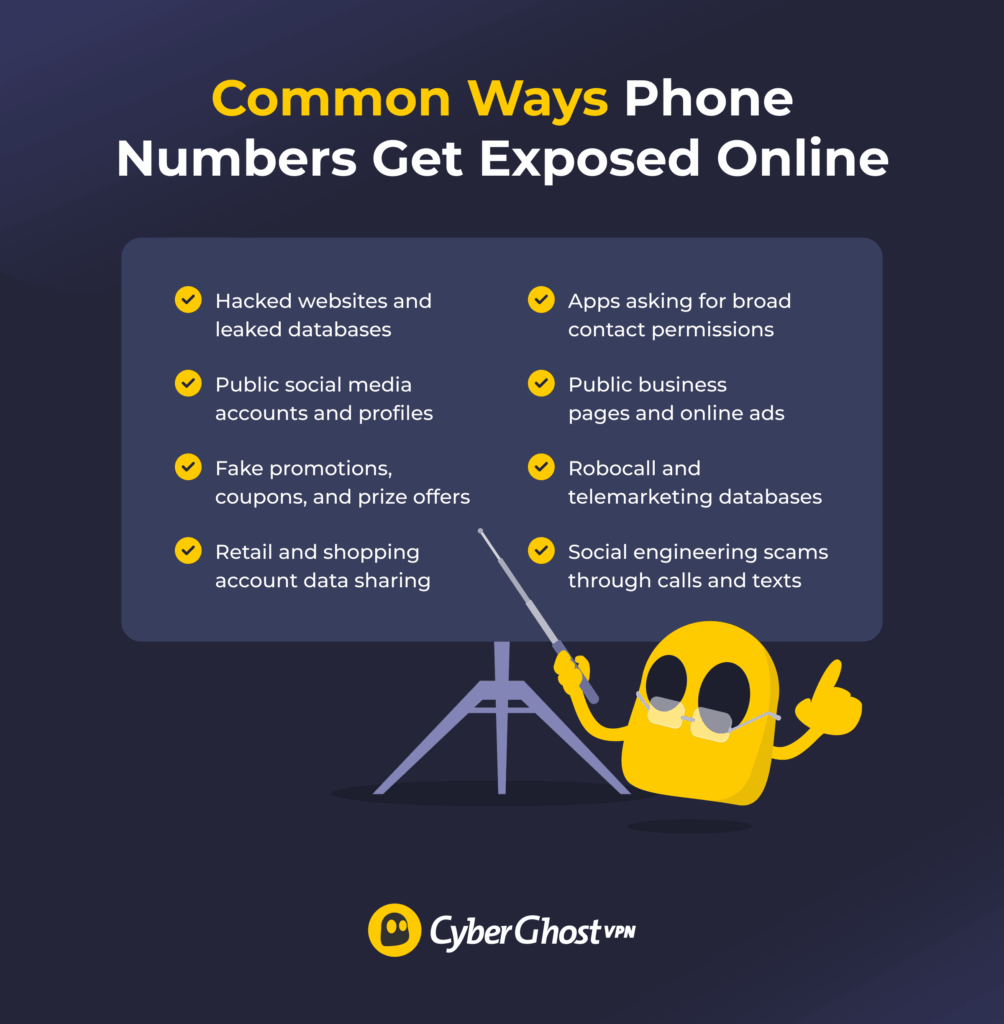
Phone numbers can end up in the wrong hands in a variety of ways, and many of them don’t involve sophisticated techniques. In most cases, they simply wait for people to share them online, reuse them across multiple accounts, or enter them into websites.
- Compromised websites and apps: A single data breach can expose phone numbers alongside emails, passwords, and usernames.
- Open social media accounts: Public profiles can reveal contact information without people realizing it.
- Fake sign-up pages and offers: Scam websites can collect phone numbers through subscriptions, coupons, or giveaways.
- Online shopping accounts: Some services share customer data with marketing companies and advertisers.
- Apps requesting broad access: Certain apps ask for contact lists or device permissions unrelated to their actual features.
- Public business pages and ads: Visible contact details can end up on spam and robocall lists.
- Scam and robocall databases: Once a number appears active, it may get passed around between different spam campaigns.
- Social engineering scams: Criminals use fake pretenses to convince people to reveal even more information.
Warning Signs Your Phone Number Is Being Misused
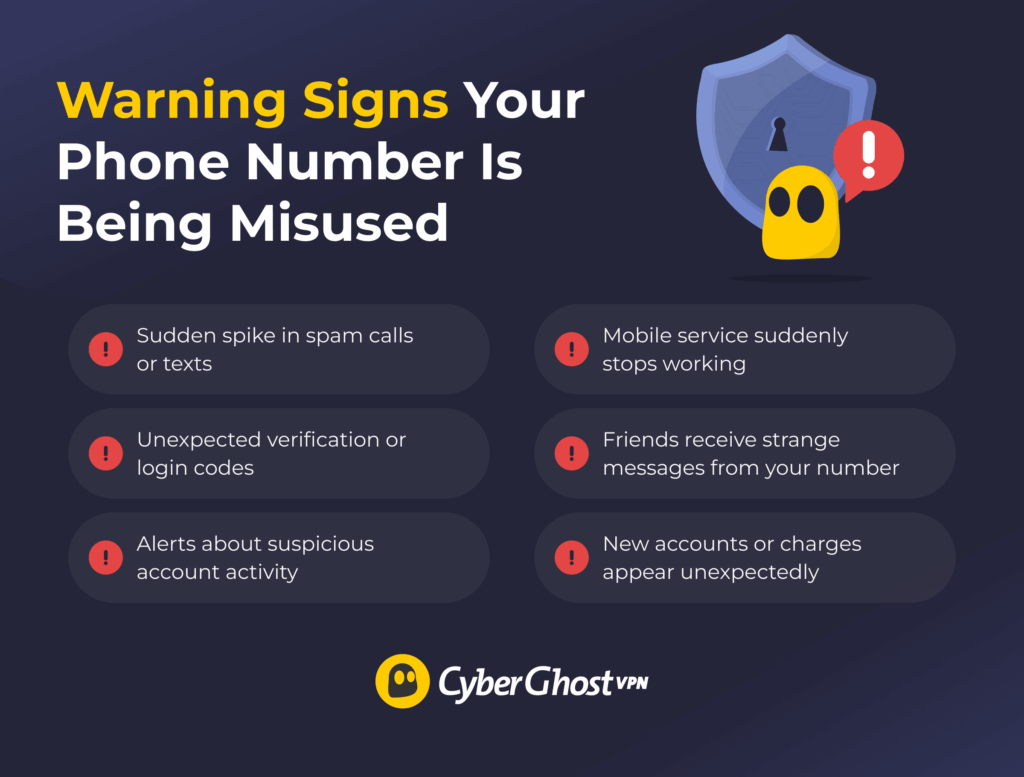
Not every misuse of a phone number is immediately obvious. Sometimes the first signs are small changes, such as unexpected verification codes, unusual login alerts, or an increase in spam calls. Knowing the early warning signs can make it easier to react quickly before the situation becomes more serious.
- Sudden increase in spam calls or texts: Can be a sign that someone exposed the number online or added it to robocall and spam databases.
- Unexpected verification codes: May indicate that someone is attempting password resets or account logins.
- Alerts about suspicious logins: Often point to possible account takeover attempts using stolen or leaked information.
- Mobile service suddenly stops working: Could signal a SIM-swapping attack targeting the phone number.
- Friends or family receive strange messages: May suggest that scammers are impersonating the victim through spoofed numbers or fake accounts.
- New accounts or charges appear unexpectedly: Might reveal possible fraud, identity theft, or misuse of exposed personal information.
What To Do If Someone Misuses Your Phone Number
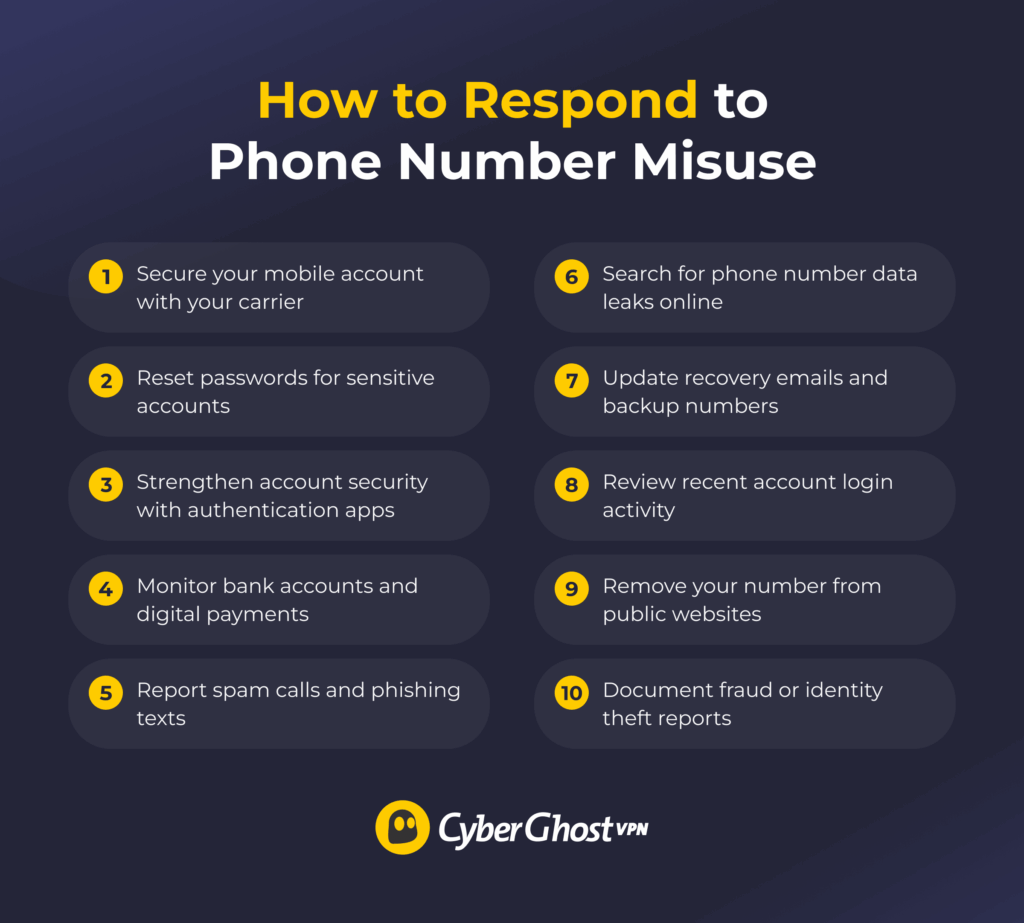
Acting early can help limit further misuse, reduce security risks, and make it harder for scammers to access sensitive data. Even small steps can make a big difference when dealing with suspicious activity linked to a phone number.
- Contact your mobile carrier immediately: Helps secure the number and check for unauthorized SIM swaps or account changes.
- Change passwords on important accounts: Reduces the risk of unauthorized access to connected services and apps.
- Enable stronger two-factor authentication: Adds extra security through authentication apps instead of SMS verification.
- Review banking and payment activity: Checks frequently to identify suspicious charges, transfers, or unauthorized account activity.
- Block and report scam numbers: Limits repeated spam calls, phishing texts, and scam attempts.
- Check for data breach exposure: Confirms whether the phone number appeared in leaked databases online.
- Update account recovery information: Strengthens access to accounts connected to the phone number.
- Watch for suspicious login alerts: Detects possible account takeover attempts or unusual device activity early.
- Remove the number from public platforms: Reduces future exposure on social media profiles, listings, and public posts.
- Report identity theft if necessary: Helps document fraud and limit further misuse of personal information.
How To Protect Your Phone Number Online
Most phone number scams start with exposed personal information online. Limiting who can access your number and staying cautious with suspicious activity can help reduce many common privacy and security risks.
- Avoid sharing your number: Keep it off public social media profiles, forums, and online marketplaces.
- Use separate numbers when possible: Keep contact numbers for work, shopping, and personal accounts more separated.
- Limit profile visibility: Restrict who can view your number on apps and platforms.
- Ignore suspicious calls and texts: Avoid replying to unknown numbers or clicking on strange links.
- Never share verification codes: Keep login and security codes private at all times.
- Use authentication apps instead of SMS: Reduce risks linked to text-based verification systems.
- Watch for unusual account activity: Monitor login alerts, password resets, and service interruptions.
- Manage unwanted and malicious callers: Filter or completely block spam numbers to limit potential phone scams and phishing attempts.
- Be careful with online forms and giveaways: Limit exposure to advertisers, scammers, and data brokers.
- Check for data breaches: Find out whether your number appeared in leaked databases.
- Keep apps and devices updated: Fix security weaknesses that criminals may target.
- Use extra privacy tools on public Wi-Fi: Reduce exposure to tracking and network snooping.
CyberGhost VPN adds an extra layer of privacy when browsing, shopping, banking, or using public Wi-Fi networks. It encrypts your connection and helps reduce online tracking that can expose personal information across websites and apps. Features like automatic Wi-Fi protection and Smart Rules can also help boost your protection on unsecured networks. If you want to check if it’s the right fit, CyberGhost VPN comes with a generous 45-day money-back guarantee (14 days for monthly users).
Take Control of Your Phone Number Privacy
A phone number might seem like a small detail, but it’s connected to many of the accounts and services you use every day. Spam calls, phishing texts, account takeover attempts, and privacy risks can start with exposed data online. The good news is that a few smart habits can help reduce those risks and make your accounts harder to target.
FAQ
Can someone hack my accounts with just my phone number?
In most cases, a phone number alone isn’t enough for someone to hack an account, but it can be used in scams and targeted attacks. Criminals may use your number for phishing texts, social engineering, SIM swapping attempts, or password reset requests to try to access accounts linked to that number. In most cases, the risk is higher when accounts rely on SMS-based verification or weak passwords.
Is it dangerous to share my phone number online?
Yes, sharing your phone number online can increase privacy and security risks, especially on websites, social media profiles, forums, or online marketplaces. Scammers may use exposed numbers for spam calls, phishing texts, SIM swapping attempts, or social engineering scams. In some cases, a public phone number can also make it easier to connect other personal information to your online accounts.
Can someone find my address from my phone number?
Sometimes, but it depends on how much information is available to the public. A phone number can link to public records, social media profiles, data broker websites, or leaked databases that contain additional personal information, including an address. The risk can be higher if the number is shared online or exposed in a data breach.
What is SIM swapping and why is it risky?
SIM swapping is a type of scam where criminals trick a mobile carrier into transferring a phone number to a SIM card they control. Once they gain access to the number, they may intercept calls and text messages, including security codes used for account logins and password resets. This can increase the risk of account takeovers, identity theft, and financial fraud, especially for accounts that rely on SMS-based verification.
How can I protect my phone number from misuse?
To help reduce misuse, avoid sharing your phone number on social media, forums, or online listings whenever possible. Use strong passwords, enable two-factor authentication with an authentication app instead of SMS when available, and never share verification codes through calls or texts. It also helps to watch for suspicious messages, scam calls, and unexpected login alerts linked to your accounts.
Can someone steal money using a phone number?
Not with a phone number alone, but someone could potentially use it as part of a larger scam. Criminals may use a phone number in phishing scams, SIM swapping attacks, or social engineering attempts to try to access banking apps, payment accounts, or verification codes.
References:

Leave a comment