
Amazon Alexa can answer questions, play music, control your smart home gadgets, order groceries, and more. You simply say its wake word, then say your command. But have you ever wondered how Alexa hears the wake word and the command? Does this mean Alexa is always listening?
While accidental wake word activations and Amazon’s past privacy controversies have raised questions, Alexa doesn’t actively record everything you say and do. Echo does passively listen for its wake word so it can respond when you need it, but most of what it hears never leaves the device. However, like other Amazon services, it collects data about you.
In this article, we explain how Alexa works, what data it collects, and the privacy risks you should consider. We’ll also outline the steps you can take to improve your privacy while using Alexa and exert more control over the data it collects.
What Is Amazon Alexa?
Alexa is Amazon’s cloud-based virtual assistant technology. It hears your spoken commands, processes them, and then responds or performs the commanded actions.
Alexa supports a wide range of hardware, including Amazon’s own Echo speakers, Fire TVs, and other smart devices in the Echo series, such as the Echo Dot or Echo Show. Some third-party manufacturers also build Alexa into their products, including smart home systems, computers, smartphones, and smart cars.
The physical device in your home has limited processing power; the actual Alexa service resides in Amazon’s cloud servers. The device waits to hear a specific trigger phrase (called a “wake word”). The wake word is usually “Alexa,” though you can change it to “Amazon,” “Echo,” “Computer,” or “Ziggy.”
How Echo Devices and Alexa Work
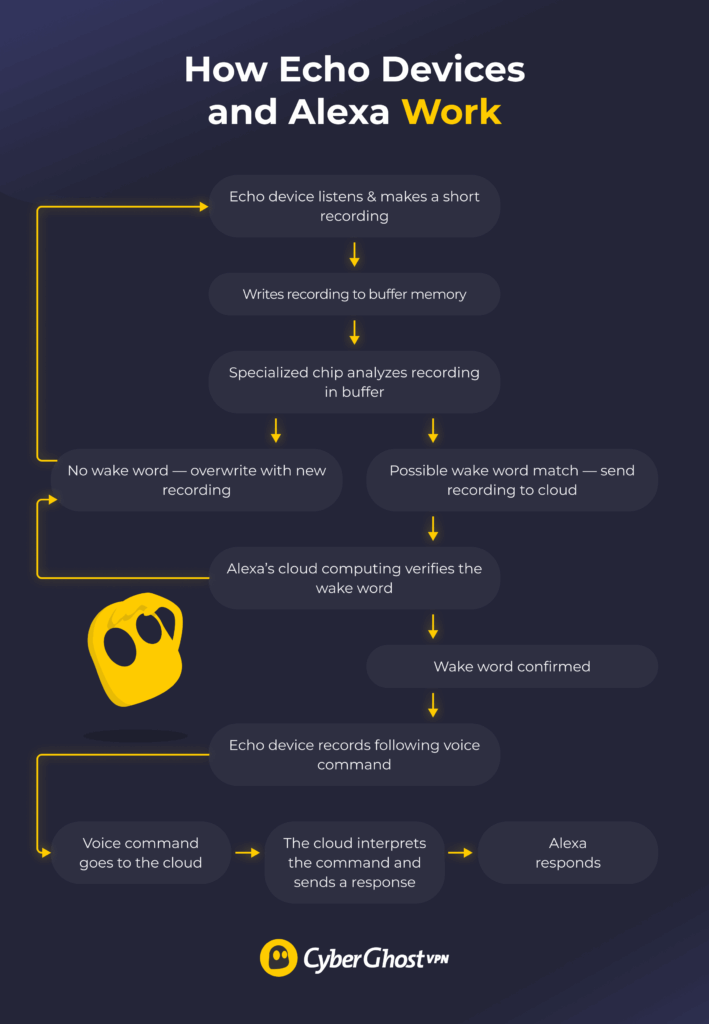
Echo devices aren’t always recording, but they’re always listening. Like most virtual assistant technology, they continuously monitor their surroundings. The device makes very short recordings at regular intervals and writes them into its buffer memory.
A specialized chip in the device analyzes each short recording, searching for acoustic patterns that match the chosen wake word. Amazon calls this process “keyword spotting.” If the chip doesn’t detect a wake word, the next short recording overwrites the current one, so it doesn’t leave the Echo device.
Once it recognizes a possible match, it sends that particular audio clip to Alexa’s cloud servers. The cloud has more sophisticated speech-recognition models to verify the wake word and reduce false-positive triggers. After confirmation, the device starts recording the following voice commands and sends them to the cloud.
Alexa’s cloud servers then process the voice command recording. They analyze the text, make a transcription you can read, and interpret the command before executing it. The cloud servers then send an adequate voice response through your Alexa-enabled device.
Privacy Concerns Surrounding Alexa
Online alarmists claiming Alexa is spying on you all the time may not be right, but some privacy concerns regarding how Alexa handles data are worth looking into.
Amazon Collects Data Through Alexa
Amazon collects voice recordings and makes transcripts of every Alexa interaction. Alexa’s Terms of Use are transparent about retaining this information to improve its services.1 This means Amazon can use the collected information to personalize the advertising you see on Amazon platforms. Amazon may also share data with third-party Skills developers.
On one hand, this practice is similar to Amazon tracking your online activity and purchase history to get a better “feel” of what you’re interested in. However, you could divulge a lot of in-depth personal details through your interactions with Alexa. Depending on the way you use Alexa, it could collect information about your daily habits, social activity, or specific preferences about food and music.
Third-Party Skills Collecting More Data
Alexa lets you customize how it works by using add-ons called Skills, which non-Amazon providers can develop. Depending on what Skills you use with your Alexa-enabled device, these third-party providers might collect information similar to what Amazon collects via Alexa. This can include your location data, contact information, and text transcripts of your voice recordings.
Misheard Wake Words Trigger Recordings
Alexa is set up to start recording only when it detects a wake word, but the detection system isn’t perfect. It can sometimes be triggered by similar-sounding words like “election,” “Lexus,” or “Alexis.” It could also start recording after hearing a wake word in a recording like a TV show or YouTube video that you’re playing. This means that Alexa could record completely unrelated conversations and then send the recording to Amazon’s cloud.
Humans Can Listen to Your Recordings
While most recordings are sent to the cloud and analyzed by Alexa’s AI, Amazon uses human reviewers to check and transcribe selected recordings. These transcribers listen to anonymized snippets to verify that the AI correctly parsed and understood the speech. This helps Amazon fix transcription errors and improve accuracy in regard to accents, background noise, or ambiguous commands.
Alexa’s Legal History
At least one legal case raised concerns about Amazon’s data retention practices regarding Alexa. In 2023, the US Department of Justice (DOJ) and Federal Trade Commission (FTC) filed a complaint claiming that Amazon retains sensitive data for extended periods of time, including voice transcriptions and geolocation data2.
The complaint also states that Amazon failed to honor parents’ requests to delete their children’s Alexa-related data, as well as that it misused this data to train its algorithms. The DOJ and FTC find this to be in violation of the Children’s Online Privacy Protection Act (COPPA).
Can You Stop Alexa From Listening?
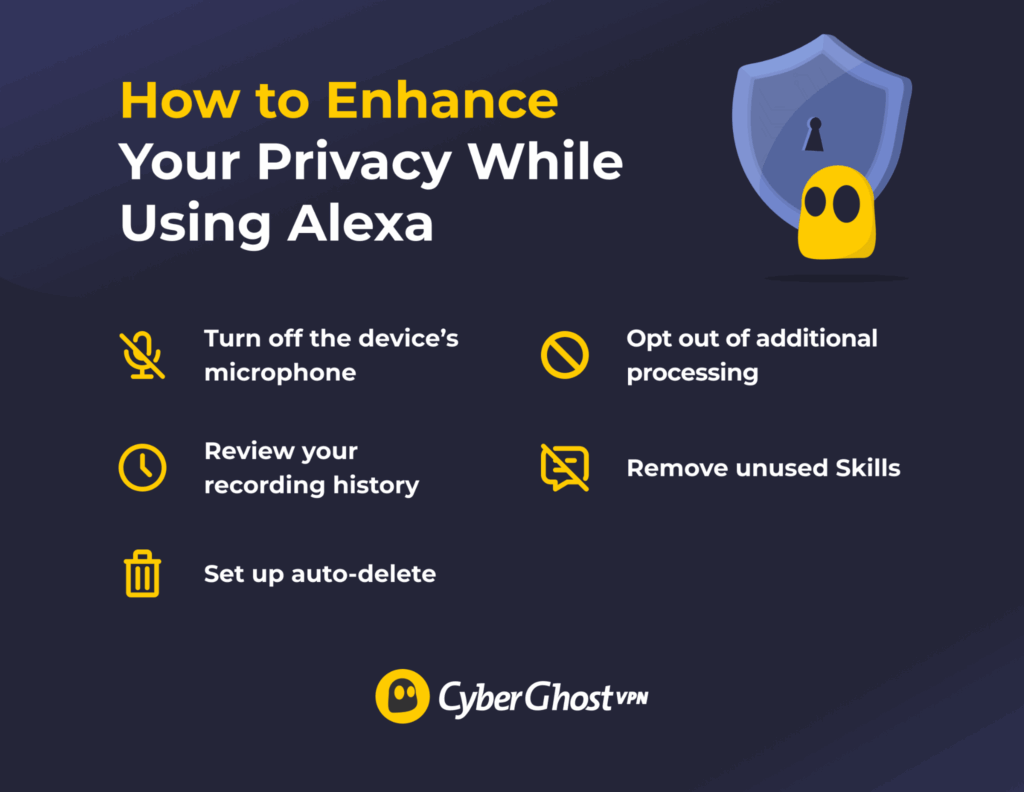
Sadly, you can’t just toggle a setting to make Alexa devices listen only when prompted; they have to keep waiting for the wake word. However, you can take certain precautions to reduce how much data Alexa stores:
- Mute the microphone: Press the “microphone off” button on the Echo device to stop it from listening until turned back on. This ensures that your device doesn’t listen unless you allow it to, but it becomes less convenient to use.
- Delete your recording history: Go to Alexa Privacy in the Alexa app or to the Alexa Privacy Settings web page. Check the saved records and delete whichever ones you want. You can also set it to automatically delete records older than 3 or 18 months.3
- Opt out of additional processing: Go to the same Privacy menu as above. Find a toggle labeled something like “Use of Voice Recordings to Improve Amazon” and turn it off. This should prevent your recordings from being sent to human reviewers.
- Disable unused Skills: Turn off Skills you don’t need to reduce how much data goes to third-party developers.
Should You Worry About Alexa Spying on You?
Alexa is a voice-controlled assistant that operates on a clear and unavoidable condition: it must listen in order to respond. Alexa-enabled devices listen all the time, but most of what they hear is confined to the device and quickly deleted. This brings about very real privacy concerns, but they’re largely predictable and well-documented.
The main concerns include Amazon collecting more data than intended through accidental triggers. The company also has documented failures to comply with certain regulations and clearly communicate its data retention practices. Whether this constitutes spying or not is debatable, but the more important question is how willing you are to accept the trade-offs between convenience and data collection.
FAQ
Is Alexa safe to use at home?
Yes, but with some considerations. Alexa is a cloud-based virtual assistant that can execute a large variety of voice commands. However, it has some trade-offs, such as accidental recordings, data retention, and possible human access to transcripts. These risks are well-documented, and you can reduce them to some extent. The final decision depends on your personal level of comfort with data collection.
Does Alexa always listen to conversations?
Yes, but only locally. An Alexa-enabled device like Echo continuously monitors for the wake word using on-device storage. It doesn’t normally transmit audio to Amazon’s servers unless it detects the wake word. Once Amazon’s cloud verifies the wake word, it begins recording and processing the command.
Can Alexa record me without my knowledge?
Sometimes. Echo and its related devices have a ring-shaped light indicator that visibly turns on whenever the device is actively recording and sending audio to Amazon’s cloud servers. However, a device could mishear a wake word and start recording while you’re not paying attention to it. You can review all Alexa recordings in its associated app.
How do I delete Alexa voice recordings?
You can do this through the Alexa app or the Alexa Privacy Settings web page. From there, you can delete individual recordings or clear your entire history. You can also enable automatic deletion for any recording older than 3 or 18 months.
Can I stop Alexa from listening?
Muting a device’s microphone is the only surefire way to stop Alexa from listening. Press the physical mic button on the device. The light indicator then turns red, and the device stops listening until you switch the microphone back on again.

Leave a comment