
You can change your location in Pokémon GO, but changing your IP address isn’t enough. Pokémon GO uses your device’s location services to position your trainer, so a VPN can’t move you to another location in the game.
If Pokémon GO is showing the wrong location, you can usually troubleshoot the problem by checking your GPS signal, location permissions, and accuracy settings. Making your trainer appear somewhere else requires GPS spoofing, which violates Niantic’s rules and can put your account at risk.
This guide explains how Pokémon GO determines your location, how to fix an inaccurate one, and what you need to know about GPS spoofing, cooldowns, and account warnings.
How to Change Location in Pokémon GO: Quick Answer
How you change your location in Pokémon GO depends on what you’re trying to change. If the game is showing your real location incorrectly, check your phone’s location permissions, GPS accuracy, signal, and app settings. If you want your trainer to appear somewhere you aren’t physically located, you’d need to falsify the device-location data Pokémon GO uses.
Here’s a quick overview of your options:
| What You Want to Do | What Changes It |
| Correct a trainer shown in the wrong place | Phone location permissions, GPS accuracy, signal, and app settings |
| Move your trainer by traveling | Your phone’s real device location |
| Make your trainer appear in another city or country | A tool that falsifies device-location data |
| Change the IP address and its associated location | CyberGhost VPN, but this won’t move your trainer |
| Change your app store region | App store settings, but this won’t move your trainer |
Falsifying your device’s location violates Niantic’s player guidelines and can lead to gameplay restrictions, suspension, or account termination.
How to Fix Pokémon GO Location Problems Without Spoofing
If Pokémon GO places your trainer in the wrong spot, try these device-level checks first.
On Android
- Open Settings > Location and turn location access on.
- Open Settings > Apps > Pokémon GO > Permissions > Location.
- Turn on Precise Location where your device offers it.
- Enable Improve Location Accuracy. The exact path varies by device.
- Close Pokémon GO fully, then open it again.
- Move outdoors or away from tall buildings if the trainer is drifting.
- Switch between Wi-Fi and mobile data to see whether the location becomes more accurate.
- Update Pokémon GO and restart your phone.
- Test the location in a trusted map app. If that app shows the wrong place too, the problem is likely with the device or its location settings.
- If you see Failed to detect location, open Settings > System > Developer options and make sure you didn’t select a mock-location app.
On iPhone
- Open Settings > Privacy & Security > Location Services.
- Make sure Location Services is on.
- Select Pokémon GO and permit location access while using the app.
- Turn on Precise Location.
- Turn off Low Power Mode and test the game.
- Close and reopen Pokémon GO.
- Test the position in Apple Maps.
- Update Pokémon GO and restart your iPhone.
If your trainer is still in the wrong place after these checks, make sure your phone meets Pokémon GO’s current device requirements. You can then contact Pokémon GO support through Main Menu > Settings > Help to report a persistent location problem.
How to Access More Pokémon GO Content Without Changing Your GPS
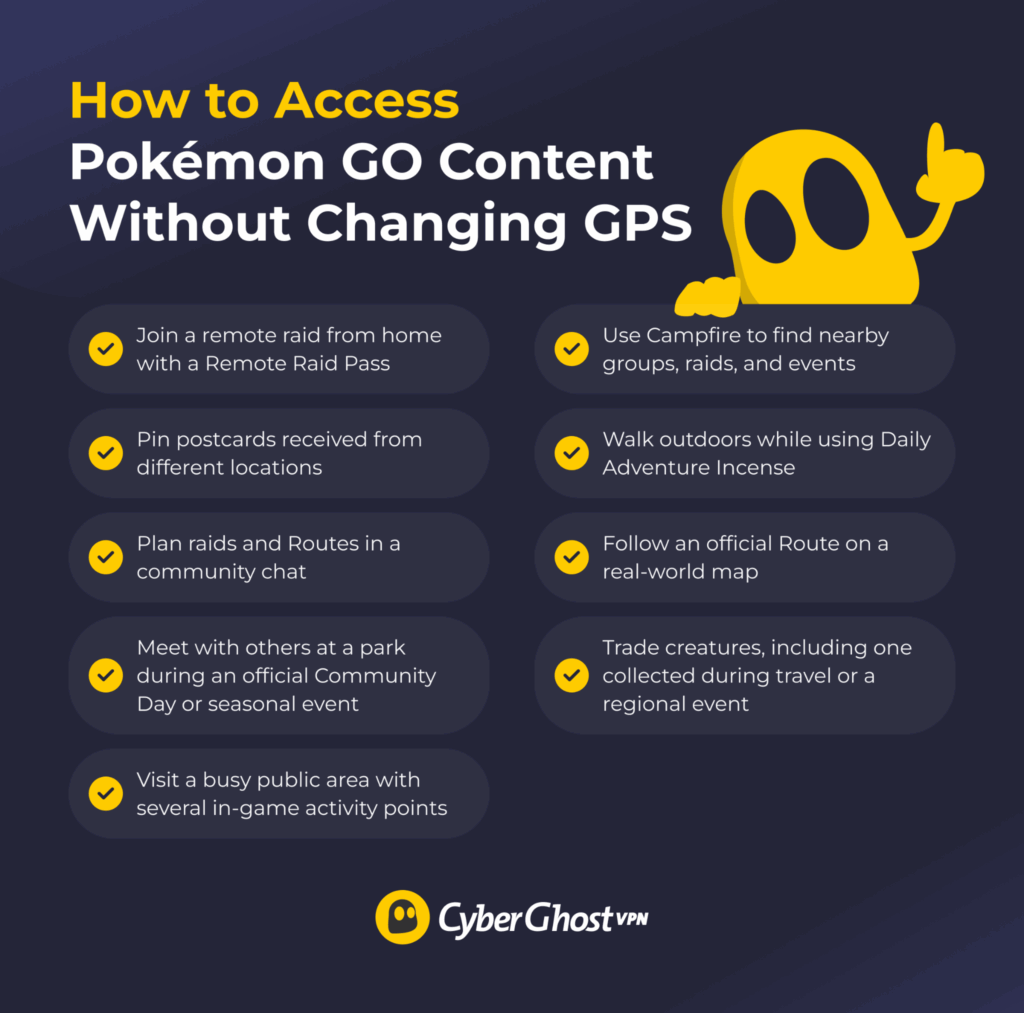
You don’t always need to change your location to access more Pokémon GO content. If your area has fewer PokéStops, raids, spawns, or active players, you can use built-in features and local communities to expand what you can do.
- Join raids remotely: Use Remote Raid Passes (where available) to take part in supported raids from a distance.
- Find nearby activity: Rely on Pokémon GO Campfire and local community groups to discover raids, Routes, events, and other players in your area.
- Make the most of official events: Check Community Days, seasonal events, and other events to bring additional activity and opportunities to your area.
- Explore while you play: Visit public parks, shopping areas, and other busy locations, use Daily Adventure Incense while walking, and check official Routes nearby.
- Collect Pokémon from other regions: Trade with friends who have traveled or attended regional events, and pin postcards from different places to work toward Vivillon patterns.
When using social features, avoid sharing postcards, screenshots, or group posts that reveal your home, school, workplace, or daily routine.
What Determines Your Pokémon GO Location?
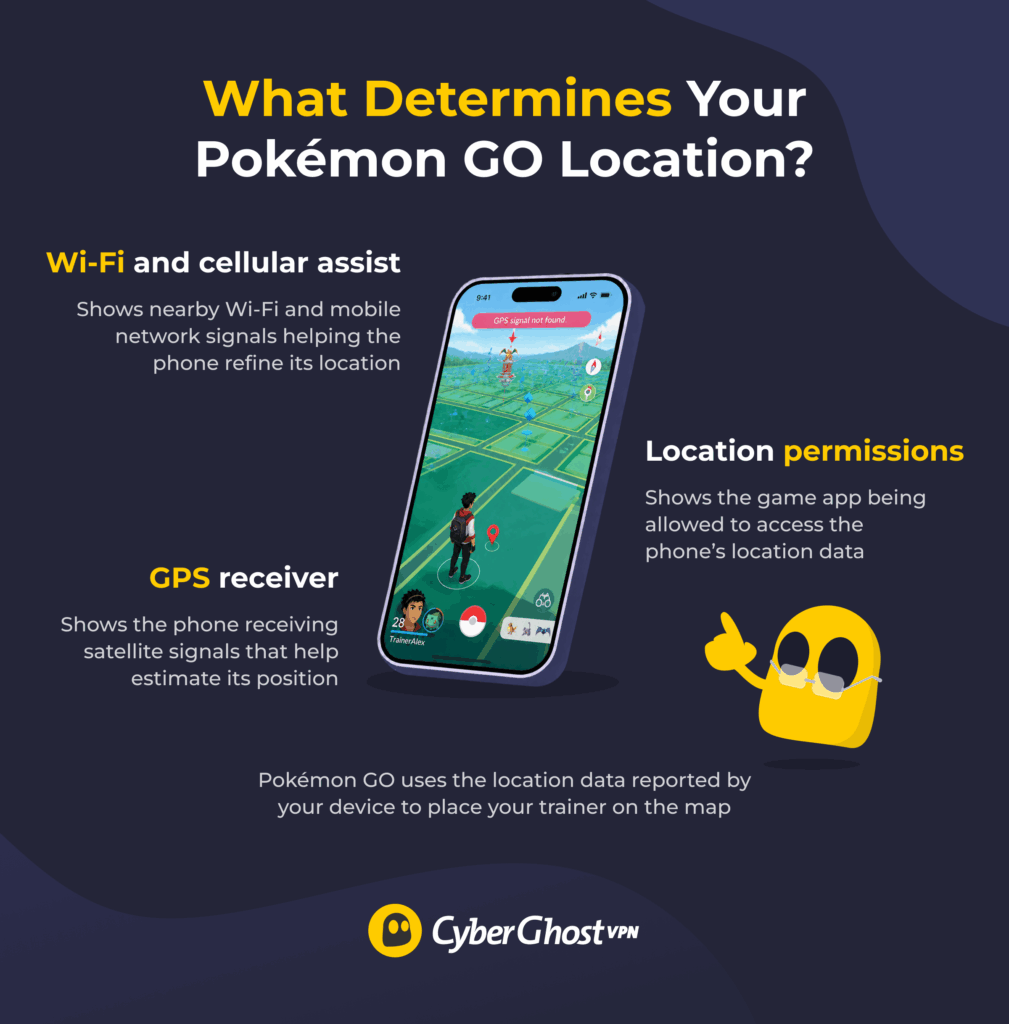
Pokémon GO uses the location data reported by your device to place your trainer on the map. Several parts of your phone’s location system can contribute to that position:
- GPS receiver: Your phone uses a built-in GPS chip to pick up signals from overhead satellites to estimate your coordinates.
- Location permissions: Pokémon GO requires active permission from your phone’s operating system (iOS or Android) to read your location data.
- Wi-Fi and cellular positioning: Nearby Wi-Fi networks and cell towers can help your phone determine its location, particularly when GPS signals are weak.
That’s why changing your IP address alone won’t move your trainer. To appear somewhere else in Pokémon GO, the location data reported by your device would need to change.
Why a VPN Doesn’t Change Your Pokémon GO Location
A VPN can change your visible IP address and its associated location, but it can’t change the GPS location Pokémon GO uses to position your trainer. For example, connecting to a CyberGhost VPN server in London won’t move your trainer there if your device reports that you’re in Rome.
CyberGhost VPN encrypts the internet traffic routed through the VPN tunnel, which can help protect your connection on networks you don’t control, such as hotel, airport, or café Wi-Fi. It doesn’t alter your device’s GPS coordinates, hide activity associated with your Pokémon GO account, or prevent Niantic from detecting rule violations.
What Is a Pokémon GO Location Changer?
A Pokémon GO location changer falsifies the location data your device reports, making the game place your trainer somewhere you aren’t physically located. These tools can include:
- Mock-location apps: Replace your device’s reported location with selected coordinates.
- Virtual GPS tools: Simulate a different GPS location on your device.
- Route simulators and joystick tools: Simulate movement between locations.
- Modified Pokémon GO clients: Alter the official app or add location-changing functionality.
- Desktop or Bluetooth location changers: Use another device or accessory to change the location data your phone reports.
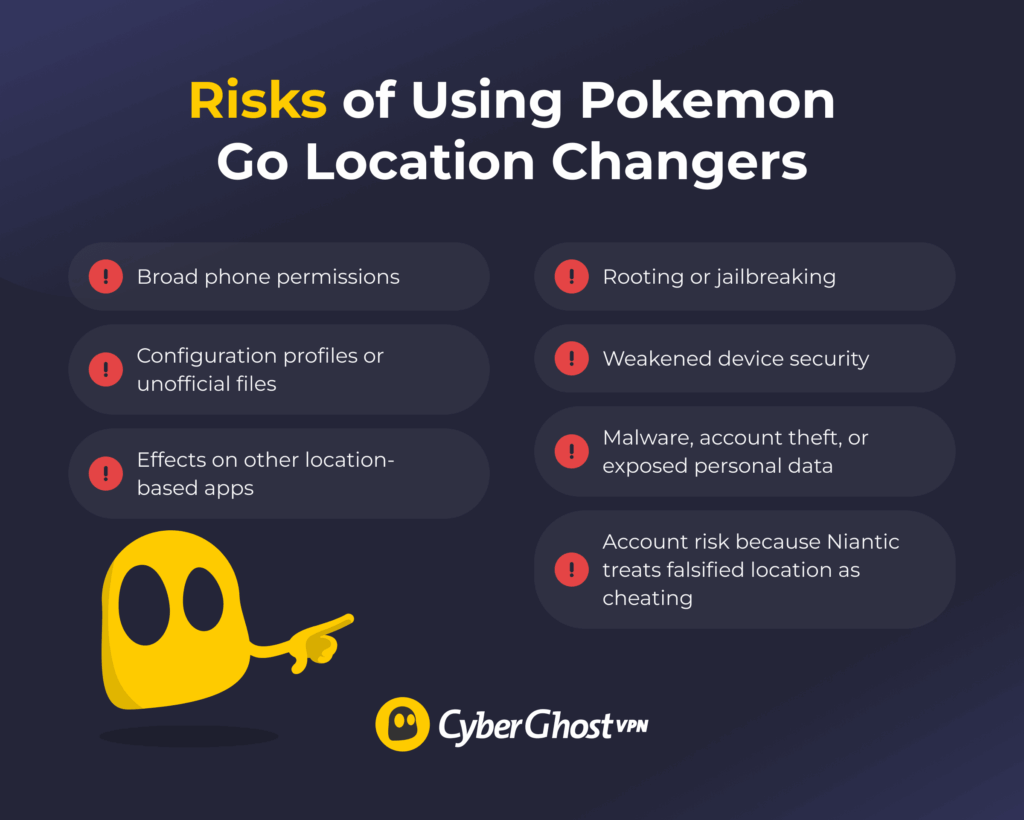
These tools may ask for broad phone permissions, configuration profiles, mock-location access, desktop control, or unofficial game files. Changing your device’s reported location can also affect other apps that rely on location data, including maps, weather services, and delivery services.
Some methods require rooting or jailbreaking your device or installing an unofficial Pokémon GO client. These changes can weaken built-in security protections, expose personal or account data, and increase the risk of malware or account theft.
Pokémon GO doesn’t support rooted or jailbroken devices, and falsifying your location violates Niantic’s rules regardless of the type of tool you use.
Soft Bans, Shadow Bans, and Official Account Actions
Players often use the terms “soft ban” and “shadow ban” after unusual or fast location changes. These are community terms, not official categories in Niantic’s current Gameplay Fairness Policy. The table below shows the difference between community terms and official Niantic categories.
| Term | What Players Usually Mean | Official Niantic Term |
| Soft ban | Temporary interaction problems, such as Pokémon fleeing or PokéStops not responding | ❌ |
| Shadow ban | Reduced access to rare Pokémon or selected features | ❌ |
| First strike | An in-app warning and degraded gameplay | ✅ |
| Second strike | Temporary account suspension | ✅ |
| Third strike | Account termination | ✅ |
A first strike typically restricts parts of your gameplay for about seven days. You may lose access to rare Pokémon, social features, Routes, or PokéStop Showcases. A second strike can suspend your account for about 30 days, while a third can lead to permanent termination. Niantic may also terminate accounts immediately for certain violations, including location spoofing, skipping earlier strikes entirely.
What Players Mean by Cooldowns in Pokémon GO
A cooldown is a period players wait after changing location before interacting with Pokémon GO again. Community-made cooldown charts suggest waiting different amounts of time before actions such as catching Pokémon, spinning PokéStops, joining raids, or battling in Gyms.
Niantic doesn’t publish or recognize an official cooldown schedule. Following a player-made cooldown doesn’t make location spoofing compliant with its rules or guarantee that your account won’t be detected or restricted.
If Pokémon keep fleeing or PokéStops stop responding after a location change, players may describe that as a “soft ban.” That doesn’t mean you’ve received an official strike. Niantic confirms an account suspension or termination through a message when you try to log in, and ordinary loading or connection errors can have other causes.
Change Your Pokémon GO Location According to Game Rules
If Pokémon GO is showing the wrong location, start with your phone’s location settings rather than a location changer. Check permissions, precise location, signal quality, and app settings on Android or iPhone. If your goal is to access more Pokémon GO content, features like Remote Raid Passes, Campfire, Routes, events, and trading may give you more options without changing your GPS location.
Making your trainer appear somewhere you aren’t requires falsifying the location data your device reports. That violates Niantic’s rules and can lead to account restrictions or termination.
A VPN doesn’t change GPS coordinates. CyberGhost VPN can still protect the internet traffic routed through its encrypted tunnel and change your visible IP address, which is useful when playing on public or shared Wi-Fi.
FAQ
Is Pokémon GO region locked?
Yes and no. Pokémon GO is available in most countries where Niantic operates, but it limits some Pokémon and in-game content to particular regions. Changing your IP address won’t unlock regional Pokémon because the game uses your device’s location data to position your trainer. Trading with other players and participating in supported events can help you collect Pokémon from different regions.
How to change your Pokémon GO location?
If Pokémon GO is showing an incorrect location, check your phone’s location permissions, GPS accuracy, signal, and app settings. Making your trainer appear somewhere you aren’t requires falsifying the location data your device reports, which violates Niantic’s rules and can put your account at risk. A VPN can change your visible IP address, but it won’t change your trainer’s location.
Can you get banned for using a VPN in Pokémon GO?
Using a VPN for privacy and security won’t get you banned from Pokémon GO. CyberGhost VPN encrypts your internet traffic and changes your visible IP address, but it doesn’t alter the GPS location Pokémon GO uses to position your trainer. However, using tools like GPS spoofers to actually falsify your location violates Niantic’s rules and can lead to account restrictions, suspensions, or terminations.
Is it safe to change my location in Pokémon GO?
It depends on how you change it. Physically moving or correcting inaccurate location settings is fine. Falsifying your GPS location with a spoofing tool violates Niantic’s rules and can lead to warnings, gameplay restrictions, suspension, or account termination.
How do you change location in Pokémon GO for free?
If Pokémon GO is showing the wrong location, you can change your phone’s location permissions and accuracy settings for free. Making your trainer appear somewhere you aren’t requires a tool that falsifies your device’s location, such as a mock-location app or other GPS spoofing tool. Using these violates Niantic’s rules and there’s a risk your account will be suspended or banned.
Can Pokémon GO detect location spoofing?
Yes. Niantic says it uses automated detection systems and other methods to identify rule violations, including location spoofing, although it doesn’t disclose exactly how its detection systems work. No spoofing method or cooldown period can guarantee that your account won’t be detected or restricted.

Leave a comment
Michel
Posted on 28/04/2022 at 01:58
Can I also use this for example badoo, tinder etc.?
Ghostie
Posted on 30/04/2022 at 08:41
Great question, Michel.
Location spoofing alters your device’s GPS coordinates, so all GPS-dependent apps will default to your mock location — including the services you mentioned.
Remember: Just because you can, it doesn’t mean you should. Both Tinder and Badoo state falsifying your location is a violation of their respective community guidelines. We don’t condone breaching any app’s terms of service, with or without a VPN.
Stay safe, have fun, and be kind to your potential matches!