
Scam websites can look like a legitimate business, and victims don’t always realize something’s amiss until it’s too late. Nowadays, scammers can easily use AI to design convincing websites that look reliable. While fake sites are getting harder to spot, knowing the red flags can help you identify potential warning signs before it’s too late.
To help you avoid suspicious websites and online scams, we’ve put together a recent list of platforms that users have reported concerns about. We’ll also cover how scam sites work, common scam tactics, and how to identify fake websites.
What Are Scam Websites?
Cybercriminals use scam websites to deceive you into sending money, divulging personal information, or clicking on a link that installs harmful programs on your device. Scam websites include fake shopping websites, copycat sites of popular businesses, and sites carrying malicious payloads.
For example, fake retail websites sell products, but when you purchase something, it never arrives. Other times, the goal is to steal your personal information to commit fraud or identity theft. Other scam websites infect your device with malware.
How Do Scam Websites Work?
While the specific steps can vary, most scams follow a predictable playbook for quick profit with minimal risk. Let’s take a look at some typical tactics.
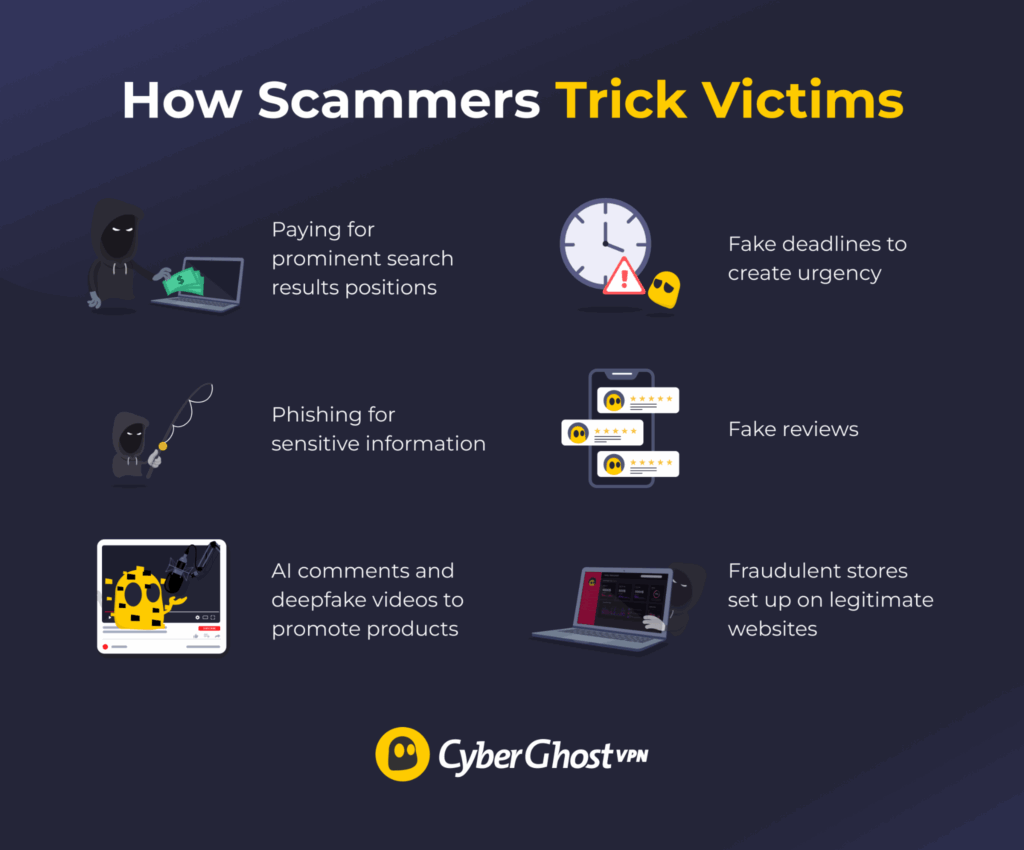
Most of the time, it’s not the build of the actual website that’s dubious. It’s the goal of the scammers behind it and the sneaky tactics they use to make everything feel safe and legitimate while they steal from you. Below, we cover different ways cybercriminals promote scam sites and exploit unsuspecting individuals.
Paid Ads
Scammers use paid ads to make their fake sites show up at the top of your search engine results or on your feed. Ads usually look polished and match your interests, which is why they can feel so convincing.
Social Engineering
Social engineering is when scammers use deception to gain your trust, only to exploit you later. They often reach out on messaging apps or social media. Over weeks or months, they slowly build what feels like a real friendship or romance. Once you start trusting them, they gently introduce a scam.
Pig butchering is a sophisticated type of online scam that combines romance scams with investment fraud. The name comes from the farming practice of “fattening a pig before slaughter.”
According to the Federal Trade Commission (FTC), investment scams driven by pig-butchering and romance tactics caused $5.7 billion in reported financial losses in the United States alone in 20241. This makes them one of the most financially damaging categories of consumer fraud.
Phishing and Smishing
Phishing is when scammers trick you into sharing sensitive information like passwords, credit card details, or a Social Security number by pretending to be someone you trust. You might receive unsolicited emails, texts, or messages that seem to come from your bank, Amazon, PayPal, Microsoft, a courier service (e.g., USPS, UPS, or FedEx), or even a government office.
Phishing remains one of the biggest online threats. The FBI’s Internet Crime Complaint Center (IC3) received more than 193,000 phishing and spoofing complaints in 2024 alone, making it one of the most commonly reported cybercrimes2.
Social Media and Influencer Tricks
Social media scams led to more reported losses than any other scam contact method. In 2025, Americans reported losing a staggering $2.1 billion to scams that started on social media. Nearly 30% of people who reported losing money to a scam said it began on a social media platform. That’s an eightfold increase in reported losses since 2020, highlighting the growing impact of social media fraud3.
AI-generated comments and deepfake videos of influencers recommending the product make their scams look more believable and exciting.
Urgency and Pressure Tactics
Scammers often create fake deadlines to create a sense of urgency, pushing you into making quick decisions before you have time to think clearly. You might see countdown timers telling you a great deal will end or messages saying the offer is only for the next few people. This clever trick makes it harder for you to pause, research, or make an informed choice.
Fake Reviews and Social Proof
While reviews usually give you a good idea of whether a company is trustworthy, scam websites are often packed with glowing five-star reviews and customer stories that are completely fake. They use AI tools to create hundreds of realistic-looking reviews with phony names, photos, and personal stories.
Scam Storefronts on Legitimate Sites
Some scammers rely on the positive reputation of known, trusted online marketplaces. They set up a storefront and employ various tactics to make it look legitimate. They might write false positive reviews to seem more trustworthy and use stolen or AI-generated photos of products. When enough users fall for the scam and pay for their orders, the storefront closes.
Types of Scam Websites
Scam websites come in many shapes and sizes. This way, cybercriminals can attack different target audiences. Whether your weakness is online shopping or new exciting crypto opportunities, scammers probably have something in the works.
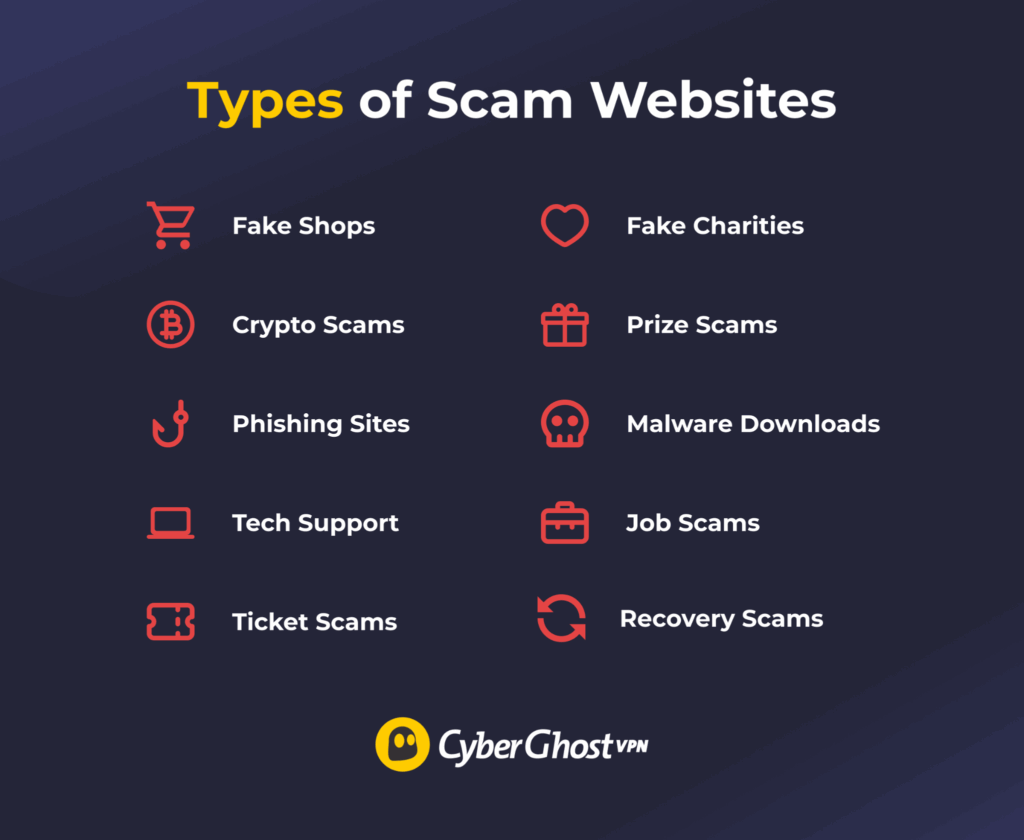
- Fake shopping websites: Mimic real online stores and offer popular products at very low prices. You pay but never receive the items or get cheap fakes. They often steal your payment details too.
- Investment and crypto scams: Promise high returns on cryptocurrency or new investments. They show fake profit dashboards at first, then block withdrawals. Many come from pig-butchering schemes.
- Phishing websites: Imitate or impersonate trusted entities like banks, PayPal, Amazon, or government agencies with the goal of stealing your money or personal information.
- Tech support scam sites: Claim your computer has a virus and urge you to call a fake number or download harmful software that gives scammers access to your device.
- Ticket and travel scam websites: Sell cheap tickets to concerts or sports events like the World Cup, or vacation packages that don’t exist. You pay upfront and receive nothing in return.
- Charity scam sites: Pretend to be legitimate nonprofits, especially during disasters or holidays. They collect donations that never reach real causes.
- Fake lottery and prize websites: You get messages saying you won a prize but must pay fees or share personal details to claim it. Legitimate lotteries never ask for upfront payments to claim your winnings.
- Malware distribution sites: Trick you into downloading games or tools that secretly install malicious software like ransomware or spyware on your device.
- Job and employment scam sites: Fake job portals offering great positions that ask for money for training, equipment, or background checks. Some involve reshipping scams.
- Recovery scam websites: Contact previous victims pretending to help recover lost money. In reality, they want more fees from you.
Suspicious Websites and Platforms Reported by Users
Here’s a list of suspicious websites that users have reported as active or recently active scams. These platforms are frequently short-lived, so many may already be offline.
1. Opazity[dot]com
Opazity[.]com is an online store that advertises trendy women’s clothing, including tops, dresses, and fashion accessories at unusually low prices. The site uses polished product photos and a modern layout that can make it appear like a legitimate fashion retailer.
Some customers claim they never received the items they ordered after making a purchase. Multiple online reviews also mention difficulty contacting customer service or getting responses to refund requests and support inquiries.
User reviews on platforms like Gridinsoft include complaints about delayed orders, refund problems, and communication issues4. Before purchasing from unfamiliar retailers, it’s a good idea to research recent customer experiences and review the site for warning signs.
2. Thecraze[dot]in
Thecraze[.]in is an online store that advertises fashion products, accessories, jewelry, and lifestyle items at heavily discounted prices. Despite the professional appearance, users mention unresolved orders and poor customer experiences.
Online complaints on Trustpilot include reports of missing orders, refund issues, and difficulty reaching customer support after payment5. Several online reviews also mention the company allegedly blocks users on social media after they’ve raised public complaints.
3. Mystore[dot]ch
Mystore[.]ch presents itself as an online general store selling electronics, furniture, home goods, and other products, often at competitive prices. Online trust platforms like Scam Detector warn that users should exercise caution on the site6. Negative reviews related to unauthorized charges, delivery issues, and customer service complaints prompted these warnings.
A number of customers report seeing charges for items they never ordered. Similarly, some customers claim they’ve placed orders that were never fulfilled.
4. Primepharmacyuk[dot]com
Primepharmacyuk[.]com presents itself as a legitimate UK-based online pharmacy offering a wide range of medications, such as pain relief or weight loss treatments like Ozempic and Wegovy.
Reputation platforms like Scam Detector7 and Trustpilot8 give the site a low score. The site doesn’t display a GPhC (General Pharmaceutical Council) registration number, which is legally necessary for any pharmacy operating in the UK9.
Some customers report that their paid orders didn’t arrive. They also report orders having either a fake tracking number or none at all. Worse yet, several reviewers complain about unexpected repeat charges on their credit cards, even after cancelling orders.
5. user[dot]vanguradtradeprocrm[dot]com (Vanguard Copycat)
Online users have raised complaints about this website, which seems to be an impersonation of the legitimate investment company Vanguard. The complaints have reached California’s DFPI (Department of Financial Protection & Innovation), which has issued a warning for the site10. It targets people interested in traditional investment firms who are now exploring crypto.
The site uses a deliberate misspelling of the trusted Vanguard brand to confuse users — a practice called typosquatting. Victims report seeing fabricated profitable trades on their dashboard to build false confidence. Users also claim the site blocks any requests to withdraw funds with demands for additional fees.
6. Coinget[dot]finance
Coinget[.]finance presents itself as a modern, easy-to-use cryptocurrency trading platform with advanced tools and impressive returns. Users have complained about alleged fraudulent activity involving large sums of money. California’s DFPI has issued a warning about the site11.
Users report that contacts from the site use video or phone calls to guide potential victims into depositing money. The platform displays impressive gains to encourage larger investments. Also, users say that withdrawal attempts can trigger demands for taxes or security deposits.
7. Lgdbite[dot]com
Lgdbite[.]com operates as a cryptocurrency trading platform that promises simple and profitable trading experiences. It’s often promoted through dating apps and social media advertisements. The DFPI documented two cases of fraud and issued a warning for lgdbite[.]com and variants of the spelling like “lgdbit12.”
Users report initial on-site profits to lure victims into investing larger amounts. They also claim that cashout requests result in demands for certification and security fees. Multiple people have reported losses ranging from several thousand to tens of thousands of dollars, and the platform becoming unresponsive after trying to collect funds.
8. Quantumxex[dot]net
Quantumxex[.]net claims to be a professional crypto exchange offering advanced trading features and high returns with low risk. The platform is mainly promoted inside private WhatsApp and Telegram investment groups, where group admins instruct members how to deposit funds.
Investigation and legal firms specializing in crypto-related fraud, such as Cybertrace13 and Cryptolegal14, have reported the site as a likely scam. Users report seeing artificial profits before the platform blocks their withdrawals or access to the site. Some users also say they received requests for extra processing or verification fees.
How to Spot Scam Websites
Here are some friendly tips to help you stay safe:
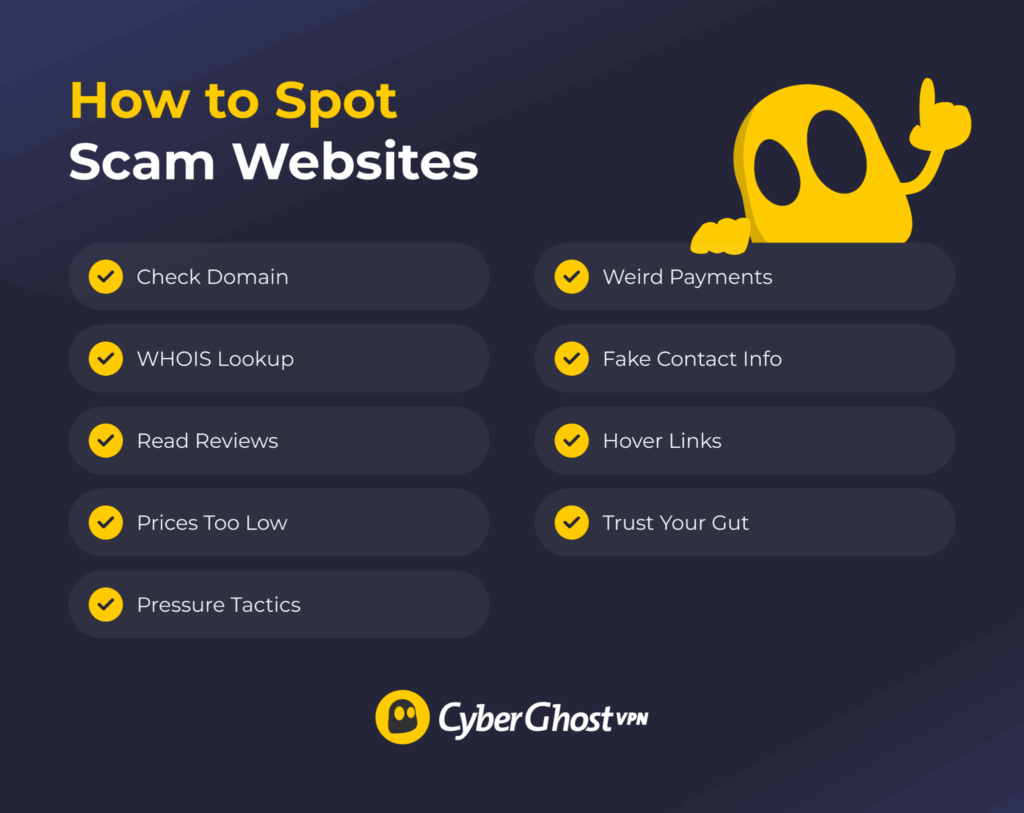
- Check the domain name: Look for weird spellings (like “amaz0n” or “paypa1”) or strange top-level domains like .vip, .top, or .xyz.
- Conduct a WHOIS Lookup: Use a free tool like whois.com to see the domain’s registration date. Recently registered websites can potentially raise some red flags, especially if the business claims to be an established company.
- Read recent reviews: Trustpilot and Reddit forums often reveal if people are getting scammed.
- Too good to be true: If the prices are ridiculously low, it’s usually a red flag.
- Watch for pressure: Countdown timers and “only 2 left!” messages are classic tricks.
- Payment warnings: Be extra careful if they only accept crypto, wire transfer, or gift cards.
- Contact info test: Legitimate sites have clear contact details including a real email address or phone number.
- Hover before clicking: Always check where the link actually leads.
- Trust your gut: If something feels off, just close the tab and go to the official website.
Fraud Alert: Stay Ahead of Scams
Scam websites are getting annoyingly good at looking real these days. Thanks to AI, even cautious people can get fooled by polished designs, fake reviews, and urgent “limited time” offers. It’s frustrating, but the good news is you’re now much better equipped to spot them.
Remember: if the deal feels too good to be true, the domain looks a bit strange, or they’re pushing hard for quick payment — pause. Take a breath, do a WHOIS check, read recent reviews, and always go straight to the official website instead of clicking random links.
At the end of the day, a little healthy skepticism is your superpower online. Stay sharp, trust your instincts, and don’t let the scammers win.
FAQ
How can I check if a website is legit?
To check if a website is legit, always go to the official website by typing the correct domain name into your browser instead of clicking links from social media ads. Look for proper contact information like a working email address, phone number, and clear contact details. It also helps to check reviews on sites like Trustpilot.
How do I know if a link is safe?
One way to check is to hover over the link to see the real domain name before clicking. Safe links usually have well-known top-level domains (.com, .net, etc.). If the link leads to a site asking for login credentials, credit card details, or financial information right away, treat it as a potential fraudulent site.
What is the most trusted online shopping site?
Large retailers and official brand websites are generally considered safer options for online shopping. It’s a good idea to purchase from the brand’s official website when possible and to avoid sites that only accept wire transfer or push fake products at unrealistic prices. Large online marketplaces tend to have an active community writing reviews, which can help you suss out fraudulent sellers.
What do I do if I’ve been scammed?
If you’ve been scammed, act fast. You should contact your bank or credit card company to dispute the charges and protect your bank account and credit card information. You can report the fraudulent site to a consumer protection body like the FTC and your local authorities. Consider placing a credit freeze with the major credit bureaus to prevent unauthorized access.
References
- New FTC Data Show a Big Jump in Reported Losses to Fraud to $12.5 Billion in 2024 – Federal Trade Commission
- Federal Bureau of Investigation Internet Crime Report 2024 – Federal Bureau of Investigation
- New FTC Data Show People Have Lost Billions to Social Media Scams – Federal Trade Commission
- Gridinsoft – Opazity.com Store Scam Warning (7/100 Trust Score)
- Trustpilot – Read Customer Service Reviews of thecraze.in
- Scam Detector – mystore.ch Reviews: Is this site a scam or legit?
- Scam Detector – primepharmacyuk.com Reviews: Is this site a scam or legit?
- Primepharmacyuk Reviews – Trustpilot
- Check registration for online health services – General Pharmaceutical Council
- VanguardTrade – Account Balance (Fraudulent Platform) – Department of Financial Protection & Innovation
- Coinget.finance – Homepage (Fraudulent Platform) – Department of Financial Protection & Innovation
- Lgdbite.com – Account Page (Fraudulent Platform) – Department of Financial Protection & Innovation
- New Identified Scam Websites – Cybertrace
- List of Reported Scam Companies in 2026 – Part 2 – Crypto Legal

Leave a comment