
Imagine an email that looks like it comes from your bank, telling you to download a new banking app from the link provided. You download the app, follow the instructions, and input your card details. Suddenly, you see unexplained charges appear in your card activity. This is a typical blueprint for a credit card scam.
These scams can cost both people and organizations large amounts of money. The techniques can range from a fake text message to a device secretly attached to a payment terminal. Most credit card scams rely on the same basic pattern: getting you to act quickly before you have time to think.
This is why it’s important to recognize the most common types of scams and how to identify them. Though it’s impossible for this guide to cover every conceivable scenario, we’ll outline the most common ways scammers can get your credit card information and discuss what scammers do with the information they steal.
Quick Tips: If You’re Targeted by a Credit Card Scam, Do This First
- Contact your bank or card issuer and explain the situation.
- Freeze your card and reverse the scam transactions, if possible.
- Report the scam to your local anti-fraud authority.
- Monitor your card statements for any further suspicious activity.
What Is a Credit Card Scam?
A credit card scam is a malicious attempt to get access to your credit card information or its associated account. The scammer might try to contact you, trick you into handing over your information through a fake website, or collect your card details through physical means.
It’s worth noting that strictly speaking, “credit card scam” and “credit card fraud” are not the same thing, even if people use the terms interchangeably. A credit card scam is the attempt to get your information through phone calls, emails, or physical devices. Credit card fraud is the result of the scam, which involves using your credit card information in an unauthorized and often illegal way.
While we discuss scams and fraud in the context of credit cards, most of what we cover also applies to debit cards. A big difference is the damage the scammers can do, which is generally limited by the credit maximum for credit cards and your account balance for debit cards.
Common Credit Card Scams and Other Ways Scammers Get Your Card Details
Although at its core, each scam is a different method of getting your credit card details, most credit card scams can fall into several recognizable categories.
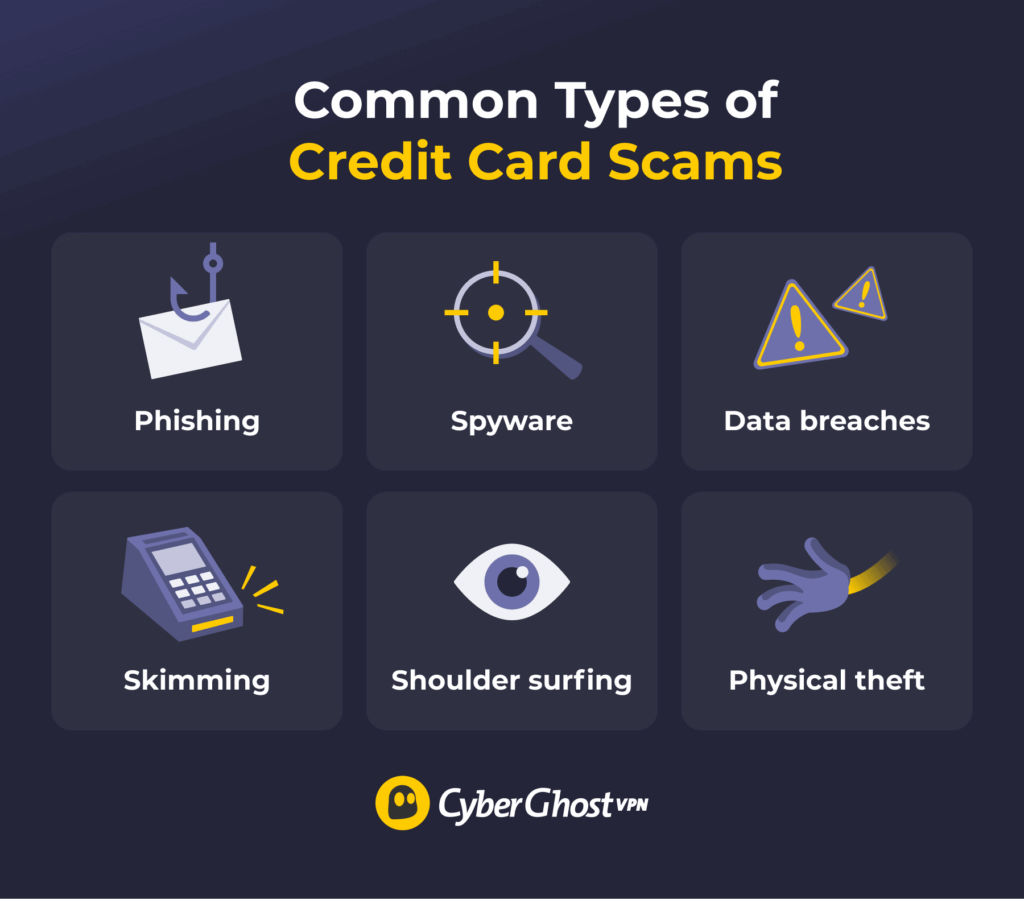
Phishing
A phishing scam involves a fake message pretending to come from a trustworthy source. It might impersonate your bank, an online retailer, or a delivery company. It comes down to a source you could assume has reason to ask about your payment details. Scammers usually send phishing messages by email, though they could also send messages through SMS texts or voice calls (called “smishing” and “vishing,” respectively).
The phishing message might ask you to reconfirm your details or verify a suspicious charge on your card. It’ll contain a link that takes you to a fake website designed to collect your card number, CVC (card verification code), account password, or one-time code. In this case, there are ways to identify these scams and protect yourself.
Spyware
Spyware is malicious software on your device that collects information without your awareness or consent. Different types of spyware could get your credit card details in different ways. For example, keylogger spyware records your typing activity, so it can pick up your credit card number and CVC.
In 2025, CERT Polska reported the emergence of a combined phishing/spyware scam.1 The target first receives a phishing message urging them to install an app. The scammers then call, posing as bank staff, and explain how to “verify” the scam app. The target places their physical card (that supports contactless payments) by the phone and enters the card’s PIN. The scam app reads the card’s details and sends them over to the scammer.
Data Breaches
Data breaches containing credit card information can also happen as a result of a phishing scam targeting a company, such as an online store or payment service. The company’s database leaks online, so criminals can use its contents, including information like your name and credit card details.
Skimming
A skimming attack involves tampering with a physical card reader to collect scanned cards’ details. The scammer attaches a small device to an ATM or a checkout terminal on or near the place where you’d swipe or tap your card. The device scans your card’s magnetic stripe or reads the data on its chip. In some cases, the scammer might also attach a tiny camera or a fake keypad to capture your PIN.
Shoulder Surfing
Shoulder surfing is exactly what it sounds like — someone watches as you type your card number or enter your PIN in public. While it’s not technically a “scam,” it’s still an overlooked method someone could use to get your credit card details. It can happen at ATMs, checkout counters, or anywhere else your screen or keypad can be visible to a stranger standing nearby.
Physical Theft
Physical theft is the simplest method through which someone gets access to your credit card. A pickpocket could steal your wallet, or you might leave your card behind at a restaurant or retail store. Once the thief has the physical card, they can use it in person until you report the loss to your bank or card provider.
What Scammers Can Do with Your Credit Card Information
Once a scammer has access to your credit card or the associated details, their goal is to use it as quickly as possible. Depending on the information they collect, a scammer can do the following:
- Make unauthorized purchases: Buying goods online or purchasing cryptocurrency to make the money trail harder to follow.
- Empty your bank account: Withdrawing cash from ATMs or transferring funds to another account, often in increments that are small enough to not look suspicious.
- Commit other fraud: Using your card details for activities that don’t immediately drain your money but require an active credit card.
- Open new accounts in your name: Applying for new credit cards or loans with your personal information.
- Sell your information: Posting your credit card details on an online marketplace. The stolen information could be used weeks or months after the original scam.
Who’s Most at Risk of Credit Card Scams?
Anyone with a credit card can be a victim of a scam, but some groups are more vulnerable than others. Older adults can be targets, partly because scammers might assume they’re less familiar with technology and partly because they may have more savings to lose. People who shop online or travel often are also vulnerable to credit card scams.
Keep in mind, the most impactful risk factor is how a person responds to pressure. Scammers try to get their targets to act right away, skip verification steps, and share information that’s private. They use tactics that create a sense of urgency, so someone who pauses and double-checks before acting is harder to scam.
How to Identify a Credit Card Scam
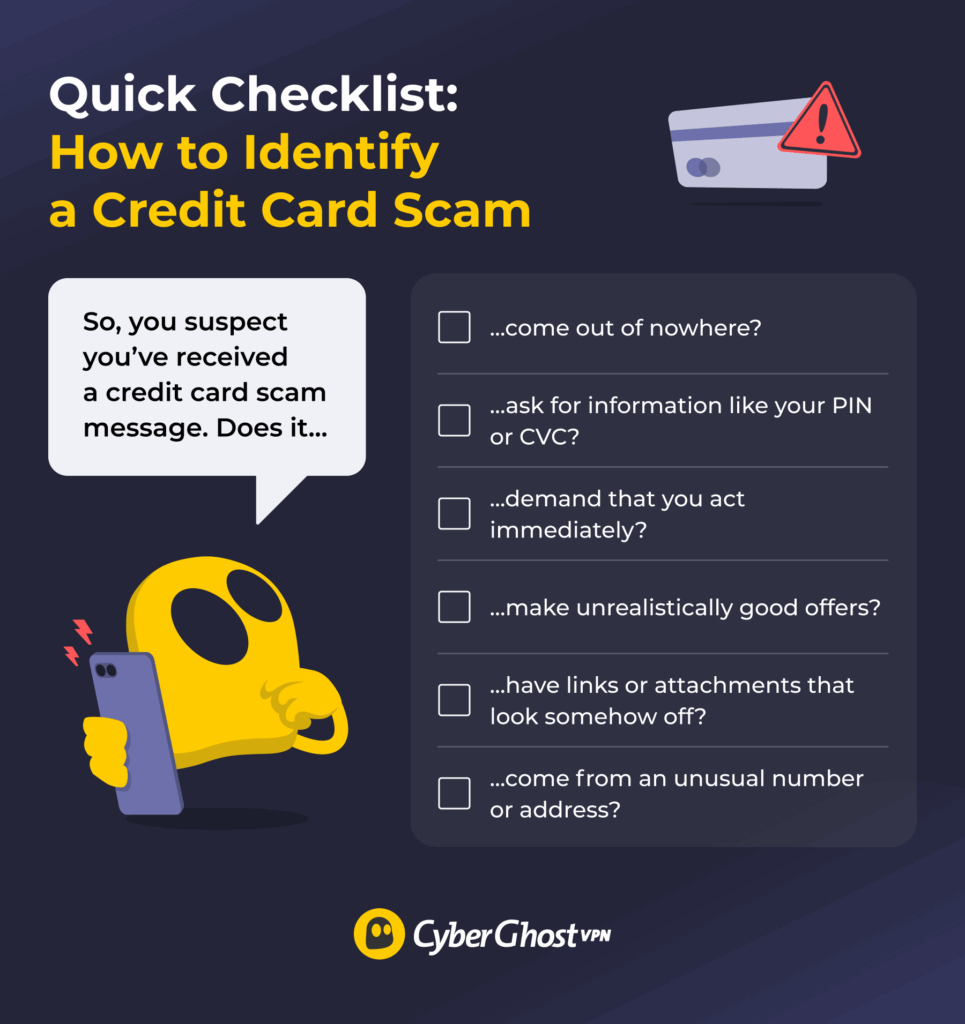
Most scams share a common set of warning signs. Even if the exact details differ from scam to scam, the pattern is usually similar. Someone contacts you, creates a pretense of urgency, and asks for payment or information.
- Unexpected contact: Your bank, the local tax office, or delivery companies will rarely contact you out of nowhere asking for your card details.
- Requests for sensitive information: Legitimate sources rarely ask for details like card numbers or passwords by email, text, or voice call.
- False sense of urgency: Threatening messages that say you need to act as soon as possible or you’ll incur consequences like additional fees or losing access.
- Too-good-to-be-true offers: Tempting offers such as unexpected prizes, free gifts, or refunds you didn’t request.
- Suspicious links or attachments: Domain names with unusual misspellings and filenames with unexpected extensions are often cause for suspicion.
- Unusual sender numbers and addresses: Look out for phone numbers from another country and email addresses with typos, which are signs of phishing scams.
- Unfamiliar charges: Card activity logs that you don’t recognize can be the sign of a compromised card.
Pro tip: An unfamiliar charge on your card statement doesn’t always mean fraud. Billing errors can happen, and sometimes a seller or service might appear under a name or code you don’t recognize. Check the date, amount, and location of the charge. If it lines up with a purchase you made, it’s likely legitimate. If not, contact your bank or credit card provider for further inquiries.
What to Do If You Suspect You’ve Been Scammed
Acting quickly helps you limit the potential damage. We ordered the steps by urgency, starting with what you should do in the first few minutes of noticing a potential scam.
- Contact your card issuer: Call your bank or card provider, explain the situation, report the scam, and ask them to freeze or block the card.
- Change your passwords and PINs: Update any login details you shared through a phishing scam, especially for banking and email accounts.
- Review your card statements: Look for charges you don’t recognize, going back several months if necessary.
- Dispute critical charges: Report scam transactions to your bank immediately. it might be able to reverse the transaction, but there’s usually a time limit.
- Report the scam: File a report with your local consumer protection or fraud reporting agency, such as the FTC in the US, Report Fraud in the UK, or the CAFC in Canada.
- Keep detailed records: Save emails, messages, screenshots, and reference numbers related to the scam. You might need them for disputes and reports.
- Monitor your accounts: Check for unusual activity on your card over the following months.
How to Protect Yourself from Credit Card Scams
Preventing credit card scams generally comes down to building good habits. These tips are important for preventing scammers from getting your information. Combining these steps helps you close most of the gaps in attention and security that scammers rely on.
- Never share your PIN or one-time codes: Make sure you’re only typing them into a trustworthy site or app.
- Use strong, unique passwords: Avoid reusing the same password across accounts. Consider using a secure password manager.
- Enable multi-factor authentication (MFA): Add an extra verification step for your banking accounts to make it harder for someone to access them, even if they have your password and other details.
- Check card readers before using them: Look for loose parts, cameras pointing at the keyboard, or anything that seems stuck on top of the machine or looks like a duplicate part. Cover the keyboard when entering your PIN on a terminal or an ATM.
- Shop only on secure online stores: Make sure you’re using the official, legitimate site for any online retailer you want to shop from.
- Review your card statements: Check for small, unfamiliar charges. They could be a test before larger credit card fraud.
- Set up transaction alerts: Ask your bank if they send notifications via email or SMS for every transaction.
- Keep your credit card details private: Don’t save card details on sites you don’t trust and don’t read your card number, PIN, or CVC in public.
Avoiding Credit Card Scams Is Simpler than You Might Expect
Credit card scams succeed when they create strong pressure and exploit your trust. The exact steps might change, but the process is largely the same. Someone contacts you via mail, SMS, or phone call, asks for something urgent, and wants your card details. Once you recognize that pattern, many scams become easier to notice.
The steps you can take to protect yourself are simple. Keep your information safe, slow down when something tries to sound urgent, double-check anything that wants your card details or your money, and check your statements regularly.
FAQ
What are the most common credit card scams?
The most common credit card scams usually involve phishing, which are messages from a scammer pretending to be your bank. Large-scale phishing operations can target whole businesses that log credit card information, which can then result in a data breach. Some scams also use spyware to collect credit card information, often combined with a phishing message to trick you into downloading it.
How can I tell if a credit card charge is a scam?
Unexplained charges are a common sign of a credit card scam. Check the exact date, time, and recipient of the transaction. Try to retrace your steps and remember if you made a purchase at that time. Go through fiscal receipts or any email confirmations for online purchases. Keep in mind some sellers might appear under an unrecognizable name or code in your card statement. If you’re not sure, follow up with your credit card provider.
Can scammers steal my credit card information online?
Yes, scammers can potentially steal your card information online. They often do this through a phishing scam. The scammer sends an email, SMS, or direct message posing as a trustworthy source, such as your bank. The message contains a link to a web page that asks for your card information. Alternatively, it contains a download link that can get spyware on your device, which could then read information from your banking app.
What should I do if my credit card is compromised?
If someone compromises your credit card, the first thing you should do is contact your bank or credit card provider. They can freeze the card to prevent further misuse and in some cases, revert a scam transaction if you’ve reported it as soon as it happens. You should then collect evidence of the scam, such as messages, emails, and screenshots, and report the scam to the relevant anti-fraud agency.
How can I protect my credit card from scams?
It comes down to building good habits related to privacy and security. Check terminals and ATMs for signs of tampering before using them, use your card only for verified, legitimate businesses, and never read out your card number, PIN, or CVC in public.

Leave a comment