
Finding the right cybersecurity book can be challenging. The field covers everything from ethical hacking and malware analysis to cloud security and risk management, so the best place to start depends on your experience level and what you want to learn.
Whether you’re exploring cybersecurity for the first time or building specialized skills, we compiled a list of the best books to help you build knowledge on key concepts, develop a cybersecurity mindset, and better understand today’s evolving threats. Remember that reading is only a part of the journey. The best results come from combining theory with real-world practice.
How to Find The Best Cybersecurity Books Based on Your Goal
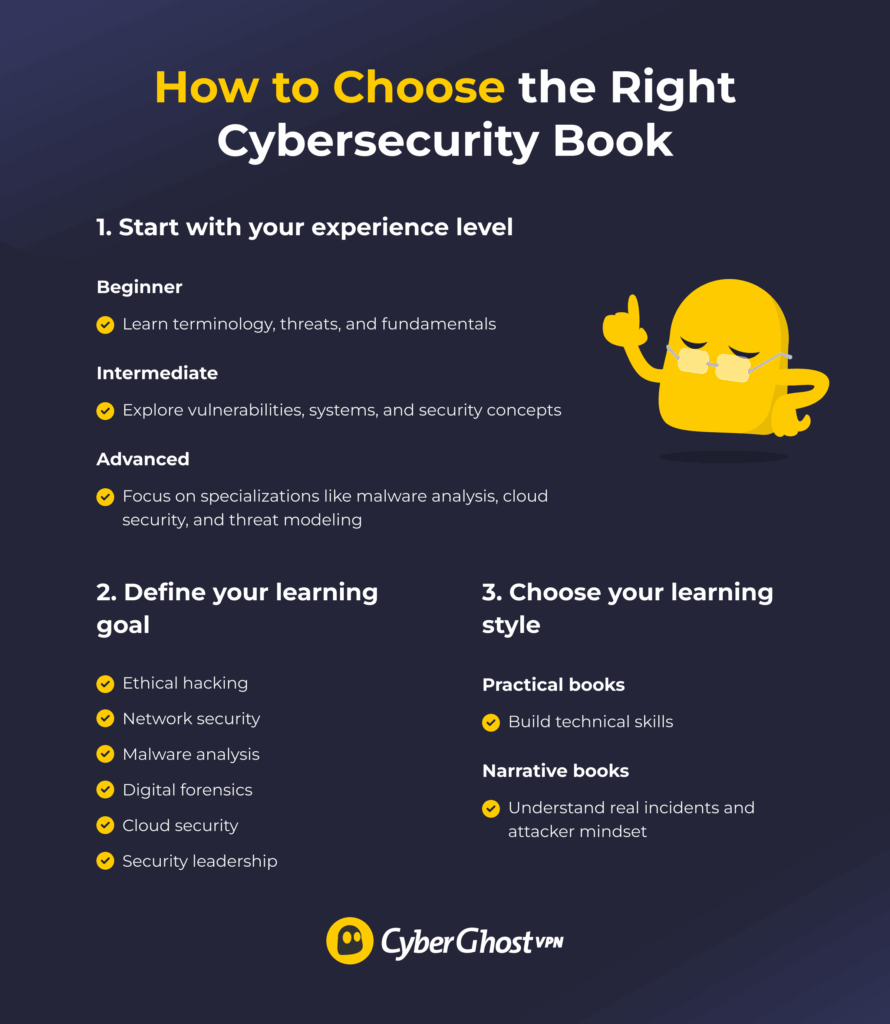
The best cybersecurity book depends on your experience level, learning goals, and the area of security you want to explore. Reading lists from universities and cybersecurity organizations often cover multiple areas, including ethical hacking, network security, privacy, cyberwarfare, and security engineering.
Use the table below to find a good starting point before exploring the recommendations in more detail.
Choose the Right Cybersecurity Book: Quick Guide
| Goal | Recommended Book | Level |
| Learn cybersecurity basics | Cybersecurity for Beginners | Beginner |
| Understand security mindset | Security Engineering | Intermediate |
| Learn ethical hacking | Hacking: The Art of Exploitation | Intermediate |
| Learn network security | Practical Packet Analysis | Beginner-Intermediate |
| Learn malware analysis | Practical Malware Analysis | Advanced |
| Learn digital forensics | Network Forensics | Intermediate |
| Learn cloud security | Practical Cloud Security | Intermediate |
| Understand cybercrime and cyberwarfare | Sandworm | Beginner-Intermediate |
| Learn threat modeling | Threat Modeling: Designing for Security | Intermediate |
| Understand cybersecurity strategy | The Fifth Domain | Intermediate-Advanced |
Consider these three points before choosing a title:
- Your experience level: Beginners should start with terminology, common threats, and core security principles. More experienced readers can move into ethical hacking, malware analysis, cloud security, digital forensics, or security architecture.
- Your learning goal: Books that match what you want to achieve are the best fit, whether that’s building technical skills, preparing for a role, or becoming familiar with cybercrime and security strategy.
- Your preferred learning style: Practical books are better for hands-on concepts, while narrative books are better for explaining attacker behavior and real-world incidents.
A balanced reading path usually includes both. Technical books build skills, while broader books add context and improve security judgment.
Best Cybersecurity Books for Beginners to Build Foundations
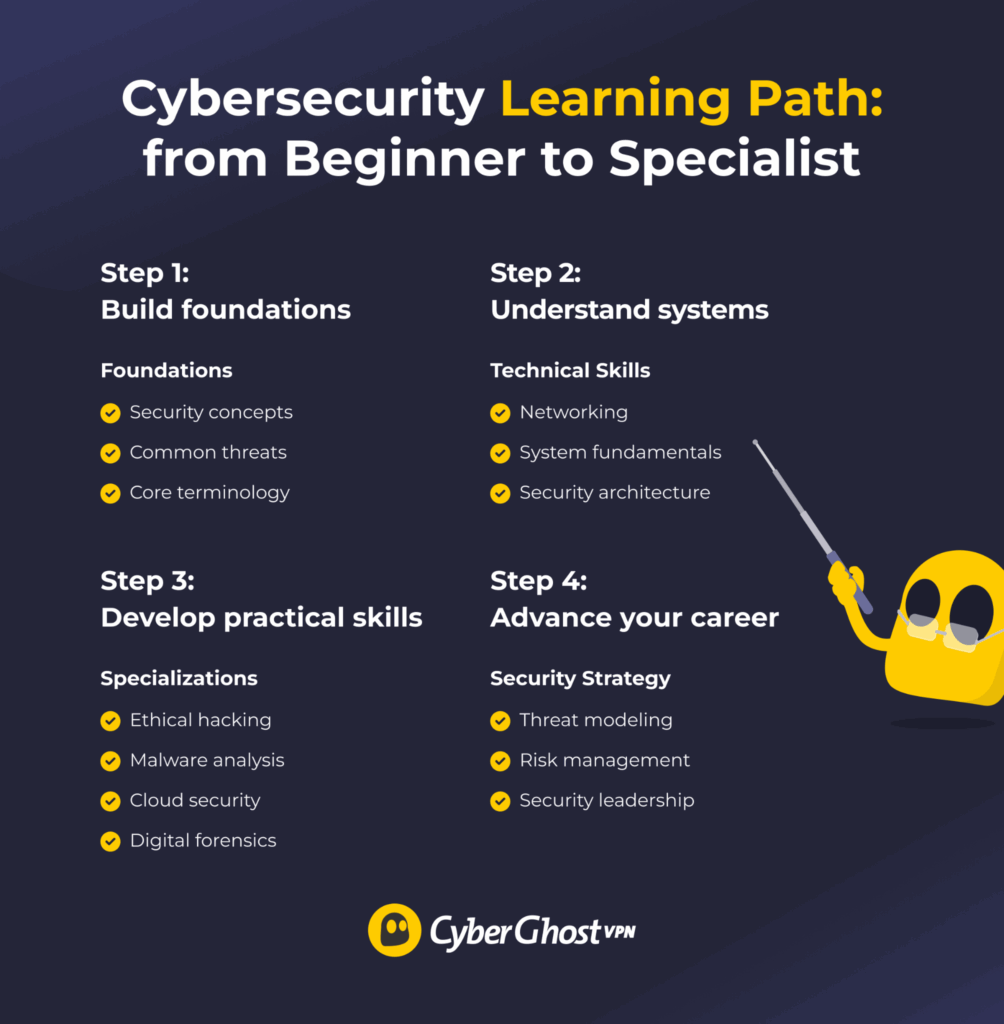
Cybersecurity books for beginners tend to concentrate on the vocabulary and core concepts you need before tackling technical material. That grounding makes specialized topics far easier to pick up later.
Cybersecurity for Beginners by Raef Meeuwisse
Best for: People starting their cybersecurity journey from scratch.
Cybersecurity for Beginners introduces the core ideas behind the field without assuming a technical background. It explains common threats, security principles, and defensive practices in plain language.
The book covers malware, phishing, encryption, authentication, and risk management, giving newcomers solid foundational knowledge.
It’s a strong starting point for anyone who wants to learn the language of cybersecurity first. The accessible writing suits students, career changers, and general readers who want to explore the field before choosing a specialization.
Cybersecurity for Dummies by Joseph Steinberg
Best for: Non-technical readers looking for a broad introduction.
Cybersecurity for Dummies works well for readers who want a general understanding of cybersecurity without immediately getting into programming, exploitation techniques, or security tools.
It breaks down complex security concepts into plain explanations. It covers everyday cybersecurity concerns, including malware, phishing, password security, encryption, and protecting personal and business information.
The book works well if you want a general understanding of cybersecurity without immediately getting into programming, exploitation techniques, or security tools. It’s also useful for professionals outside technical roles who need to know about cybersecurity risks and how security decisions affect organizations.
The Cuckoo’s Egg by Clifford Stoll
Best for: Readers who prefer learning through real-world stories.
The Cuckoo’s Egg takes a different approach from traditional cybersecurity textbooks. Instead of teaching through definitions and technical explanations, it follows the investigation of a real intrusion and shows how analysts uncover security incidents.
The book introduces important security ideas through curiosity, investigation, and problem-solving. You can see how small clues, system logs, and unusual activity can reveal a larger attack.
While it isn’t a technical guide for learning cybersecurity tools, it’s an excellent way to develop a security mindset and see how real investigations unfold.
Best Cybersecurity Books for Technical Skills
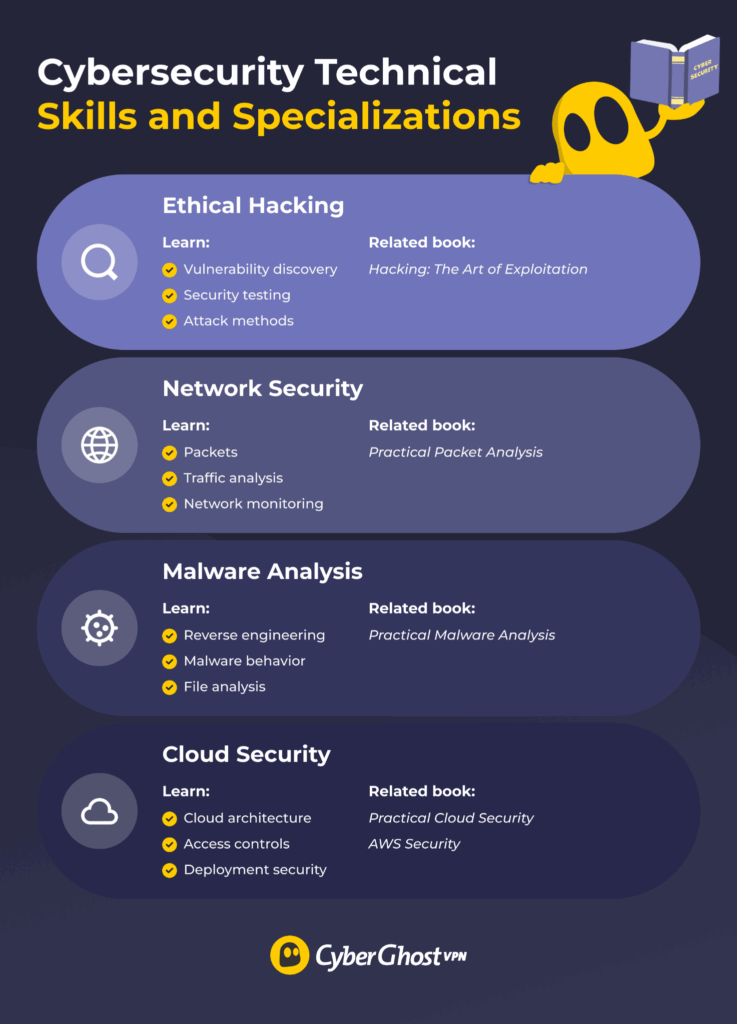
Technical cybersecurity books and IT security books explore how systems work, how IT professionals discover vulnerabilities, and how security professionals investigate and defend against attacks. They’re best suited to readers who already know the fundamentals and want to build practical skills.
Hacking: The Art of Exploitation by Jon Erickson
Best for: Readers who want to learn how vulnerabilities work.
Hacking: The Art of Exploitation is a strong choice for readers interested in ethical hacking or security engineering, but it’s better suited for those comfortable with some programming concepts.
The book deals with the technical foundations behind software vulnerabilities and covers programming, memory management, networking, cryptography, and exploitation techniques. It helps you realize how attackers analyze systems and why certain weaknesses exist in software.
While it explains the basics of attack tools, it also explores the concepts that enable vulnerabilities. It works best as a more in-depth technical resource rather than as a first cybersecurity book.
Security Engineering by Ross Anderson
Best for: Readers who want to see how security decisions shape system design.
Unlike practical hacking books, Security Engineering is about the principles behind building dependable systems. If you want to learn about the reasoning behind security controls, it’s a valuable long-term reference for security engineers and experienced readers.
This book takes a broader view of cybersecurity by exploring how systems fail and how security decisions affect real-world designs. It covers authentication, access control, cryptography, distributed systems, and security architecture.
Because of its depth, beginners may find it challenging at first. It rewards readers who already grasp the fundamentals and want to sharpen their security thinking.
Practical Packet Analysis by Chris Sanders
Best for: Readers learning network traffic analysis and investigation.
Practical Packet Analysis teaches readers how to examine network traffic and grasp what’s happening inside a system. It uses packet captures and Wireshark examples to explain how analysts investigate communication patterns and identify unusual activity.
In addition to packets, the book also covers protocols, network traffic analysis, and troubleshooting techniques that are useful for network security and incident response.
It’s a practical choice for beginners exploring network security, especially those looking for books that connect theory with real-world investigative skills.
Pro reading tip: If you prefer a more academic approach, Network Security Essentials by William Stallings covers encryption, authentication, access control, and network security fundamentals. If you’re exploring cloud environments, you can look into Practical Cloud Security by Chris Dotson or AWS Security by Dylan Shields. Because cloud platforms are always evolving, these books work best alongside current provider documentation and practical labs.
Practical Malware Analysis by Michael Sikorski and Andrew Honig
Best for: Readers interested in malware investigation and reverse engineering.
Practical Malware Analysis is more advanced than general cybersecurity guides and assumes some grounding in systems and programming. It covers static and dynamic analysis, debugging, reverse engineering, and investigation workflows, making it a useful reference for incident response work.
For readers heading into malware investigation, it delivers a strong technical foundation. It also stands out for its exploration of examining suspicious files and malware behaviors.
Pro reading tip: Network Forensics by Ric Messier covers digital forensics, which touches on on packet analysis, logs, and evidence gathering. The Art of Memory Forensics, which covers memory analysis techniques, is also a useful read for incident response and malware investigations.
Best Cybersecurity Books for Real-World Threats and Security Thinking
Some cybersecurity books focus less on technical skills and more on cybercrime, cyberwarfare, privacy, and security decision-making. Ethical hacking books can help readers learn about how attackers discover and assess vulnerabilities.
These recommendations show how attacks affect people, organizations, and critical infrastructure.
Sandworm by Andy Greenberg
Best for: Readers who are interested in real-world cyberattacks and cyberwarfare.
Sandworm explores major cyberattacks linked to nation-state groups and shows how digital threats can affect real-world infrastructure. Through investigative reporting, Andy Greenberg examines incidents such as malware campaigns, attribution challenges, and the wider impact of cyber operations.
It’s a strong choice for beginners and professionals who want to know about cybersecurity beyond individual devices or networks. The storytelling approach makes complex incidents easier to follow.
Countdown to Zero Day by Kim Zetter
Best for: Readers interested in malware, cyberwarfare, and major cyber incidents.
Countdown to Zero Day explores the discovery and investigation of Stuxnet, showing how attackers can use malware as a strategic cyber weapon. The book helps readers make sense of zero-day vulnerabilities, malware analysis, and the connection between technical attacks and global security events.
Ghost in the Wires by Kevin Mitnick
Best for: Readers interested in social engineering and attacker mindset.
Through a retrospective on Kevin Mitnick’s hacking career, Ghost in the Wires illustrates how human behavior can become a major security weakness. It will expand your thoughts on social engineering, persuasion techniques, and why security depends on people as much as technology.
Threat Modeling: Designing for Security by Adam Shostack
Best for: Security professionals, developers, and anyone involved in designing systems.
Threat modeling identifies security risks before they become problems. The concept is especially useful for security engineers, developers, and architects because it shifts the direction from reacting to attacks toward anticipating risks earlier.
Threat Modeling: Designing for Security teaches readers how to think about potential threats, identify weaknesses, and make better security decisions during the design process.
You don’t need to work in security to benefit from learning about threat modeling. Evaluating how attackers approach systems can help anyone involved in building or managing technology make more informed decisions.
The Fifth Domain by Richard A. Clarke and Robert K. Knake
Best for: Readers interested in cybersecurity strategy, risk, and leadership.
The Fifth Domain looks at cybersecurity from a broader organizational and national perspective. It explores how governments, businesses, and critical infrastructure providers approach cyber risks. The book focuses less on technical skills and more on strategy, decision-making, and the challenges organizations face when preparing for cyber threats.
It’s a useful choice for security managers, business leaders, and readers who want to expand their knowledge beyond technical controls.
Pro reading tip: Cybersecurity and Cyberwar by P.W. Singer and Allan Friedman offers a broader introduction to cyber conflict, policy, and strategy. Readers interested in surveillance, data collection, and digital privacy may prefer Data and Goliath by Bruce Schneier.
Are Cybersecurity Books Enough to Learn Cybersecurity?
Cybersecurity books are useful for building foundational knowledge for security concepts and learning how professionals approach problems. However, reading alone won’t develop the practical skills needed for most cybersecurity roles.
Combine books with lab exercises, personal projects, practice environments, and current security research. Certifications can also provide a structured learning path, but they shouldn’t replace practical experience.
Books give you the theory. Applying what you learn turns that knowledge into usable skills.
Can You Learn Cybersecurity from Free Books or PDFs?
Free cybersecurity books and PDFs can be a useful starting point when they come from legitimate sources. University libraries, publisher previews, open educational resources, and official free chapters can help readers access reliable learning materials without resorting to questionable downloads.
Avoid downloading books from unofficial PDF websites or unauthorized uploads. Besides raising copyright concerns, these copies may be outdated, incomplete, or unreliable.
Wherever the material comes from, check that it reflects current tools and threats, since older free copies can fall behind.
Put Your Cybersecurity Knowledge into Practice
Books give you the foundation, but labs, projects, and current research help bring that knowledge to life. Experimenting with real security tools can make concepts like encryption, network routing, and secure connections easier to understand. It also helps you build practical skills that could come in handy in a cybersecurity career.
CyberGhost VPN gives you a few ways to put that knowledge to work. You can switch between WireGuard®, OpenVPN, and IKEv2 to explore different VPN protocols, compare your IP address before and after connecting, or run DNS leak tests. Troubleshooting connection issues can help you understand how DNS and network routing affect connectivity, too.
The best way to understand cybersecurity is to get curious and start experimenting. CyberGhost VPN offers a practical way to explore some of the technologies you’ll encounter in your studies, with a 45-day money-back guarantee on longer-term plans (14 days for monthly subscriptions).
FAQ
What are the best cybersecurity books for beginners?
Cybersecurity for Beginners, Cybersecurity for Dummies, and The Cuckoo’s Egg are strong starting points. The first two explain core concepts clearly, while The Cuckoo’s Egg teaches through a real-world investigation.
Which cybersecurity books are recommended for professionals?
Professionals can explore Security Engineering, Hacking: The Art of Exploitation, Threat Modeling: Designing for Security, and Practical Malware Analysis. These books cover system design, vulnerabilities, risk assessment, and technical investigations.
Are cybersecurity books enough to learn cybersecurity?
Books help build foundational knowledge, but practical experience matters too. Pair reading with labs, projects, training platforms, and current security research to turn theory into usable skills.
What books should I read to become an ethical hacker?
Start with Hacking: The Art of Exploitation to learn how vulnerabilities work. You can then explore Penetration Testing: A Hands-On Introduction to Hacking and The Hacker Playbook 3 for more practical offensive security concepts.
Which cybersecurity books are best for certification preparation?
Choose study guides written for the exact exam version you plan to take. Security+ guides suit broad foundational study, while CISSP guides target advanced security management and strategy. Use them alongside practice questions and applied learning.
Are free cybersecurity books and PDFs worth using?
Yes, provided they come from legitimate sources such as university libraries, publisher previews, open educational resources, or official free chapters. Avoid unofficial PDF download sites, as the content may be outdated, incomplete, or unauthorized.

Leave a comment