
A decentralized VPN (dVPN) is a type of VPN in which other users’ devices act as VPN servers. This differs from a traditional VPN, which runs on a private server fleet owned and managed by a single provider. That said, the basic purpose of a dVPN is the same as that of a traditional VPN. It masks your IP address and encrypts your traffic by routing it through a device in a different location.
The core principle of a dVPN is that you don’t need to trust one company with your data. However, instead of a provider’s privacy policy, you have to trust a network of users. Here’s everything you need to know about how decentralized VPNs work, what their advantages and disadvantages are, and how they compare to traditional VPNs.
How a Decentralized VPN Works

A dVPN lets you connect to the device of another user, which then forwards your traffic on to the internet. These devices are typically called “exit nodes” because they’re the points where your traffic “exits” the dVPN and goes onto the public web. The users on a dVPN are often called “peers” because the users have an equal level of authority on the network. This means dVPNs are peer-to-peer networks, and there isn’t a central hub site overseeing the whole grid.
A dVPN operates very similarly to a traditional VPN, but with some differences. Here’s a step-by-step of the process:
- Selecting a node: You open your dVPN client (usually an app) and pick an available exit node to connect. Some dVPNs automatically choose an exit node based on factors like speed or location.
- Routing and encryption: The client encrypts your traffic and routes it through the selected node.
- Accessing the internet: The node decrypts the traffic and forwards it to the destination address. The website or service receiving the traffic only sees the exit node’s IP address, not your original IP.
- Returning traffic: Data from the internet goes back to the exit node. The node encrypts the data and routes it to your device.
Many dVPNs work on a fee-per-session basis instead of a typical monthly subscription like traditional VPNs. After the connection closes, the client transfers payment to the exit node operator, usually in cryptocurrency, as compensation for the consumed bandwidth.
Advantages of dVPNs
- Dynamic server list: Available nodes frequently change. The network simultaneously gains new nodes from new users and loses old ones from inactive users. This makes it difficult to compile a list of known exit node IP addresses.
- Decentralized server network: Each node operates on its own. There’s no central point of failure, so it’s very difficult for potential cybercriminals to compromise the entire network. No one has physical access to all of the network’s nodes.
- Potential profitability: Participating users can get paid when someone uses their exit node. Also, a pay-per-use model can be more cost-effective than a long-term subscription for users who only occasionally use the dVPN.
- Decentralized authority: No single entity can monitor all the traffic on the network because the connection is directly established between your device and the exit node.
Disadvantages of dVPNs
- Inconsistent performance: Connections can be slow or unstable, depending on the exit node’s internet speeds. This can make activities like streaming or gaming unreliable or difficult.
- Security risks: dVPNs don’t always vet the nodes on their networks. A poorly secured exit node could be a target for hackers. The node could also be malicious itself.
- Privacy concerns: While traffic traveling to a dVPN node is encrypted, the operator of the node can potentially see unencrypted traffic on the other side. For example, if you visit a site that uses HTTP rather than HTTPS. Even with HTTPS, the exit node could still see the names of the domains you visit.
- Potential for misuse: If a user commits an illegal activity while connected to your exit node, your IP address could also be linked to that activity.
Decentralized VPNs vs Traditional VPNs
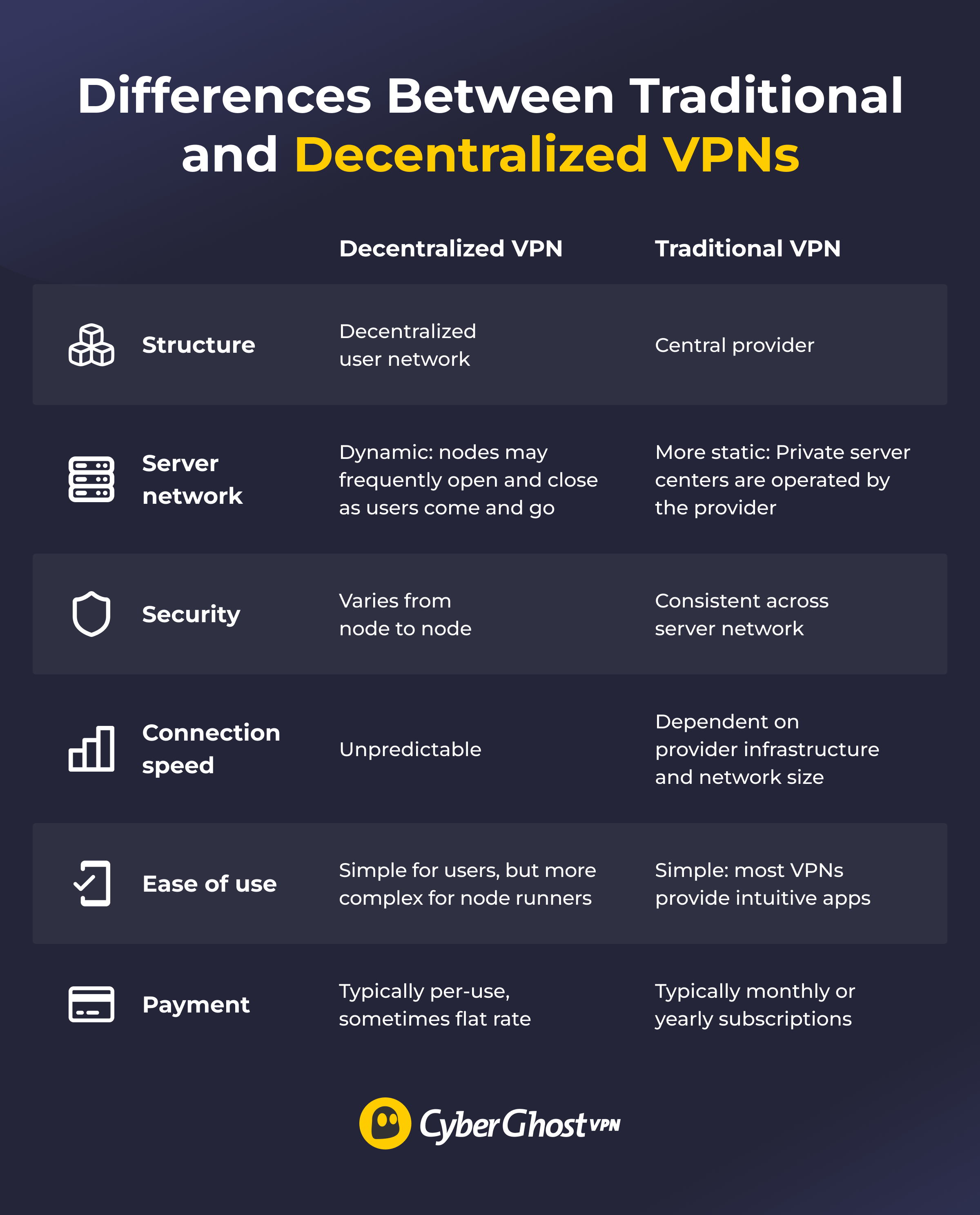
Decentralized VPNs are run on user devices, rather than a centralized server network. That means there isn’t a central provider that could log, monitor, or be legally pressured into surrendering your information. However, your connection’s performance, security, and privacy largely depend on the specifics of the exit node you’re using.
Traditional VPNs have a centralized structure, so the provider can typically maintain consistent security and connection quality across the server network. However, when you use a traditional VPN, you’re relying on its privacy policy not to keep logs of your traffic. A good no-logs VPN should have had its privacy policy independently audited and verified.
Decentralized VPNs vs Tor

Tor (The Onion Router) and dVPNs operate on similar principles. Both use encryption and a decentralized network to help you maintain your privacy online. Both also rely on volunteer-run servers, meaning that malicious exit nodes could monitor any unencrypted traffic that passes through.
The difference is that Tor isn’t a VPN; it’s a free privacy tool that routes your traffic through three nodes at a time. These nodes are called relays, and there’s a separate layer of encryption for each node. This makes your online movements very difficult to trace. It also means the exit node typically can’t link your activity back to you, since it can’t see where your traffic is coming from.
However, Tor’s “multihop” method can make its connections very slow as your traffic has more stops on its journey. You also have no control over which nodes your traffic is routed through. That means your real IP address is hidden as you browse, but you can’t choose the location of the IP address you get instead.
Typically, a dVPN reroutes your traffic through a single node (like a traditional VPN). This makes it faster and more likely to have a stable connection than Tor. You can also usually choose an exit node, which lets you pick the location of the IP address you get for the session. The downside is that dVPNs aren’t as private as Tor, and you normally have to pay to use them. Tor is generally more suitable when you need very strong privacy, while dVPNs are better if you need a faster and more stable connection.
Bottom Line: Should You Use a Decentralized VPN?
A decentralized VPN can be a useful tool for improving your privacy. It’s a good option for users who prefer decentralized systems and are comfortable managing the required tech, such as cryptocurrency wallets. However, a dVPN’s community-run network usually means a connection’s speed and security can vary greatly between exit nodes.
For more reliable connections, it can be easier to use a traditional VPN. Just make sure you’re choosing a service with a verified no-logs policy. CyberGhost VPN doesn’t log, record, or track your online activities. It has a large server network spanning 100 countries, giving you fast speeds and plenty of locations to choose from. If you find it doesn’t suit your needs, you can easily get a refund thanks to the 45-day money-back guarantee on long-term plans.
FAQ
What is a decentralized VPN?
A decentralized VPN (dVPN) is a peer-to-peer network that provides VPN services without a central hub controlling the network. A user’s internet traffic is routed through another user’s device (called a node) instead of a centralized server fleet.
How does a decentralized VPN work?
The first step is installing and running a dVPN client. You can then connect to a global network of user-run nodes. Your traffic is encrypted and rerouted through an exit node, where it connects to the internet. Some dVPNs have subscriptions, while others let you automatically pay the node operator for the bandwidth you use, usually with cryptocurrency.
What are the benefits of using a decentralized VPN?
One of the main advantages of a dVPN is the dynamic server list. Nodes change frequently, which makes it difficult for ISPs, authorities, or network admins to block IP addresses associated with the VPN. Also, there’s no central company that could hypothetically log your information. dVPNs usually have a pay-per-use model, too.
Is a decentralized VPN more secure than a traditional VPN?
It depends. A dVPN doesn’t have a central point of failure, so it’s hypothetically harder to compromise the entire network. However, an important difference is that dVPNs require you to trust community-based exit nodes, rather than a central provider’s server fleet. A bad actor setting up a malicious node on a dVPN could seriously compromise your security.
What makes a VPN decentralized?
A VPN is decentralized if its infrastructure isn’t owned and operated by a single entity. Instead, it uses a network of volunteered, user-owned nodes. Also, many dVPNs have a pay-per-use model that relies on cryptocurrency.
Are decentralized VPNs legal to use?
As with traditional VPNs, using a dVPN is legal in many countries. However, keep in mind that illegal activities done through a dVPN are still illegal. Keep yourself up-to-date on your local laws regarding VPN use.

Leave a comment