
A sugar daddy scam is a type of online fraud where someone promises financial support or an allowance, then tricks you into sending money, sharing personal data, or sending account details. A common sign is that someone who claims they want to give you money suddenly needs you to pay a fee, return part of a payment, buy gift cards, or provide sensitive information first.
These scams often start on dating apps or social media, where scammers use attention, compliments, and promises of generous payments to build trust. Here’s how the scam works, which warning signs to look for, and what to do if you’ve already sent money or shared personal information.
What Is a Sugar Daddy Scam?
A sugar daddy scam is a type of romance fraud where scammers act as wealthy individuals offering financial support in exchange for companionship or attention. Instead of providing the money as promised, they find ways to extract cash, personal information, or account access from you.
These scams work because they combine two powerful motivations: the promise of financial help and the feeling of a meaningful relationship. The scammer may spend time building trust, so when they eventually ask for a fee, share information, or help with an alleged payment problem, the request doesn’t seem out of place.
Anyone can be targeted, and scammers often tailor their approach to what they learn about you. A college student might hear about an allowance to help with tuition. Someone struggling with bills might be offered help with rent. The promise changes depending on what the scammer thinks will be most convincing.
Why Scammers Use the Promise of Easy Money
When you’re struggling with bills, student loans, or unexpected expenses, the idea of getting hundreds or even thousands of dollars a week for simply chatting can be difficult to ignore. And that’s exactly what scammers count on.
The promise of a much larger payment can make a smaller request seem worth the risk. If someone says they’ll send you $2,000 but first needs a $20 processing fee, that $20 may not seem like much in comparison. Scammers can repeat the same tactic with verification charges, deposits, or other requirements before you can receive the money.
It’s not always about money, either. Regular messages, compliments, and attention can make the arrangement feel personal. This emotional investment often makes it difficult to walk away, even when red flags pop up.
How Do Sugar Daddy Scammers Operate?
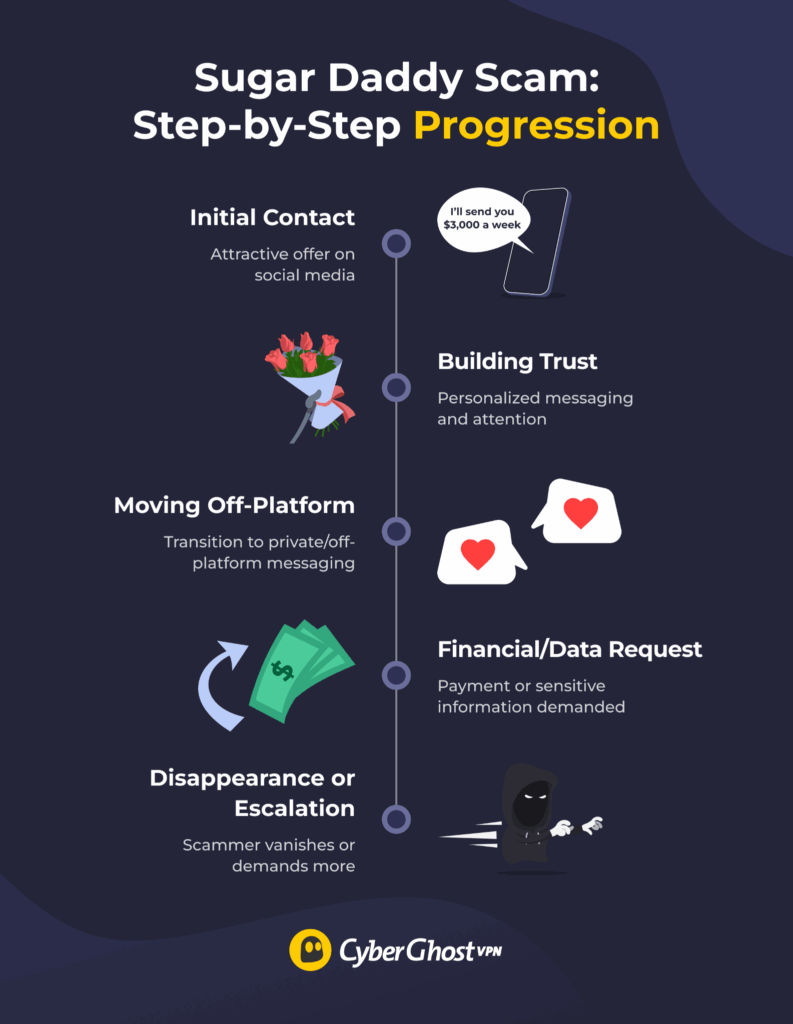
Sugar daddy scams vary, but many follow a similar pattern. Knowing how they can progress makes it easier to spot when a generous offer starts turning into something else.
The Initial Contact
Scammers often first contact you through dating apps, Instagram, TikTok, Snapchat, or other social platforms. Their approach may feel casual. They comment on your post, send a friendly message, or respond to something you’ve shared before introducing the idea of financial support.
The profile itself may look convincing, with photos of expensive cars, luxury vacations, designer clothing, or other signs of wealth. The photos may be stolen from legitimate accounts or AI-generated, and chosen to support the story the scammer is trying to sell. At this stage, they may not ask you for anything at all. The goal is to get the conversation started.
Building Trust and Moving Off-Platform
Initial conversations are usually light. The scammer showers you with attention, asking about your life, goals, or challenges. They may message throughout the day, offer compliments, and show an unusual amount of interest in getting to know you.
Once they’ve established some basic rapport, they push to move communication to WhatsApp, Telegram, Signal, or other messaging apps. The explanation can sound perfectly reasonable: “This app works better,” “The platform deleted my account,” or “I prefer privacy.”
Moving to another app isn’t proof that someone is a scammer, but it can work in their favor. It takes the conversation away from the original platform’s moderation, safety features, and reporting tools. It can also make it easier for the scammer to continue the conversation if a platform removes their dating or social media profile.
The Financial Request Emerges
Now comes the pivot. The scammer introduces a “complication” that prevents them from sending you the promised money. They may blame a delay in processing, say your account needs to be verified, or claim there’s a fee you need to pay before the transfer can go through.
Common variations include:
- A “transaction fee” or “processing fee” to release the funds
- A “verification charge” to confirm your identity
- A “loyalty test” to prove you’re serious about the arrangement
- A fake payment followed by a request to send a part of the money back
- A request for banking details or other information supposedly needed to set up the payment
The amount may seem small compared to what they promised you. If someone is offering you thousands of dollars, paying a relatively small fee first can feel like a reasonable trade-off.
The Disappearance or Escalation
Once you send money or information, one of two things often happens. In the simpler version, the scammer blocks you and vanishes. Your messages go unanswered, and their profile may disappear or show as deactivated.
In the more elaborate version, the scammer introduces new complications. They claim the check they sent bounced. They say they need additional fees to complete the transfer. They request your banking login information to set up direct deposit. Each new request happens to be the final thing standing between you and the money they promised.
The requests can also become more serious. They may ask for your online banking login, verification codes, ID documents, or other sensitive information. If they get enough information to access an account, they may be able to make unauthorized transactions or use your details for other types of fraud.
Common Sugar Daddy Scam Tactics
Scammers use different payment tricks, phishing methods, and requests for personal information to turn the promise of financial support into a way to get something from you.
Fake Payments and Overpayment Scams
The scammer sends you a fake check, wire transfer, or proof of digital payment. In some cases, your bank may make the funds available before it discovers that the check is fraudulent. Money briefly appears in your account, your guard drops, and it looks like the arrangement is working.
The scammer then claims they sent too much by mistake. They ask you to return part of the funds, often through a wire transfer, gift card, or cryptocurrency. Later, they reverse the payment or you discover the original payment is fraudulent, but the money you sent came from your own funds and can’t be recovered.
This works because the fake payment appears legitimate at first. Funds being available doesn’t necessarily mean a check has cleared or that the payment is genuine. Don’t send part of a payment back to someone you’ve only met online. If there’s a problem with a payment you received, contact your bank or payment provider before moving or returning any money.
Advance Fee Requests
This is one of the most direct versions of the scam. The scammer claims they need an upfront fee to release the promised allowance. They might call it a:
- Processing fee
- Clearance fee
- Verification charge
- Security deposit
- Platform activation fee
The fee may seem reasonable relative to the promised payments. The scammer might even provide fake documentation, screenshots, or email confirmations to make the request seem official.
Once you pay, however, the promised money never arrives. The scammer may disappear or come back with another fee you need to pay first. Be especially cautious if they ask for gift cards, cryptocurrency, wire transfers, or other payment methods where recovering money after a scam can be difficult. Verify any supposed payment or account requirement with the bank, platform, or payment service involved.
Gift Card Scams
Gift cards are attractive to scammers because codes can be used without a physical card and recovering the money can be difficult. The scammer may ask you to buy gift cards and send them the codes as a “trust test,” verification step, or requirement before they can send your allowance.
They might ask for Google Play, Apple, Amazon, or other popular gift cards and tell you exactly which cards to buy and how much to load onto them. Once you share the card number or PIN, they may redeem the balance or resell the code before you realize what’s happened.
Remember that a gift card isn’t a legitimate verification method for receiving an allowance or proving that you’re serious about an arrangement.
Phishing and Identity Theft
Some scammers skip the payment request entirely. Instead, they ask for sensitive information under the guise of setting up your allowance, verifying your identity, or arranging the deposit. They may request:
- Online banking login credentials
- Social Security number or other identification details
- Routing and account numbers
- Photos of ID documents
- Verification codes sent to your phone
The request may sound reasonable because it’s tied to the money they promised you. But with enough information, scammers may be able to access your accounts, make unauthorized transactions, impersonate you, or use your details for other types of identity fraud. You may not realize anything is wrong until you notice an unfamiliar login, transaction, or account opened in your name.
Privacy tip: Never share a one-time activation code with someone who asks for it. Scammers may use these codes to bypass two-factor authentication and take over your account.
Phishing Links and Malicious Websites
The scammer may send you a link claiming you need to verify payment, sign a contract, or set up an account before they can send you money. The link might actually direct you to a fake website designed to look like your bank, PayPal, or another legitimate service.
You enter your login credentials thinking you’re accessing your real account. The credentials go to the scammer instead. Some links may also lead to malicious websites or downloads that attempt to steal information, install malware, or compromise your device.
Don’t use a payment or verification link because the person who sent it claims it’s necessary to receive your money. If they claim the link belongs to your bank, payment service, or another account you use, open its official app or website and check there instead.
Red Flags to Watch For
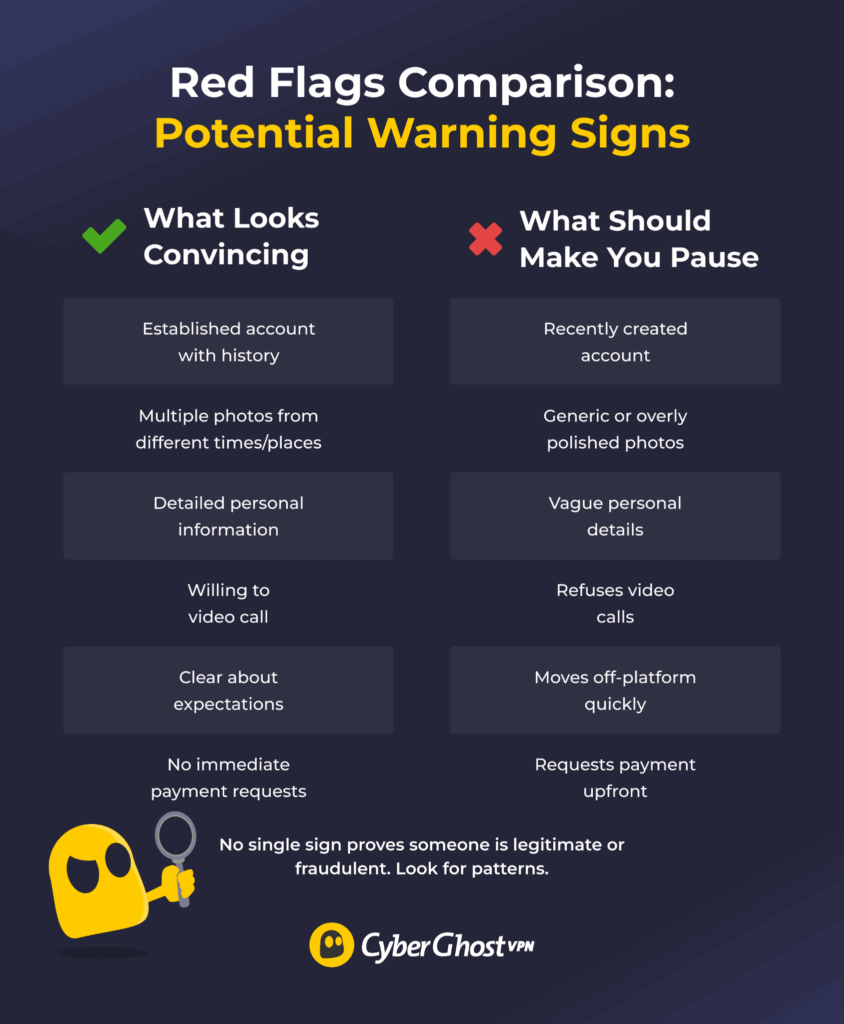
No single warning sign proves that someone is a sugar daddy scammer, but several red flags together should give you reason to be cautious. Pay attention to the person’s profile, how they communicate with you, and what happens when money enters the conversation.
Profile Red Flags
- Recently created account: The profile has little history or activity.
- Suspicious photos: Their photos appear stolen, reused, AI-generated, or inconsistent with their story.
- Very little personal information: Their profile is vague about basic details, or those details change during your conversations.
- Unusual account activity: Their followers, engagement, or other interactions don’t seem consistent with the profile they’re presenting.
Communication Red Flags
- Unsolicited offers of large amounts of money: Someone you don’t know offers an allowance or financial support.
- Pressure to move off-platform: They quickly want to switch from the dating or social platform to another messaging app.
- Inconsistent stories: Details about their job, lifestyle, location, or availability keep changing.
- Scripted conversations: Their messages feel generic, repetitive, or don’t quite respond to what you’ve said.
- Avoiding verification: They make excuses when you suggest a video call or another reasonable way to confirm who they are.
- Intense attention early on (“love bombing”): They shower you with compliments or affection before you’ve had much time to get to know each other.
Financial Red Flags
- Upfront fees: You need to pay a processing, verification, clearance, or other fee before receiving money.
- Gift card or cryptocurrency requests: They tell you to buy gift cards, send cryptocurrency, or use another unusual payment method.
- Pay first to get money: They promise to send you money but say they need something from you before they can do it.
- Overpayment requests: They send a check or payment, claim they sent too much, and ask you to return part of it.
- Requests for sensitive financial information: They ask for banking passwords, verification codes, or other credentials needed to arrange your payment.
- Payment “proof” you can’t verify: They send screenshots, emails, or documents claiming they made a payment instead of letting you confirm it through your own bank or payment account.
Protecting Yourself from Sugar Daddy Scams
You can reduce your risk by verifying who you’re talking to, being cautious with unexpected payment requests, and limiting the personal information you share. None of these checks can guarantee that someone is genuine, so pay attention to the overall pattern rather than relying on a single sign.
Verify Identities Thoroughly
Start by checking whether the person’s profile matches the story they’re telling you. You can perform a reverse image search on their profile photos using Google Images or TinEye. If the same photo appears under different names or on unrelated accounts, it may be stolen or reused.
Look at the rest of the profile too. Recently created accounts, minimal personal history, vague information, or details that change over time can all give you a reason to be cautious. An established online presence with consistent information can provide more context, but it doesn’t prove that someone is genuine.
You can also suggest a video call or another reasonable way to verify who you’re speaking to. Keep in mind that verification isn’t foolproof on its own. A person showing their face or having a convincing social media profile doesn’t make unusual payment requests, upfront fees, or requests for sensitive information automatically safe.
Be Cautious With Payment Requests
Be suspicious if someone promising to give you money suddenly asks you to send money first. Processing fees, deposits, verification charges, and other upfront payments are common ways sugar daddy scammers turn the arrangement around.
Pay particular attention to how they ask you to pay. Requests for gift cards, cryptocurrency, wire transfers, or other difficult-to-recover payment methods are a major red flag, especially when they’re required to release an allowance or payment.
Don’t let screenshots, payment confirmations, or promises of a much larger amount rush you into sending anything. If someone claims a bank, payment app, or other service requires you to pay a fee, check with that service through its official app or website before taking any action.
Keep Personal Information Private
Be careful about how much personal information you share, especially early in an online relationship. Scammers can piece together details from your conversations and social media profiles to make their stories more convincing or target your accounts. Avoid sharing information such as:
- Your home address
- Social Security number or government ID numbers
- Bank account or card details
- Online banking passwords
- Photos or copies of ID documents
- One-time verification or authentication codes
Think about the smaller details you reveal, too. Your workplace, school, birthday, family members, and daily routine may not seem particularly sensitive on their own, but together they can tell someone a lot about you.
Scammers may also ask for intimate images and later threaten to share them unless you pay. If this happens, don’t send more money or images. Save the evidence, stop engaging with the person, and report the threat to the platform and the appropriate authorities.
Don’t Send Money or Sensitive Information
Learn to avoid common red flags for scams in order to help secure your accounts. If someone asks you to do any of these things, stop communicating with them until you can verify their legitimacy:
- Pay a fee to receive money
- Buy gift cards and send the codes
- Deposit a check and return part of it
- Send cryptocurrency to “unlock” a payment
- Share your banking password
- Share a one-time verification code
- Click a payment/verification link
One request may lead to another. A small “verification fee” can turn into another charge, while sharing one piece of account information can lead to requests for passwords or authentication codes. Don’t keep complying because you’ve already invested time or money in the arrangement.
Trust Your Instincts
If something feels off, don’t ignore it. You don’t owe someone your trust because they’ve spent time talking to you, promised you money, or already sent what looks like a payment. It’s okay to slow things down and take a closer look at what they’re asking you to do.
Pay attention when the story stops adding up. Maybe they keep avoiding a video call, their personal details change, or a promised allowance suddenly comes with fees and conditions. One odd detail doesn’t mean you’re dealing with a scammer, but several warning signs are a good reason to stop and verify what’s happening.
You can also talk it through with someone you trust. A friend or family member may notice inconsistencies or unusual requests that are harder to spot when you’ve been speaking to someone for a while.
Use Privacy and Security Tools
Privacy tools can make it harder for scammers to access your accounts or expose information about you online. They won’t tell you whether someone is genuine, but they can add useful layers of protection while you use dating apps, social media, and messaging services.
Enable two-factor authentication (2FA) on your dating apps, social media, and email accounts. This adds another step before they can access the account. Use strong, unique passwords for each platform. A password manager can generate and store them for you, so one compromised password doesn’t put several accounts at risk. Keep your apps and device software updated too, as updates often include fixes for known security vulnerabilities.
If you use dating or messaging apps on public Wi-Fi, CyberGhost VPN encrypts traffic between your device and the VPN server, adding another layer of protection against network-level snooping. A VPN can help protect your connection, but it can’t tell whether someone you’re talking to is a scammer, make a phishing site legitimate, or protect money or information you choose to send them.
What to Do If You’ve Been Scammed
If you realize you’re the target of a sugar daddy scam, immediate action limits damage. What you need to do next depends on whether you sent money, shared personal information, or gave the scammer access to any of your accounts.
- Save the evidence: Take screenshots of their profile, messages, payment requests, transaction details, usernames, and any links or documents they sent you before blocking the scammer. Keep this information somewhere safe in case you need it when reporting the scam.
- Cut contact: Stop communicating with the scammer and block them on the original platform and anywhere else they’ve contacted you. Don’t respond if they come back through another account.
- Contact your bank or payment provider: If you sent money, report the transaction as soon as possible and ask what options are available. If you shared banking credentials or other account information, tell your provider what happened and follow its advice for securing your account.
- Secure your accounts: Change any passwords you shared or think may have been compromised. Change reused passwords on other accounts too, sign out of other sessions where possible, and enable 2FA.
- Protect your identity: If you shared your Social Security number, ID documents, or other sensitive identity information, consider placing a fraud alert or credit freeze and check your credit reports for accounts you don’t recognize.
- Report the scam: Report the account to the dating app or social media platform where you encountered it. You can also report the fraud to the appropriate authorities in your country and to any payment service involved.
- Watch for follow-up scams: Be suspicious of unexpected recovery offers that require upfront payment or more personal information. Someone may contact you claiming they can recover your money, investigate the scam, or get the scammer arrested for a fee.
Why Your Digital Privacy Matters When Dating Online
A sugar daddy scam often starts with someone promising to give you money and ends with them finding a reason to take money or information from you instead. Watch for that shift. Upfront fees, gift card requests, fake overpayments, suspicious verification links, and requests for banking credentials are all signs that the arrangement may not be what it seems.
Protecting your accounts and personal information can also make it harder for scammers to cause further damage. Use strong passwords and 2FA, be careful about what you share with people you meet online, and verify unexpected payment requests yourself. CyberGhost VPN can add another layer of privacy to your connection, particularly on public Wi-Fi, but spotting the scam still comes down to recognizing the person and payment tactics.
FAQ
What is a sugar daddy scam?
A sugar daddy scam is a romance fraud scheme where scammers pose as wealthy individuals to extract money or personal information from victims. Instead of providing promised financial support, they disappear after obtaining payments or sensitive data. Scammers often target people facing financial difficulties or seeking emotional connection.
How do sugar daddy scammers operate?
Scammers build trust through personalized messaging, then introduce a “complication” preventing payment and request money upfront. The process typically involves initial contact on social media, rapid rapport-building, a request to move to unmonitored messaging apps, and finally, a financial request framed as a temporary verification step. Once the victim sends money or shares sensitive information, they either disappear or escalate with new demands.
How can I tell if a sugar daddy offer is a scam?
There are several signs that can serve as evidence of sugar daddy scams. Urgent demands for payment, requests for gift cards, and sending fake checks are all financial red flags. Another warning sign is if the other party requests your credentials while refusing to verify their own identity. If you feel pressured or notice inconsistencies in their stories, trust your instincts.
What should I do if a sugar daddy asks for money or gift cards?
Stop communication immediately and block the account. Requests for gift cards, processing fees, verification charges, or other upfront payments are major scam warning signs. Don’t send money even if the person provides convincing documentation or screenshots. Don’t share banking information or ID photos.
How can I avoid sugar daddy scams?
Verify identities through reverse image searches, avoid unsecured networks for dating conversations, and never send money to people you haven’t met. Use two-factor authentication and keep personal information private. If you use dating apps on public Wi-Fi, encrypt your traffic with a VPN to prevent interception of your conversations and personal data. Protect your accounts with strong passwords stored in a password manager.
What if a sugar daddy sends me a check?
Avoid depositing the check if possible, and don’t send any money back to the sugar daddy. Contact your bank if you’ve already deposited it and alert them to the potential fraud. While your account may initially show that funds are available, this doesn’t mean the check is legitimate.
Can a sugar daddy scam steal my identity?
Yes, a sugar daddy scammer may attempt to access your SSN, ID photos, or other credentials in order to take over your accounts. If you suspect you are a victim of identity fraud, immediately secure any compromised accounts. Contact any relevant financial institutions and consider a credit freeze if necessary.

Leave a comment